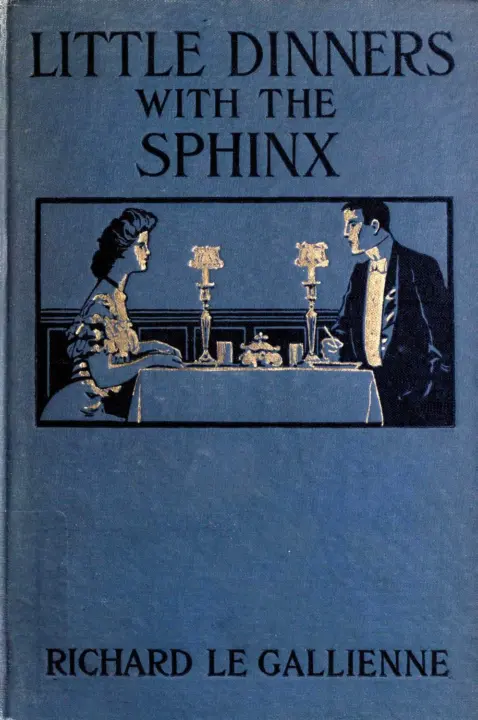
Little Dinners With the Sphinx, and Other Prose Fancies
Richard Le Gallienne
THE CLASSIC COLLECTION · 1898
"Young Lives" by Richard Le Gallienne is a novel written during the late 19th century. The book delves into the lives and struggles of the Mesurier family, particularly focusing on the tensions between generations and the yearning for individuality among the children, especially Henry and Esther, as they seek to assert their identities and break free from their father's strict and traditional expectations. The opening of the novel sets the scene in a modest middle-class home, where a family conflict is brewing. On a significant evening, the eldest son Henry and his sister Esther boldly confront their parents about their dissatisfaction with home life and their yearning for freedom. With their father, James Mesurier, embodying a rigid and puritanical worldview, the children feel stifled in their pursuits, leading to a dramatic clash of wills within the front parlour. As family dynamics unfold, themes of rebellion, familial love, and the quest for artistic expression become apparent, laying the groundwork for the emotional and societal explorations that follow in their lives.
Introduction adapted from the source catalogue; source summaries may be automatically generated.
Free to read · English · 71,249 words · No account needed
MAKE TIME FOR A GOOD BOOK
On by default. Untick to stop anonymous reading totals. Each page counts after 10 seconds in view. How this works.
Anonymous counting is on unless you have switched it off.
After the long happy silence which followed Henry's recitation of his verses, Angel at length spoke,--
"Shall I tell you something now?" she said. "I'm almost ashamed to, for I know you'll laugh at me, and call me superstitious."
"Go on, little child," said Henry.
"You remember the day," said Angel, in a hushed little impressive voice, "I first saw you in father's office?"
Henry was able to remember it.
"Well, that was not the first time I had seen you."
"Really, Angel! Why didn't you tell me before? Where was it, then? In
the street, or where?"
"No, it was much stranger than that," said Angel. "Do you believe the future can be foretold to us?"
"Oh, it was in a dream, you funny Angel; was that it?" said Henry,
whose rationalism at this period was the chief danger to his
imagination.
"No, not a dream. Something stranger than that."
"Oh, well, I give it up."
"It was like this," Angel continued; "there's a strange old gipsy woman
who lives near us--"
"Oh, I see, your hand--palmistry," said Henry, with a touch of gentle
impatience.
"Henry, dear, I said you would laugh at me. I won't tell you now, if you're going to take it in that spirit."
Henry promptly locked up his reason for the moment, with apologies, and professed himself open to conviction.
"Well, mother sometimes helps this poor old woman, and, one day, when she happened to call, Alice and Edith and I were in the kitchen helping mother. 'God bless you, lady,' she said,--you know how they talk,--'you've got a kind heart; and how are all the young ladies? It's time, I'm thinking, they had their fortunes told.' 'Oh, yes,' we all said, 'tell us our fortunes, mother,'--we always called her mother. 'I'll tell you yours, my dear,' she said, taking hold of my hand. 'Your fortunes are too young yet, ladies,' she said to Alice and Edith; 'come to me in a year's time and, maybe, I'll tell you all about him.'"
"You dear!" said Henry, by way of interruption.
"Then," continued Angel, "she took me aside, and looked at my hand; and she told me first what had happened to me, and then what was to come. What she told me of the past"--as if dear Angel, whose life was as yet all future, could as yet have had any past to speak of!--"was so true, that I couldn't help half believing in what she said of the future. Now you're laughing again!"
"No, indeed, I'm not," said Henry, perfectly solemn.
Your reading position is saved on this browser. Take it to another device with a library code. Reading pages adapt to text, rather than matching a printed edition.
Richard Le Gallienne
Richard Le Gallienne
Richard Le Gallienne
Richard Le Gallienne
BEHIND THE BOOK
This eBook is for the use of anyone anywhere in the United States and most other parts of the world at no cost and with almost no restrictions whatsoever. You may copy it, give it away or re-use it under the terms of the Project Gutenberg License included with this eBook or online at www.gutenberg.org. If you are not located in the United States, you will have to check the laws of the country where you are located before using this eBook. Read the source licence.
The original source file, including credits and licence, is retained by this library. Request an original-format copy at no charge. Please include the book title and Project Gutenberg identifier #10922.
KEEP YOUR CURIOSITY GOING
Coulson Kernahan

Maurice Baring
Frances Wright
Cécile Tormay

Frederic Jesup Stimson

W. H. P. (William Henry Pope) Jarvis