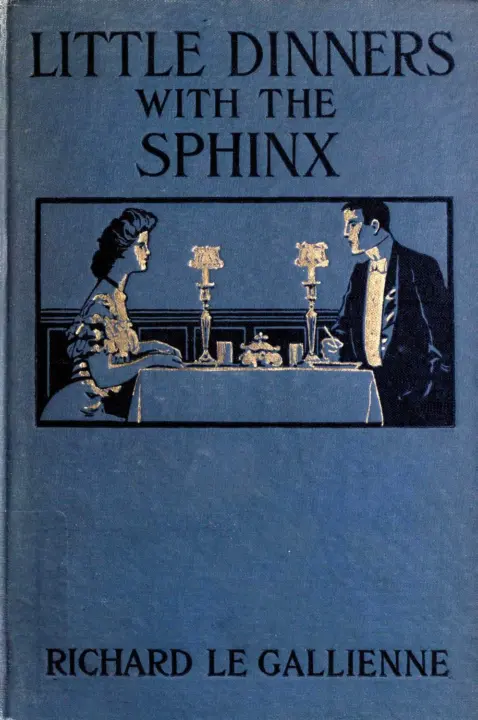
Little Dinners With the Sphinx, and Other Prose Fancies
Richard Le Gallienne
THE CLASSIC COLLECTION · 1898
"Young Lives" by Richard Le Gallienne is a novel written during the late 19th century. The book delves into the lives and struggles of the Mesurier family, particularly focusing on the tensions between generations and the yearning for individuality among the children, especially Henry and Esther, as they seek to assert their identities and break free from their father's strict and traditional expectations. The opening of the novel sets the scene in a modest middle-class home, where a family conflict is brewing. On a significant evening, the eldest son Henry and his sister Esther boldly confront their parents about their dissatisfaction with home life and their yearning for freedom. With their father, James Mesurier, embodying a rigid and puritanical worldview, the children feel stifled in their pursuits, leading to a dramatic clash of wills within the front parlour. As family dynamics unfold, themes of rebellion, familial love, and the quest for artistic expression become apparent, laying the groundwork for the emotional and societal explorations that follow in their lives.
Introduction adapted from the source catalogue; source summaries may be automatically generated.
Free to read · English · 71,249 words · No account needed
MAKE TIME FOR A GOOD BOOK
On by default. Untick to stop anonymous reading totals. Each page counts after 10 seconds in view. How this works.
Anonymous counting is on unless you have switched it off.
One afternoon the step coming along the corridor was almost light enough to be Angel's, though a lover's ear told him that hers it was not. Once more that feminine rustle, the very whisper of romantic mystery; again the little feminine knock.
Daintiness and Myrtilla!
"Well, this is lovely of you, Myrtilla! But what courage! How did you ever dare venture into this wild and savage spot,--this mountain-fastness of Bohemia?"
"Yes, it was brave of me, wasn't it?" said Myrtilla, with a little laugh, for which the stairs had hardly left her breath. "But what a climb! It is like having your rooms on the Matterhorn. I think I must write a magazine article: 'How I climbed the fifty-thousand stairs,' with illustrations,--and we could have some quite pretty ones," she said, looking round the room.
"That big skylight is splendid! As close, dear lad, to the stars as you can get it? Are you as devoted to them as ever?"
"Aren't you, Myrtilla?"
"Oh, yes; but they don't get any nearer, you know."
"It's awfully good to see you again, Myrtilla," said Henry, going over to her and taking both her hands. "It's quite a long time, you know, since we had a talk. It was a sweet thought of you to come. You'll have some tea, won't you?"
"Yes, I should love to see you make tea. Bachelors always make such good tea. What pretty cups! My word, we are dainty! I suppose it was Esther bought them for you?"
Henry detected the little trap and smiled. No, it hadn't been Esther.
"No? Someone else then? eh! I think I can guess her name. It was mean of you not to tell me about her, Henry. I hear she's called Angel, and that she looks like one. I wish I could have seen her before I went away."
"Going away, Myrtilla? why, where? I've heard nothing of it. Tell me
about it."
The atmosphere perceptibly darkened with the thought of Williamson.
"Well!" she said, in the little airy melodious way she had when she was telling something particularly unhappy about herself--a sort of harpsichord bravado--"Well, you know, he's taken to fancying himself seriously ill lately, and the doctors have aided and abetted him; and so we're going to Davos Platz, or some such health-wilderness--and well, that's all!"
"And you I suppose are to nurse the--to nurse him?" said Henry,
savagely.
"Hush, lad! It's no use, not a bit! You won't help me that way," she said, laying her hand kindly on his, and her eyes growing bright with suppressed tears.
"It's a shame, nevertheless, Myrtilla, a cruel shame!"
Your reading position is saved on this browser. Take it to another device with a library code. Reading pages adapt to text, rather than matching a printed edition.
Richard Le Gallienne
Richard Le Gallienne
Richard Le Gallienne
Richard Le Gallienne
BEHIND THE BOOK
This eBook is for the use of anyone anywhere in the United States and most other parts of the world at no cost and with almost no restrictions whatsoever. You may copy it, give it away or re-use it under the terms of the Project Gutenberg License included with this eBook or online at www.gutenberg.org. If you are not located in the United States, you will have to check the laws of the country where you are located before using this eBook. Read the source licence.
The original source file, including credits and licence, is retained by this library. Request an original-format copy at no charge. Please include the book title and Project Gutenberg identifier #10922.
KEEP YOUR CURIOSITY GOING
Coulson Kernahan

Maurice Baring
Frances Wright
Cécile Tormay

Frederic Jesup Stimson

W. H. P. (William Henry Pope) Jarvis