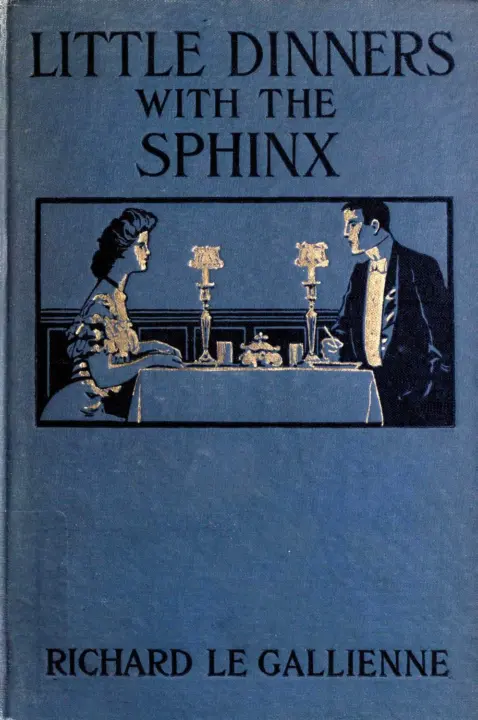
Little Dinners With the Sphinx, and Other Prose Fancies
Richard Le Gallienne
THE CLASSIC COLLECTION · 1898
"Young Lives" by Richard Le Gallienne is a novel written during the late 19th century. The book delves into the lives and struggles of the Mesurier family, particularly focusing on the tensions between generations and the yearning for individuality among the children, especially Henry and Esther, as they seek to assert their identities and break free from their father's strict and traditional expectations. The opening of the novel sets the scene in a modest middle-class home, where a family conflict is brewing. On a significant evening, the eldest son Henry and his sister Esther boldly confront their parents about their dissatisfaction with home life and their yearning for freedom. With their father, James Mesurier, embodying a rigid and puritanical worldview, the children feel stifled in their pursuits, leading to a dramatic clash of wills within the front parlour. As family dynamics unfold, themes of rebellion, familial love, and the quest for artistic expression become apparent, laying the groundwork for the emotional and societal explorations that follow in their lives.
Introduction adapted from the source catalogue; source summaries may be automatically generated.
Free to read · English · 71,249 words · No account needed
MAKE TIME FOR A GOOD BOOK
On by default. Untick to stop anonymous reading totals. Each page counts after 10 seconds in view. How this works.
Anonymous counting is on unless you have switched it off.
"But never mind about the moon. Tell us how you got on with The
Sothern."
The Sothern was an amateur dramatic club in Tyre which took itself very seriously, and to which Mike was seeking admission, as a first step towards London management. He had that day passed an examination before three of the official members, solemn and important as though they had been the Honourable Directors of Drury Lane, and had been admitted to membership in the club, with the promise of a small part in their forthcoming performance.
"Oh, that's good!" said Esther. "What were they like?"
"Oh, they were all right,--rather humorous. They gave me 'Eugene Aram' to read--Me reading 'Eugene Aram'!--and a scene out of 'London Assurance,' which was, of course, better. Naturally, not one of the men was the remotest bit like himself. One was a queer kind of Irving, another a sad sort of Arthur Roberts, and the other was--shall we say, a Tyrian Wyndham."
Actors, like poets, have provincial parodists of their styles in even greater numbers, so adoringly imitative is humanity. Some day, Mike would have his imitators,--boys who pulled faces like his, and prided themselves on having the Laflin wrinkles; just as it was once the fashion for girls to look like Burne-Jones pictures, or young poets to imitate Mr. Swinburne.
"Yes, I've got my first part. I've got it in my pocket," said Mike.
"Oh, really! That's splendid!" exclaimed Esther, with delight.
"Wait till you see it," said Mike, bringing out a French's acting edition of some forgotten comedy. "Yes; guess how many words I've got to say! Just exactly eleven. And such words!"
"Well, never mind, dear. It's a beginning."
"Certainly, it's a beginning,--the very beginning of a beginning."
"Come, let me see it, Mike. What are you supposed to be?"
At last Mike was persuaded to confess the humble little rôle for which the eminent actors who had consented to be his colleagues had cast him. He was to be the comic boy of a pastry-cook's man, and his distinguished part in the action of the piece was to come in at a certain moment with the pie that had been ordered, and, as he delivered it, he was to remark, "That's a pie as is a pie, is that there pie!"
"Oh, Mike, what a shame!" exclaimed Esther. "How absurd! Why, you're a better actor with your little finger than any one of them with their whole body."
"Ah, but they don't know that yet, you see."
"Any one could see it if they looked at your face half-a-minute."
Your reading position is saved on this browser. Take it to another device with a library code. Reading pages adapt to text, rather than matching a printed edition.
Richard Le Gallienne
Richard Le Gallienne
Richard Le Gallienne
Richard Le Gallienne
BEHIND THE BOOK
This eBook is for the use of anyone anywhere in the United States and most other parts of the world at no cost and with almost no restrictions whatsoever. You may copy it, give it away or re-use it under the terms of the Project Gutenberg License included with this eBook or online at www.gutenberg.org. If you are not located in the United States, you will have to check the laws of the country where you are located before using this eBook. Read the source licence.
The original source file, including credits and licence, is retained by this library. Request an original-format copy at no charge. Please include the book title and Project Gutenberg identifier #10922.
KEEP YOUR CURIOSITY GOING
Coulson Kernahan

Maurice Baring
Frances Wright
Cécile Tormay

Frederic Jesup Stimson

W. H. P. (William Henry Pope) Jarvis