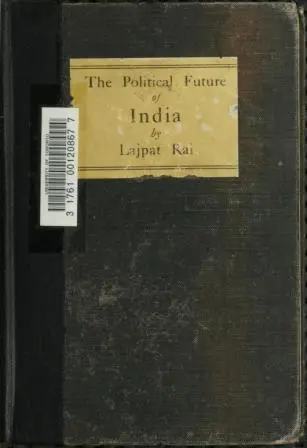
The Political Future of India
Lala Lajpat Rai
THE CLASSIC COLLECTION · 1916
"Young India" by Lala Lajpat Rai is a historical account written in the early 20th century. The book offers an interpretation and a detailed analysis of the nationalist movement in India during a time of significant political unrest under British rule. It aims to present the perspectives and aspirations of the Indian people in their pursuit of self-governance and freedom from colonial oppression. At the start of the book, the author provides a foreword that establishes his credentials as a prominent leader and advocate for Indian nationalism. Lajpat Rai expresses the deep-seated grievances of the Indian populace against British rule, highlighting the aspirations for self-government and the challenges faced by nationalist leaders. He emphasizes the necessity of understanding the Indian perspective, particularly in light of the misinformation propagated by foreign writers and the government. The foundation is set for a comprehensive exploration of the Indian Nationalist Movement, detailing the ongoing struggle for freedom, the political landscape, and the determination of the Indian people to achieve autonomy within the British Empire.
Introduction adapted from the source catalogue; source summaries may be automatically generated.
Free to read · English · 74,949 words · No account needed
MAKE TIME FOR A GOOD BOOK
On by default. Untick to stop anonymous reading totals. Each page counts after 10 seconds in view. How this works.
Anonymous counting is on unless you have switched it off.
I do not propose to burden this preface with other complaints which the Indian politicians make against the British Government, but I can not refrain from giving one more quotation from my own pamphlet on the question of Education:
“Let us look at education in India. India has been under British rule now for a century and a half in some parts, for over a century in others, and for at least 65 years in the Punjab. Yet the percentage of illiteracy is well nigh 95 per cent., taking the whole of India. Greatest ignorance prevails among the peasantry and the military classes, the two great bulwarks of British rule in India. What has the Government done to educate these classes? Nothing. Some maintain that they have been deliberately kept out of education because, once educated, they may no longer be such willing tools as they are now.
“Agriculture in India, as elsewhere, is the least paying of industries, and it is not at all strange that large numbers of sturdy Punjabees prefer to labour in other countries rather than rot on their farms in the Punjab. In the early years of British rule the educated and the trading classes flourished and became prosperous, but now they are thoroughly discontented. The native traders are no longer happy under British rule, (1) because the railways and foreign import and export offices dealing directly with the producer and the consumer have ruined their business, (2) because the facilities available to them in the early days of British rule have disappeared, (3) because the bureaucracy is always inciting the agricultural and military classes against them and heaping insults on their devoted heads both by word and deed. In almost every province, special legislation has been enacted professedly in the interests of the agricultural classes but really directed against the Indian trader or money lender. On the other hand, what has the Government done to open non-agricultural pursuits to them? Nothing. In the whole length and breadth of the country there is not a single technological institute. The private or aided technological institutes are called by that name only by courtesy. In these days of international trade there is no provision in any of the Indian universities for the teaching of modern languages. While Germans, Austrians, Italians, Americans and Japanese can learn Hindustanee and English in their own countries in order to further their trade with India, the Government of India has never given a thought to the necessity of making a provision for the teaching of German, French, Japanese, &c., to the Indians and of encouraging Indians to learn these languages. The best part of a boy’s student life is compulsorily spent in acquiring excellence in the use of the English language. Indians are not supposed to know other languages or to trade with other countries, because the English do it for them. It is not the concern of the British to encourage the native to have direct commercial transactions with foreign countries. There is not a single place in India where an Indian student can do research work in chemistry or other sciences. While the country is full of mines, there is no place to learn mining. Hundreds of steamers come and go from Indian ports, but there is no place in India where an Indian youth can qualify himself even for the merchant marine, not to speak of the navy. In the whole of India with its splendid resources, there is not a single place where ships can be built. The Indian Government has never given a thought to these questions because they do not concern them, because they are not interested in the development of the indigenous industries and in raising the status of the people. They have done a lot to encourage the produce of raw materials necessary for their industries or for their food (cotton, wheat, oil, seeds, etc.), but almost nothing to encourage manufacturing industries. Originally they wanted to preserve the Indian markets for themselves only, but their policy of free trade stood in the way, and latterly the Germans and now the Japanese are sharing that market with them. But to teach the Indian to manufacture for his own consumption has never entered the thought of those responsible for the administration of India. Perhaps it is not right to say that it never entered their thought. They are too intelligent and shrewd not to know that they had not done their duty to India in these matters, but the interest of their own people was paramount and that they could not set aside.
Your reading position is saved on this browser. Take it to another device with a library code. Reading pages adapt to text, rather than matching a printed edition.
BEHIND THE BOOK
This eBook is for the use of anyone anywhere in the United States and most other parts of the world at no cost and with almost no restrictions whatsoever. You may copy it, give it away or re-use it under the terms of the Project Gutenberg License included with this eBook or online at www.gutenberg.org. If you are not located in the United States, you will have to check the laws of the country where you are located before using this eBook. Read the source licence.
The original source file, including credits and licence, is retained by this library. Request an original-format copy at no charge. Please include the book title and Project Gutenberg identifier #49329.
KEEP YOUR CURIOSITY GOING
Cécile Tormay

Moritz Busch
John L. Ransom
Frances Wright
Cécile Tormay

Mabel Potter Daggett