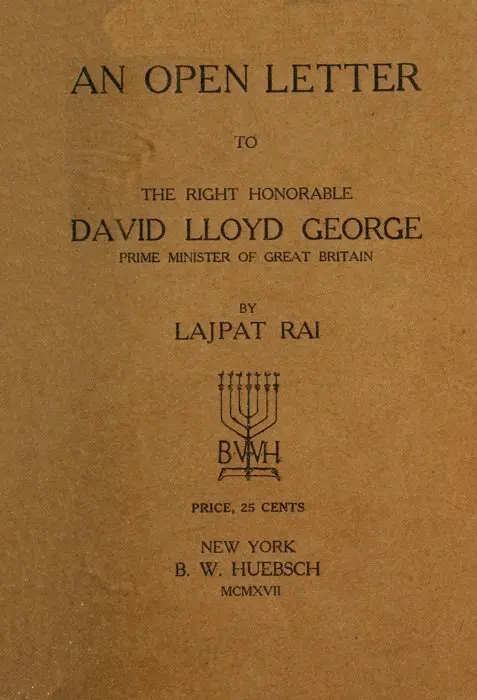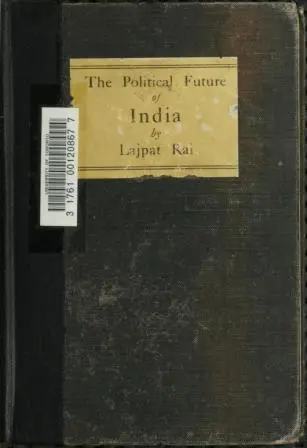
The Political Future of India
Lala Lajpat Rai
THE CLASSIC COLLECTION · 1916
"Young India" by Lala Lajpat Rai is a historical account written in the early 20th century. The book offers an interpretation and a detailed analysis of the nationalist movement in India during a time of significant political unrest under British rule. It aims to present the perspectives and aspirations of the Indian people in their pursuit of self-governance and freedom from colonial oppression. At the start of the book, the author provides a foreword that establishes his credentials as a prominent leader and advocate for Indian nationalism. Lajpat Rai expresses the deep-seated grievances of the Indian populace against British rule, highlighting the aspirations for self-government and the challenges faced by nationalist leaders. He emphasizes the necessity of understanding the Indian perspective, particularly in light of the misinformation propagated by foreign writers and the government. The foundation is set for a comprehensive exploration of the Indian Nationalist Movement, detailing the ongoing struggle for freedom, the political landscape, and the determination of the Indian people to achieve autonomy within the British Empire.
Introduction adapted from the source catalogue; source summaries may be automatically generated.
Free to read · English · 74,949 words · No account needed
MAKE TIME FOR A GOOD BOOK
On by default. Untick to stop anonymous reading totals. Each page counts after 10 seconds in view. How this works.
Anonymous counting is on unless you have switched it off.
“The British Government in India can not go in for universal elementary education, as there is danger of even greater disaffection resulting therefrom; they can not give technical education of a high order, as that might interfere with British industries; they can not protect Indian industries for the same reason; they can not provide for real high class commercial education with a teaching of foreign languages and a knowledge of seafaring and navigation, as they do not want the Indians to directly engage in oversea trade and contract relations with other nations. They can not protect and subsidise Indian industries, as that is opposed to free trade and detrimental to British industries. Yet they want the Indians to believe that the British Government in India is primarily conducted in the interests of India.
“The people of India must remain ignorant, illiterate and industrially and commercially dependent because that benefits England and is for the advantage of her people.
“But that is not all. The Government of India can not even provide for high class education in sciences, in engineering, and in medicine, for the simple reason that the higher positions in these professions they want to reserve for their own people. Of late the number of Indians, educated and trained in these departments of knowledge in British and other foreign universities, has so increased as to become rather embarrassing to the Government of India. They can not utilise them without reducing the number of Britishers in these services. This they do not desire. The result is that there are numbers of trained Indians in India with high class British and European qualifications who have to be contented with subordinate positions under Britishers of lesser qualifications, and perhaps, at times, of no qualifications. The competitive examinations for higher services are held in England, which in itself is a great injustice; but this year on account of the war, there being fewer qualified Britishers to compete for these services, the Government has resolved to discontinue[20] some of the examinations, for fear lest a larger number of Indians than is desirable might get into them. Can they still say that the Government of India is as good as or perhaps better than a national government? The truth is that they do not want a larger number of Indians in the higher services because they can not trust them. For the same reason they distrust private educational institutions and insist upon the employment of Britishers as inspectors of schools and as professors in the educational service. They will allow a certain number of Indians in the higher offices but that number must not be so large as to make it even remotely possible for them to create trouble for the Government. The same fear underlies the administration of local bodies and the constitution and powers of the Councils. It is simply begging the question to argue that Indians are not yet ready or fit for representative institutions. The real question is the dread of power passing from the Britishers into Indian hands.[21] It is this dread that is the dominating influence in the policy of the British Government in India. India is a possession and a dependency and must be administered in the best interests of the master. Many credulous Indians talk of the liberty-loving traditions of the British democracy, but they forget that the application of these traditions to India would make such big holes in their safes, purses, and incomes, that they as men swayed by self-interest and love of power and glory, can never think of enforcing these principles in India. The British are good people. In all personal dealings they are honest, frank, and reliable. But when national interests are at stake and when the interests of the nation dictate a different line of policy, they can not help following the latter, however much injustice and hardship they may inflict upon others in doing so. The English political moralist and thinker believes and preaches that the state exists for the people, that state and people are really interchangeable words, and that the teachings of Treitschke, that the state is greater than the people and that the latter exists for the former, is immoral and vicious. In Great Britain and the Colonies the British act as they believe, but in India they follow the doctrines of the German professor. The state in India is an authority imposed from without and is therefore distinct from and independent of the people.[22] The state in India is the British people, and therefore the interests of the latter must override those of the Indian people. Everything in India is judged by that standard. The English may be good, benevolent, just, kind, and fair-minded, but all these virtues are dominated by the supreme test mentioned above. All the real troubles of India arise from this circumstance. Everything connected with India is looked at from this angle. Unless this angle changes there is no possibility of any such changes taking place in the system and the policy of the Government of India as are likely to satisfy the self-respect of the Indian or to remove the disadvantages from which the country suffers.”
Your reading position is saved on this browser. Take it to another device with a library code. Reading pages adapt to text, rather than matching a printed edition.
BEHIND THE BOOK
This eBook is for the use of anyone anywhere in the United States and most other parts of the world at no cost and with almost no restrictions whatsoever. You may copy it, give it away or re-use it under the terms of the Project Gutenberg License included with this eBook or online at www.gutenberg.org. If you are not located in the United States, you will have to check the laws of the country where you are located before using this eBook. Read the source licence.
The original source file, including credits and licence, is retained by this library. Request an original-format copy at no charge. Please include the book title and Project Gutenberg identifier #49329.
KEEP YOUR CURIOSITY GOING
Cécile Tormay

Moritz Busch
John L. Ransom
Frances Wright
Cécile Tormay

Mabel Potter Daggett