
Moving the Mountain
Charlotte Perkins Gilman

THE CLASSIC COLLECTION · 1898
"Women and Economics" by Charlotte Perkins Gilman is a book published in 1898. Gilman argues that women's economic dependence on men has stunted their development and harmed society. She challenges traditional notions of marriage, motherhood, and domestic life, proposing radical reforms like professionalizing housework and creating cooperative kitchens. Her central claim: women must achieve economic independence to transform themselves and improve civilization. The book became wildly popular, establishing Gilman as a leading voice in the women's movement virtually overnight.
Introduction adapted from the source catalogue; source summaries may be automatically generated.
Free to read · English · 78,963 words · No account needed
MAKE TIME FOR A GOOD BOOK
On by default. Untick to stop anonymous reading totals. Each page counts after 10 seconds in view. How this works.
Anonymous counting is on unless you have switched it off.
Centre of moral influence, woman a self-conscious, 336.
Change of the sexuo-economic relation, 122.
—— of basis in the family relation, 271.
—— in condition means one in conduct, 320.
Changes, family ties strengthened by economic, 302.
Changing scale of virtues, 322.
Chastity demanded by society, 95.
—— the importance of, 318.
Chattel slavery, Christ blind to, 78.
—— a social institution, 78.
—— results of, 82.
—— opponents of, 137.
Check to race-development, reduced environment a, 65.
—— to excessive sex-development, death a ready, 72.
—— to social progress, home duties a, 156.
Child, old and new needs of the, 271.
—— wrong relation between parent and, 272.
—— effect of servant-motherhood on, 280.
—— fuller companionship for, 287.
—— a broader relationship for, 291.
—— necessities of, 301.
“Childe Harold,” quotation from, 24.
Child-bearing, women economically profited by, 169.
Child-education, development of, 283.
Child-feeding, instinct in, 196.
Children, precocity of sex-development in, 54–56.
—— economic burden of, 169.
—— brought up at home, 282.
—— how to know one’s, 301.
—— value to marriage of care of, 301.
—— trained to sex, 309.
China, family worship in, 223.
Chinaman, sex-prejudice of the, 69.
Choice of a young man, the wide, 71.
—— of a young woman, the single, 71.
—— of a father, 202.
—— of professions, woman’s limited, 246.
Christ blind to chattel slavery, 78.
Christianity, injustice of, to the Jew, 78.
Church, the convent and the, 165.
Cities, the larger social interests of, 267.
City, the young man in the, 311.
Civilization, effect of the growth of, 63.
—— a perfect, 73.
—— our race-distinction, 74.
—— a decadent, 158.
Classification, power of, 81.
Cleaners, advantage of professional, 255.
Club movement, woman’s, 164–166.
Collectivity vs. marriage, 115.
Comfort in the home, treason to society the price of, 278.
—— for women, peace and, 300.
Command to woman, Paul’s, 68.
Commander, the Greek, and his Persian captives, 72.
Common table, a common tie, 252.
Community of interest vs. sex-relation, 114.
Companionship of love, 219.
—— fuller, for the child, 287.
Competition, early individual, 100.
Complex society, life of a, 102.
Condition, change in, means a change in conduct, 320.
—— of woman, the doorway of evil, 329.
Conduct, instinct not always a true guide to, 209.
—— change in condition means change in, 320.
—— and ethics, 320.
Consumers, women non-productive, 118.
Contribution to moral progress, woman’s one-sided, 335.
Convent, the church and the, 165.
Cookery, evils of fancy, 232.
Cooking, woman’s practice of, 229.
—— art and science of, 230.
—— as a profession, 239.
—— of servants, 239.
—— a social function, 240.
—— professional service in, 241.
—— retarded as a race-function, 241.
—— advantages of home, 249.
—— science and emotion of, 251.
—— results of the future development of, 254.
Co-operation, failure of family, 240.
Corset, first effect of, 77.
Corsicans, vendetta of, 275.
Cost of pleasing women, 312.
Crises, birth of historic, 146.
Cross-bred product of our human marriage, 332.
Custom, liking and, in food, 250.
Dane, 147.
Daniel, proclamation of, 71.
Darkest Africa, 180.
Dead-line of religious development, 68.
Death, gates of, in child-birth, 181.
Decadence of sex, 158.
Decadent civilization, 158.
Decline of the family, 215.
—— of home life, causes of, 266.
Decoration, household, an expression of woman’s economic dependence,
257.
Defence and feeding of woman, 61.
Deficiencies of human motherhood, 172.
Definition of human progress, 208.
Delicacy, feminine, an expression of sexuality, 46.
Demand, increasing, for a true marriage, 218.
Your reading position is saved on this browser. Take it to another device with a library code. Reading pages adapt to text, rather than matching a printed edition.
Charlotte Perkins Gilman

Charlotte Perkins Gilman

Charlotte Perkins Gilman
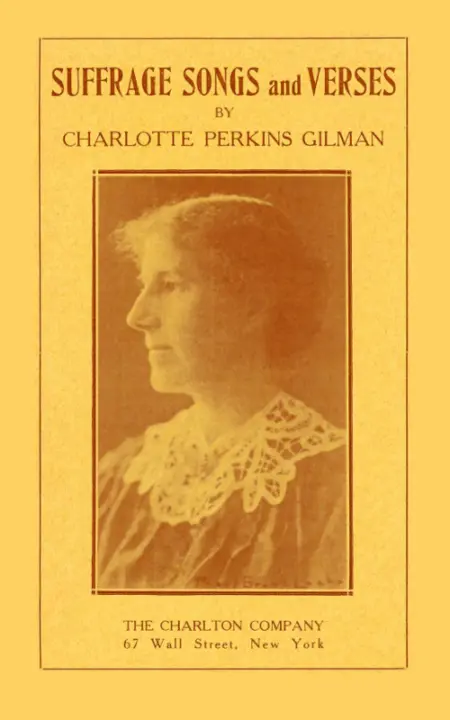
Charlotte Perkins Gilman
BEHIND THE BOOK
This eBook is for the use of anyone anywhere in the United States and most other parts of the world at no cost and with almost no restrictions whatsoever. You may copy it, give it away or re-use it under the terms of the Project Gutenberg License included with this eBook or online at www.gutenberg.org. If you are not located in the United States, you will have to check the laws of the country where you are located before using this eBook. Read the source licence.
The original source file, including credits and licence, is retained by this library. Request an original-format copy at no charge. Please include the book title and Project Gutenberg identifier #57913.
KEEP YOUR CURIOSITY GOING

Charles G. (Charles Griffith) Ross
Hannah Webster Foster

Emily Lawless
Edwin Hamlin Carr

Charles De Lano Hine
Andrew Ure