Moving the Mountain
Charlotte Perkins Gilman
THE CLASSIC COLLECTION · 1898
"Women and Economics" by Charlotte Perkins Gilman is a book published in 1898. Gilman argues that women's economic dependence on men has stunted their development and harmed society. She challenges traditional notions of marriage, motherhood, and domestic life, proposing radical reforms like professionalizing housework and creating cooperative kitchens. Her central claim: women must achieve economic independence to transform themselves and improve civilization. The book became wildly popular, establishing Gilman as a leading voice in the women's movement virtually overnight.
Introduction adapted from the source catalogue; source summaries may be automatically generated.
Free to read · English · 78,963 words · No account needed
MAKE TIME FOR A GOOD BOOK
On by default. Untick to stop anonymous reading totals. Each page counts after 10 seconds in view. How this works.
Anonymous counting is on unless you have switched it off.
—— for a freer social intercourse between the sexes, 296.
Democracy, the Federal, 148.
Dependence, economic, of rich women, 170.
—— household decoration an expression of women’s, 257.
Desdemona, 66.
Desire for work, woman’s, 157.
Development, dead-line of religious, 68.
—— of the martyr, 80.
—— of humanity, 134.
—— of woman, 168.
—— of marriage retarded by the family, 218.
—— outside the home, the highest, 222.
—— of cooking, results of the future, 254.
—— home ties detrimental to personal, 259.
—— of the home of the individual, 264.
—— of child-education, 283.
—— of education, 284.
—— of the kindergarten, result of, 286.
—— of true social intercourse, how to assist, 302.
—— moral, of humanity, 326.
—— arrested, result of, in woman, 330.
—— of submission in woman, 333.
“Devil,” our evil impulses called the, 328.
—— the world, the flesh, and the, 328.
Devotion, a sex-distinction, 48.
—— the height of filial, 176.
—— dining-room, 232–234.
—— the vendetta an over-development of family, 275.
Disadvantage of maternity, 71.
Discord of will and action in servitude, 333.
Disease a life horror, 25.
Distinction, human, in virtue, 322.
—— altruism the main, in human virtue, 323.
Divinity, parental, 175.
Division of labor in housekeeping, 245.
Dog, the economically changed, 323.
Doorway of evil, condition of woman the, 329.
Domination of sex, 53.
“Don’t” (advice of Punch), 28.
Dual nature, man’s, 332.
Duchess of Towers, 148.
Duty of the mother, 187.
—— progress the, of human life, 207.
—— a social sense, 276.
—— restricted sense of, in the mother, 277.
Duties, home, as feminine functions, 225.
—— womanliness of, 225.
Eating, bad effects of social, 254.
Economic ability of woman, lack of development of, 9.
Economic basis, the present, of family life, 303.
Economic changes, family ties strengthened by, 302.
Economic conditions, effect of upon the human creature, 3.
—— results of special, 5.
Economic dependence, change in, in the human species, 6.
—— of female, changes made by, 37.
—— of woman, increase of, 93.
—— of woman, ending, 138.
—— of rich women, 170.
—— household decoration an expression of woman’s, 257.
Economic functions become sex-functions, 110.
Economic entity, home no longer an, 303.
Economic foods, consumption of, 11.
Economic independence, a relative condition, 10.
—— meaning of, 11.
—— of woman, result of, 304, 331.
—— women attaining, 316.
Economic paralysis, 8.
Economic production, maternity and, 17.
—— natural expression of human energy, 116.
Economic profit of woman through sex-attraction, 63.
Economic progress of the race, 8.
Economic relation, a sex-relation, 5.
—— a factor in the evolution of species, 23.
—— a field of human difficulty, 25.
—— good results of sex-equality in, 340.
Economic separation of married lovers, 219.
Economic status, of man, 7.
—— of a race, 8.
—— governed by male, 9.
—— general, of woman, 10.
—— not related to domestic labor, in women, 15.
Economic value of household labor, 13.
Economics, present problem in, 99.
Education, the process of reproduction and, 179.
—— a human function, 180.
—— motherhood in, 185.
—— of the young, 188.
—— a social function, 283.
—— development of, 284.
—— growth of systematic, 285.
—— motherhood supplemented by, 287.
Educative motherhood, 183.
—— maternity a social function, 293.
Effect of a constant impression on a nerve, 77.
—— first, of corset, 77.
—— of standard of good food, 250.
—— bad, of social eating, 254.
—— of servant-motherhood on the child, 280.
—— of changed relations of the sexes, 317.
Egotism, isolated individual profited by, 325.
Elizabethan age, 161.
Elbe, Little, 87.
Emerson, Ralph Waldo, 162.
Your reading position is saved on this browser. Take it to another device with a library code. Reading pages adapt to text, rather than matching a printed edition.
Charlotte Perkins Gilman
Charlotte Perkins Gilman

Charlotte Perkins Gilman
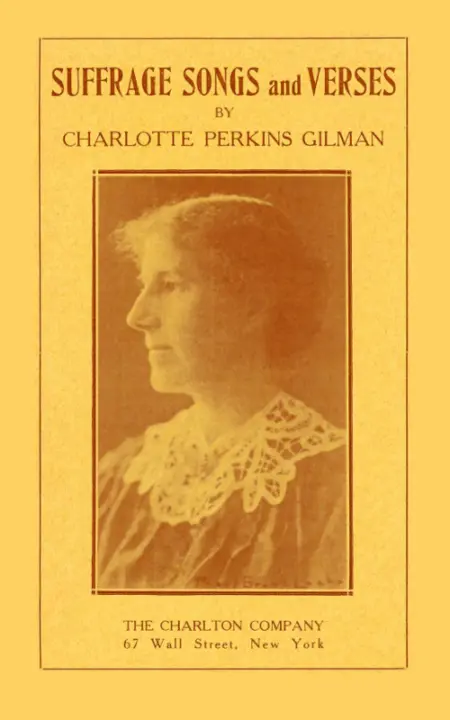
Charlotte Perkins Gilman
BEHIND THE BOOK
This eBook is for the use of anyone anywhere in the United States and most other parts of the world at no cost and with almost no restrictions whatsoever. You may copy it, give it away or re-use it under the terms of the Project Gutenberg License included with this eBook or online at www.gutenberg.org. If you are not located in the United States, you will have to check the laws of the country where you are located before using this eBook. Read the source licence.
The original source file, including credits and licence, is retained by this library. Request an original-format copy at no charge. Please include the book title and Project Gutenberg identifier #57913.
KEEP YOUR CURIOSITY GOING

Charles G. (Charles Griffith) Ross
Hannah Webster Foster

Emily Lawless
Edwin Hamlin Carr

Charles De Lano Hine
Andrew Ure