Moving the Mountain
Charlotte Perkins Gilman
THE CLASSIC COLLECTION · 1898
"Women and Economics" by Charlotte Perkins Gilman is a book published in 1898. Gilman argues that women's economic dependence on men has stunted their development and harmed society. She challenges traditional notions of marriage, motherhood, and domestic life, proposing radical reforms like professionalizing housework and creating cooperative kitchens. Her central claim: women must achieve economic independence to transform themselves and improve civilization. The book became wildly popular, establishing Gilman as a leading voice in the women's movement virtually overnight.
Introduction adapted from the source catalogue; source summaries may be automatically generated.
Free to read · English · 78,963 words · No account needed
MAKE TIME FOR A GOOD BOOK
On by default. Untick to stop anonymous reading totals. Each page counts after 10 seconds in view. How this works.
Anonymous counting is on unless you have switched it off.
Where now we strive and agonize after impossible virtues, we shall then grow naturally and easily into those very qualities; and we shall not even think of them as especially commendable. Where our progress hitherto has been warped and hindered by the retarding influence of surviving rudimentary forces, it will flow on smoothly and rapidly when both men and women stand equal in economic relation. When the mother of the race is free, we shall have a better world, by the easy right of birth and by the calm, slow, friendly forces of social evolution.
Academic groves of Greece, 285.
Accident of sex, man’s sovereignty due to, 337.
Accompaniment to social life, home life only an, 282.
Action of heredity, 70.
—— in servitude, discord of will and, 333.
Activity in obstetrics, masculine, 197.
Advance, motherhood and racial, 189.
Advantage of professional cleaners, 255.
—— of family alone planned for, 296.
Advantages of home cooking, 249.
Africa, Darkest, 180.
African, hybrid progeny of Anglo-Saxon and, 332.
Age, the Augustan, 161.
—— Elizabethan, 161.
—— Periclean, 161.
Aggregate privacy of the family, 258.
Agony of Armenia, 162.
Allen, Grant, quotation from, 172.
Altruism, the main distinction of human virtue, 323.
—— the socialized individual profited by, 325.
—— of obedience, 327.
Amateur, the mother always an, 293.
America, 162.
—— the Englishman in, 79.
—— the human soul in, 148.
American, the, in England, 79.
“Americanitis.”
Amusement, woman’s, gained through sex-attraction, 308.
Anglo-Saxon blood, 147.
—— hybrid progeny of, and African, 332.
—— hybrid progeny of, and Oriental, 332.
Anthony, Susan B., 167.
Apartments, bachelor vs. marriage, 297.
Apple-tree, Eve and the, 329.
Arabellas of the last century, 148.
Armenia, the agony of, 162.
Arrested development of woman, result of, 330.
Art and science of cooking, 230.
Association, present methods of, unsatisfactory for women, 307.
—— value of, of the sexes, 314.
Associations of home, 221.
Attitude of women to marriage, 86.
Attraction, love a necessary, 325.
Augustan age, 161.
Baby, the first impressions of a, 281.
Baby-culture, wrong training of mothers for, 270.
Baby-education, the meaning of better, 287.
Baby-educator, the mother a bad, 284.
Babyhood, the ideal, 288.
Babylon, the girls of, 97.
Bachelor apartments vs. marriage, 297.
Balance of power in living organisms, 59.
Barton, Clara, 165.
Basis, change of, in family relations, 271.
—— the economic, of present family life, 303.
—— mingling on a human, 306.
Bela, the temple of, 97.
Benefits, of our sexuo-economic relation, 136.
—— of home life, 260.
Betterment, surroundings of infancy capable of, 292.
Bible, instructions of, 28.
Birth of free France, 137.
—— of historic crises, 146.
Blackwell, Dr. Elizabeth, 167.
Boston, 80.
—— Tea Party, 146.
Brain action, two laws of, 76.
Bridge’s Food for infants, 196.
Britons, surprise of, over Boston Tea Party, 146.
Brought up at home, children that are, 282.
Burden, economic, of children, 169.
Business partners, husband and wife not, 12.
Byron, quotation from “Childe Harold,” 24.
Camp, conduct of New Englanders in a mining, 320.
Captives, stripping of the Persian, 73.
Care of children, to marriage, value of, 301.
Cause of our exaggerated sex-development, 58.
—— of insanity, loneliness often a, 267.
Causes of the decline of home life,
Your reading position is saved on this browser. Take it to another device with a library code. Reading pages adapt to text, rather than matching a printed edition.
Charlotte Perkins Gilman
Charlotte Perkins Gilman

Charlotte Perkins Gilman
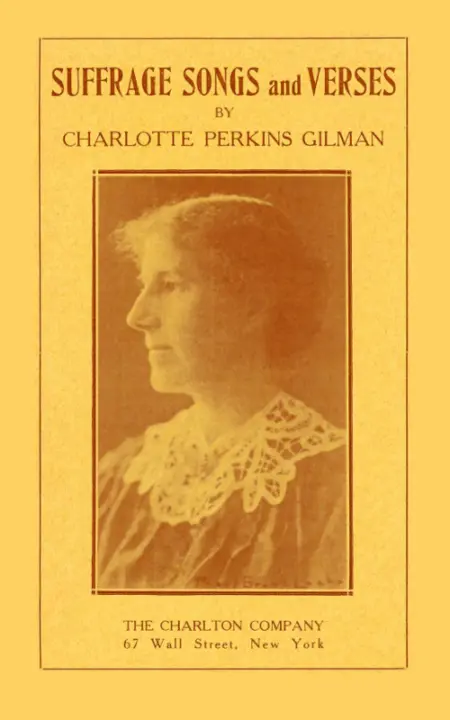
Charlotte Perkins Gilman
BEHIND THE BOOK
This eBook is for the use of anyone anywhere in the United States and most other parts of the world at no cost and with almost no restrictions whatsoever. You may copy it, give it away or re-use it under the terms of the Project Gutenberg License included with this eBook or online at www.gutenberg.org. If you are not located in the United States, you will have to check the laws of the country where you are located before using this eBook. Read the source licence.
The original source file, including credits and licence, is retained by this library. Request an original-format copy at no charge. Please include the book title and Project Gutenberg identifier #57913.
KEEP YOUR CURIOSITY GOING

Charles G. (Charles Griffith) Ross
Hannah Webster Foster

Emily Lawless
Edwin Hamlin Carr

Charles De Lano Hine
Andrew Ure