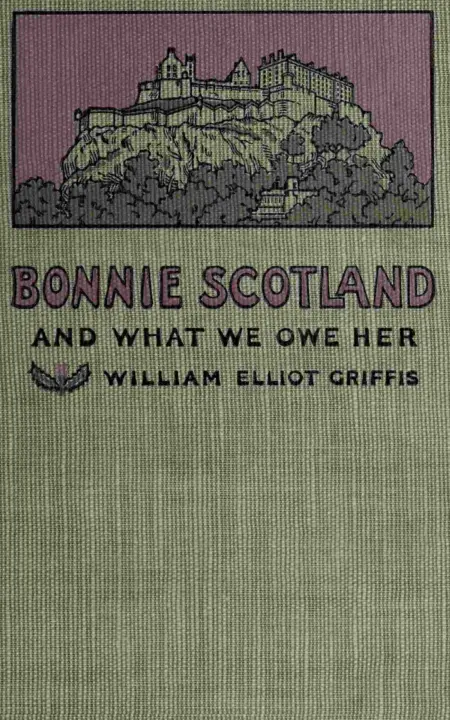
Bonnie Scotland and what we owe her
William Elliot Griffis
THE CLASSIC COLLECTION · 1921
"Welsh Fairy Tales" by William Elliot Griffis is a collection of folklore and fairy tales written in the early 20th century. This anthology draws from the rich tradition of Welsh storytelling, featuring a variety of enchanting tales that explore themes of love, bravery, and the magical elements typical of fairy lore. The stories involve various characters such as Saint David, brave maidens, fearsome monsters, and clever wizards, offering readers insight into Welsh culture and mythology. At the start of "Welsh Fairy Tales," the author presents a preface that reflects on his Welsh heritage and the cultural significance of storytelling. He then launches into the first tale, "Welsh Rabbit and Hunted Hares," where the reader is introduced to the compassionate figure of Saint David, who teaches the people of Wales about food and manners. The story unfolds with a hunting prince who encounters a maiden named Monacella, who protects a wild hare through her prayers, ultimately gaining the prince's admiration and a sacred sanctuary in his land. This opening sets the tone for a charming and whimsical exploration of Welsh fairy tales filled with magic, moral lessons, and the intertwining of everyday life with the supernatural.
Introduction adapted from the source catalogue; source summaries may be automatically generated.
Free to read · English · 43,319 words · No account needed
MAKE TIME FOR A GOOD BOOK
On by default. Untick to stop anonymous reading totals. Each page counts after 10 seconds in view. How this works.
Anonymous counting is on unless you have switched it off.
From this time forth, Gwyn was on watch over himself, day and night, like a sentinel over whom hangs the sentence of death, should he fall asleep on duty. He was ever vigilant lest, he, in a moment of forgetfulness, might, by some slip of conduct, or in a moment of forgetfulness, strike his dear wife.
The baby, whose life of pain and death of agony Nelferch had foretold, soon passed away; for, happily, its life was short. Then she and her husband attended the last rites of sorrow, for Celtic folk always have a funeral and hold a wake, even when a baby, only a span long, lies in the coffin.
Yet in the most solemn moment of the services of burial, Nelferch the wife, laughed out, so long and with such merriment, that everyone was startled.
Her husband, mortified at such improper behavior, touched her gently,
saying:
"Hush, wife! Why do you laugh?"
"Because the babe is free from all pain. And, you have thrice struck
me! Farewell!"
Fleeing like a deer home to their farm, she called together, by its name, each and every one of their animals, from stable and field; yes, even those harnessed to the plow. Then, over the mountain all moved in procession to the lake.
There, they plunged in and vanished. No trace of them was left, except that made by the oxen drawing the plow, and which mark on the ground men still point out.
Broken hearted and mad with grief, Gwyn rushed into the lake and was seen no more. The three sons, grieving over their drowned father, spent their many days wandering along the lakeside, hoping once more to see one, or both, of their dear parents.
Their love was rewarded. They never saw their father again, but one day their mother, Nelferch, suddenly appeared out of the water. Telling her children that her mission on earth was to relieve pain and misery, she took them to a point in the lake, where many plants grew that were useful in medicine. There, she often came and taught them the virtues of the roots, leaves, juices and the various virtues of the herbs, and how to nurse the sick and heal those who had diseases.
All three of Nelferch's sons became physicians of fame and power. Their descendants, during many centuries, were renowned for their skill in easing pain and saving life. To this day, Physicians' Point is shown to visitors as a famous spot, and in tradition is almost holy.
Your reading position is saved on this browser. Take it to another device with a library code. Reading pages adapt to text, rather than matching a printed edition.
William Elliot Griffis
William Elliot Griffis
William Elliot Griffis
William Elliot Griffis
BEHIND THE BOOK
This eBook is for the use of anyone anywhere in the United States and most other parts of the world at no cost and with almost no restrictions whatsoever. You may copy it, give it away or re-use it under the terms of the Project Gutenberg License included with this eBook or online at www.gutenberg.org. If you are not located in the United States, you will have to check the laws of the country where you are located before using this eBook. Read the source licence.
The original source file, including credits and licence, is retained by this library. Request an original-format copy at no charge. Please include the book title and Project Gutenberg identifier #9368.
KEEP YOUR CURIOSITY GOING

Maurice Baring
Francis Greenleaf Allinson & Anne C. E. (Anne Crosby Emery) Allinson
Stuart Dodgson Collingwood
Percy Keese Fitzhugh
Mary Macleod & Edmund Spenser

Cooke Don-Carlos