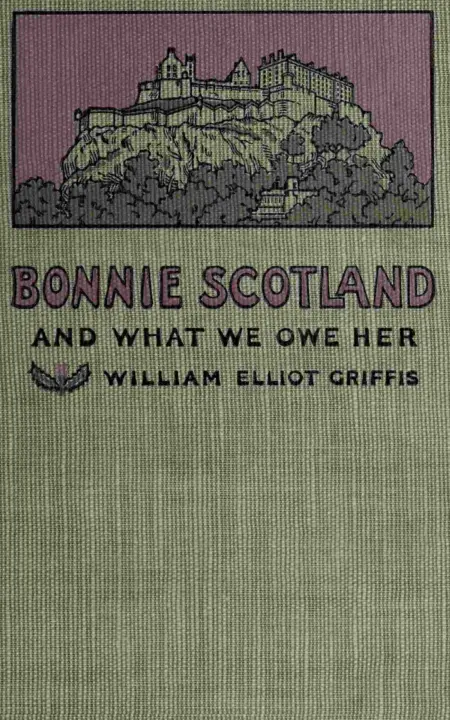
Bonnie Scotland and what we owe her
William Elliot Griffis
THE CLASSIC COLLECTION · 1921
"Welsh Fairy Tales" by William Elliot Griffis is a collection of folklore and fairy tales written in the early 20th century. This anthology draws from the rich tradition of Welsh storytelling, featuring a variety of enchanting tales that explore themes of love, bravery, and the magical elements typical of fairy lore. The stories involve various characters such as Saint David, brave maidens, fearsome monsters, and clever wizards, offering readers insight into Welsh culture and mythology. At the start of "Welsh Fairy Tales," the author presents a preface that reflects on his Welsh heritage and the cultural significance of storytelling. He then launches into the first tale, "Welsh Rabbit and Hunted Hares," where the reader is introduced to the compassionate figure of Saint David, who teaches the people of Wales about food and manners. The story unfolds with a hunting prince who encounters a maiden named Monacella, who protects a wild hare through her prayers, ultimately gaining the prince's admiration and a sacred sanctuary in his land. This opening sets the tone for a charming and whimsical exploration of Welsh fairy tales filled with magic, moral lessons, and the intertwining of everyday life with the supernatural.
Introduction adapted from the source catalogue; source summaries may be automatically generated.
Free to read · English · 43,319 words · No account needed
MAKE TIME FOR A GOOD BOOK
On by default. Untick to stop anonymous reading totals. Each page counts after 10 seconds in view. How this works.
Anonymous counting is on unless you have switched it off.
One easily gets acquainted with the Welsh fairies, for nearly all the good ones are very fond of music.
Or, they live down in the lakes, or up in the mountains. They are always ready to help kind or polite people, who treat them well or will give them a glass of milk, or a saucer of flummery.
But, oh, what tricks and mischief they do play on mean or stingy or grumpy folks with bad tempers! They tangle up the harness of the horses; milk the cows, letting the milk go to waste, on the stable floor; tie knots in their tails, or keep the dog's mouth shut, when the robbers come sneaking around. Better not offend a fairy, even though no higher than a thimble!
A favorite place for the elfin ladies of the lake is high up in one of the fresh water mountain ponds. They are cousins to the mermaids, that swim in the salt water.
They say that these lake maidens love to come up close to the shore, to smell the sweet grass and flowers, which the cows like so much.
Near one of these lakes dwelt a widow, with only one son, named Gwyn. One day he took his lunch of barley bread and cheese, and went out, as usual, to tend the cows. Soon he saw rising out of the water, to dress her long and luxuriant hair, the most beautiful lady he had ever seen. In her hand she held a golden comb, and was using the bright lake-surface as a mirror.
At once Gwyn fell in love with her, and, like an unselfish lad, held out his refreshments--barley bread and cheese--all he had--bidding her to come and take.
But though the lady glided toward him, while he still held out his hand, she shook her head, saying:
O thou of the hard baked bread,
It is not easy to catch me
Sorry enough to miss such a prize, he hurried home to tell his mother. She, wondering also, whether fairies have teeth to chew, told him to take soft dough next time. Then, perhaps, the strange lady would come again.
Not much sleep did the boy get that night, and, before the sun was up, he was down by the lake side holding out his dough.
There, hour after hour, neglecting the cows, he looked eagerly over the water, but nothing appeared, except ripples started by the breeze. Again and again, he gazed in hope, only to be disappointed.
Meanwhile he thought out a pretty speech to make to her, but he kept
his dough and went hungry.
Your reading position is saved on this browser. Take it to another device with a library code. Reading pages adapt to text, rather than matching a printed edition.
William Elliot Griffis
William Elliot Griffis
William Elliot Griffis
William Elliot Griffis
BEHIND THE BOOK
This eBook is for the use of anyone anywhere in the United States and most other parts of the world at no cost and with almost no restrictions whatsoever. You may copy it, give it away or re-use it under the terms of the Project Gutenberg License included with this eBook or online at www.gutenberg.org. If you are not located in the United States, you will have to check the laws of the country where you are located before using this eBook. Read the source licence.
The original source file, including credits and licence, is retained by this library. Request an original-format copy at no charge. Please include the book title and Project Gutenberg identifier #9368.
KEEP YOUR CURIOSITY GOING

Maurice Baring
Francis Greenleaf Allinson & Anne C. E. (Anne Crosby Emery) Allinson
Stuart Dodgson Collingwood
Percy Keese Fitzhugh
Mary Macleod & Edmund Spenser

Cooke Don-Carlos