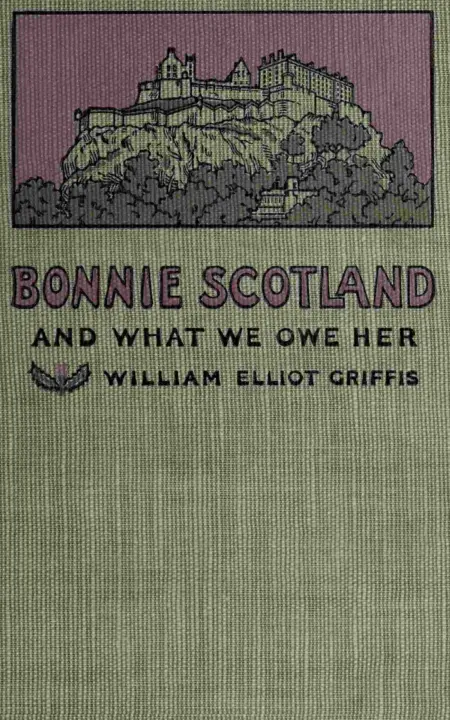
Bonnie Scotland and what we owe her
William Elliot Griffis
THE CLASSIC COLLECTION · 1921
"Welsh Fairy Tales" by William Elliot Griffis is a collection of folklore and fairy tales written in the early 20th century. This anthology draws from the rich tradition of Welsh storytelling, featuring a variety of enchanting tales that explore themes of love, bravery, and the magical elements typical of fairy lore. The stories involve various characters such as Saint David, brave maidens, fearsome monsters, and clever wizards, offering readers insight into Welsh culture and mythology. At the start of "Welsh Fairy Tales," the author presents a preface that reflects on his Welsh heritage and the cultural significance of storytelling. He then launches into the first tale, "Welsh Rabbit and Hunted Hares," where the reader is introduced to the compassionate figure of Saint David, who teaches the people of Wales about food and manners. The story unfolds with a hunting prince who encounters a maiden named Monacella, who protects a wild hare through her prayers, ultimately gaining the prince's admiration and a sacred sanctuary in his land. This opening sets the tone for a charming and whimsical exploration of Welsh fairy tales filled with magic, moral lessons, and the intertwining of everyday life with the supernatural.
Introduction adapted from the source catalogue; source summaries may be automatically generated.
Free to read · English · 43,319 words · No account needed
MAKE TIME FOR A GOOD BOOK
On by default. Untick to stop anonymous reading totals. Each page counts after 10 seconds in view. How this works.
Anonymous counting is on unless you have switched it off.
When they had all gathered together, at the evening hour, there was seen, in the moonlight, the funniest lot of creatures, that one could imagine, but all were neatly dressed and well behaved.
Quite a large number of the famous Fair Family, that moved only in the best society of fairyland, fathers, mothers, cousins, uncles and aunts, were on hand. In fact, some of them had thought it was to be a wake, and were ready for whatever might turn up, whether solemn or frivolous. These were dressed in varied costume.
Queen Mab, who above all else, was a Welsh fairy, and whose name, as everybody knows who talks Cymric, suggested her extreme youth and lively disposition, was present in all her glory.
When they saw her, several learned fairies, who had come from a distance, fell at once into conversation on this subject. One remarked: "How would the Queen like to add another syllable to her name? Then we should call her Mab-gath (which means Kitten, or Little Puss)."
"Well not so bad, however; because many mortal daddies, who have a daughter, call her Puss. It is a term of affection with them and the little girls never seem to be offended."
"Oh! Suppose that in talking to each other we call our Queen Mab-gar, what then?" asked another, with a roguish twinkle in the eye.
"It depends on how you use it," said a wise one dryly. This fairy was a stickler for the correct use of every word. "If you meant 'babyish,' or 'childish,' she, or her friends might demur; but, if you use the term 'love of children,' what better name for a fairy queen?"
"None. There could not be any," they shouted, all at once, "but let us ask our old friend the harper."
Now such a thing as inquiring into each other's ages was not common in Fairy Land. Very few ever asked such a question, for it was not thought to be polite. For, though we hear of ugly fairy brats being put into the cradles, in place of pretty children, no one ever heard, either of fairies being born or of dying, or having clocks, or watches, or looking to see what time it was. Nor did doctors, or the census clerks, or directory people ever trouble the fairy ladies, to ask their age.
Occasionally, however, there was one fairy, so wise, so learned, and so able to tell what was going to happen to-morrow, or next year, that the other fairies looked up to such an one with respect and awe.
Your reading position is saved on this browser. Take it to another device with a library code. Reading pages adapt to text, rather than matching a printed edition.
William Elliot Griffis
William Elliot Griffis
William Elliot Griffis
William Elliot Griffis
BEHIND THE BOOK
This eBook is for the use of anyone anywhere in the United States and most other parts of the world at no cost and with almost no restrictions whatsoever. You may copy it, give it away or re-use it under the terms of the Project Gutenberg License included with this eBook or online at www.gutenberg.org. If you are not located in the United States, you will have to check the laws of the country where you are located before using this eBook. Read the source licence.
The original source file, including credits and licence, is retained by this library. Request an original-format copy at no charge. Please include the book title and Project Gutenberg identifier #9368.
KEEP YOUR CURIOSITY GOING

Maurice Baring
Francis Greenleaf Allinson & Anne C. E. (Anne Crosby Emery) Allinson
Stuart Dodgson Collingwood
Percy Keese Fitzhugh
Mary Macleod & Edmund Spenser

Cooke Don-Carlos