THE CLASSIC COLLECTION✦An outlaw’s diary: the CommuneCLASSIC FREE BOOKS
An outlaw’s diary: the Commune
Cécile Tormay
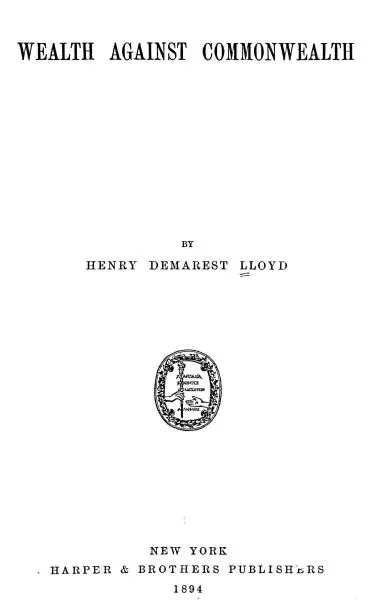
THE CLASSIC COLLECTION · 1894
"Wealth Against Commonwealth" by Henry Demarest Lloyd is a critical socio-economic analysis written in the late 19th century. The text addresses the growing issue of monopolies and trusts that control industries and markets, significantly impacting the livelihoods of the general populace. Through a realist lens, Lloyd explores the relationship between wealth and liberty, suggesting that the concentration of wealth in a few hands undermines the freedom of the many. The opening of the work sets the stage for a deep exploration of economic disparities in America, contrasting the vast riches produced by the country with the persistent poverty faced by the majority. Lloyd begins by asserting that despite natural wealth, the majority of the population is deprived of the resources they produce due to the manipulation and insatiable greed of monopolistic entities. He introduces key themes such as the imbalance of production versus consumption, critiques of contemporary economic theories, and the ramifications of corporate power over individual rights. This lays a foundation for his broader critique of capitalism and calls for accountability from those who hold economic power.
Introduction adapted from the source catalogue; source summaries may be automatically generated.
Free to read · English · 198,262 words · No account needed
MAKE TIME FOR A GOOD BOOK
On by default. Untick to stop anonymous reading totals. Each page counts after 10 seconds in view. How this works.
Anonymous counting is on unless you have switched it off.
Notwithstanding the ceremonial treaty of equal rights on the railroads to all, which had been secured by the uprising of the people against the South Improvement Company in 1872, the independents, one after the other, continued to be side-tracked by an unseen power. Four years later, on the 20th of July, 1876, their only two important survivors in Cleveland, frightened by the high death-rate of the business, and by a deepening pressure on themselves, answered a summons to come to the palace of the President of the Light of the World. The contract which was then made was afterwards produced in court.[87] It was called an "Agreement for an Adventure," in something like "the merry sport" in which the good Antonio gave a bond for a pound of his flesh.
A few years after this "adventure" with his competitors and his efforts to have them closed by the courts, the President was asked if his trust had sought in any way to diminish the production of refineries in competition with it.
"Oh no, sir," he replied.
"Nothing of the kind?"
"Oh no, sir."[88]
He was asked the question again, and again the denial was repeated.
"Done nothing of the sort?"
"Not at all."
But now he said, You must bind yourselves for ten years to refine only 85,000 barrels of oil a year.[89]
They had refined 120,000 barrels the year before, and could have done 180,000, and were growing up with the country. "The prospects were much better for the future."[90]
But they agreed.
You must give me and my associates all the profits you make during this period above $35,000 a year, until we too have got $35,000 a year out of your business, and we will guarantee you $35,000 a year, if we let you run.
They had made $41,000 the year before, but they agreed.
You must divide with "us," after each has got $35,000 a year, all the
additional profits.
They had to put into this "adventure" all their buildings and machinery, valued at $61,760.42, all their time and attention, and $10,000 in cash, while their conquerors put in only $10,000 cash and no plant and no time. But they agreed to this demand for "half."
You must stop refining altogether, and let us take out our $10,000 whenever we send you notice that through competition, or a decrease or change in the production of petroleum, Cleveland can "barely compete" with other places. You must sell the kerosene you manufacture, and buy the petroleum you make it of at the prices we fix.
The combination could make the business unprofitable whenever it chose, and under the previous stipulation could close them up at its own pleasure, until the ten years had rolled by. But they agreed.
Your reading position is saved on this browser. Take it to another device with a library code. Reading pages adapt to text, rather than matching a printed edition.
BEHIND THE BOOK
This eBook is for the use of anyone anywhere in the United States and most other parts of the world at no cost and with almost no restrictions whatsoever. You may copy it, give it away or re-use it under the terms of the Project Gutenberg License included with this eBook or online at www.gutenberg.org. If you are not located in the United States, you will have to check the laws of the country where you are located before using this eBook. Read the source licence.
The original source file, including credits and licence, is retained by this library. Request an original-format copy at no charge. Please include the book title and Project Gutenberg identifier #60473.
KEEP YOUR CURIOSITY GOING
Cécile Tormay

Moritz Busch
John L. Ransom
Frances Wright
Cécile Tormay

Mabel Potter Daggett