THE CLASSIC COLLECTION✦An outlaw’s diary: the CommuneCLASSIC FREE BOOKS
An outlaw’s diary: the Commune
Cécile Tormay
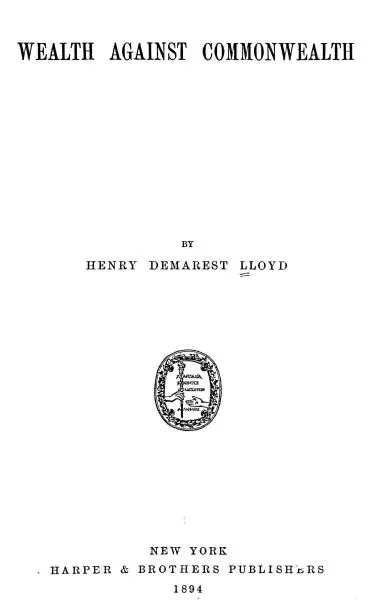
THE CLASSIC COLLECTION · 1894
"Wealth Against Commonwealth" by Henry Demarest Lloyd is a critical socio-economic analysis written in the late 19th century. The text addresses the growing issue of monopolies and trusts that control industries and markets, significantly impacting the livelihoods of the general populace. Through a realist lens, Lloyd explores the relationship between wealth and liberty, suggesting that the concentration of wealth in a few hands undermines the freedom of the many. The opening of the work sets the stage for a deep exploration of economic disparities in America, contrasting the vast riches produced by the country with the persistent poverty faced by the majority. Lloyd begins by asserting that despite natural wealth, the majority of the population is deprived of the resources they produce due to the manipulation and insatiable greed of monopolistic entities. He introduces key themes such as the imbalance of production versus consumption, critiques of contemporary economic theories, and the ramifications of corporate power over individual rights. This lays a foundation for his broader critique of capitalism and calls for accountability from those who hold economic power.
Introduction adapted from the source catalogue; source summaries may be automatically generated.
Free to read · English · 198,262 words · No account needed
MAKE TIME FOR A GOOD BOOK
On by default. Untick to stop anonymous reading totals. Each page counts after 10 seconds in view. How this works.
Anonymous counting is on unless you have switched it off.
The South Improvement plan of 1872 is still in unrelenting operation, according to the latest news. A case is now pending before the Interstate Commerce Commission,[744] in which charges of highway abuse even more sensational than any of those we have seen judicially proved are made against the thirty railroads by which the oil of Ohio, Pennsylvania, and New York reaches the Pacific coast. A San Francisco oil dealer is the petitioner for relief. He recites the discriminations given the oil combination on the Pacific coast before the Interstate Commerce law was enacted. These were admitted by the officials of the roads before the United States Pacific Railway Commission of 1887. The traffic managers of the Southern Pacific testified that the oil combination, "from the time it acquired the oil business on this coast, had lower rates than the general tariff provided, or than other shippers paid on coal oil."[745] The general freight agent of the Central Pacific Railroad admitted that his road had the same arrangement, and had accepted the business "at rates dictated" by the oil combination.[746] The general traffic manager of the Union Pacific Railroad said:
"We have paid them a good deal in rebates." It was a "pretty large"
preference.
"What was the effect on the small dealer?"
"I should think it would be embarrassing to the small shipper!"[747]
When the Interstate Commerce law went into force the oil combination introduced a patented car for the transcontinental trade, which it claimed the sole right to use. Though the new car was to the disadvantage of the railroads, as it cost more to haul, the managers gave it lower rates than any other car and carried it back free, while they punished the shippers who gave them a lighter and better car by charging them $105 for carrying that back.
The San Francisco complainant goes on to charge that a plan was concocted and put in operation by which rates were lowered whenever the combination wanted to fill its warehouses on the Pacific coast, and as soon as they were full were put back again. This lowering and raising of rates was "to the public sudden and unexpected."[748] It was known in advance only to the ring and the railroads. Before other shippers could take advantage of the low rates they would be raised again. The complaint recites that in pursuance of this plan, after the combination had transferred to the Pacific coast at the end of 1888 from its Eastern refineries all it needed for the next season's business, the railroads advanced the rates from 82-1/2 cents a hundred pounds to $1.25. The next May the railroads made a similar seesaw, and, he says, in December, 1892, "are still making ... such arbitrary and sudden reductions ... to the undue advantage" of the oil combination "and to the detriment and injury of all other shippers." The San Francisco merchant also charges that in the interest of the Eastern refineries of the combination rates are made to prevent the large product of the oil-fields and independent refineries of Colorado and Wyoming from reaching the Pacific coast, "which needs them to furnish fuel for its manufactories, as well as for light for its residents." Similarly we find the Chicago and Northwestern Railroad charging $105 for a car-load of cattle from Wyoming to Chicago, while for a car of 75 barrels of oil the freight would be $348. In connection with these charges the press published the telegrams, filling columns, which were said to have passed between the officials of the railroads and the oil combination in the negotiation of this arrangement. In one of these telegrams the freight agent of the Southern Pacific explains the new deal. "He" (the agent of the oil combination) "would stock up at the low rate, then notify the association of railroads when to advance." The advance or decline was to be "made at certain seasons of the year in accordance with this supply on hand." When the negotiation was finished and the plan was agreed to, a San Francisco agent of the oil combination is said to have telegraphed to its officers in New York: "I think we have managed this freight business pretty well from this long distance, especially when you think that we have secured the 90-cent rate with which to stock up from time to time." His telegram also discloses that the arrangement extended to lead and linseed-oil, showing, what is well known, that the combinations in these articles belong to the members of that in oil. These charges are, it is to be remembered, still unadjudicated, this published evidence is not yet substantiated. But the arrangement which is charged is in exact pursuance of that part of the South Improvement Company contract which bound the railroads to "lower or raise the gross rates of transportation ... for such times and to such extent as may be necessary to overcome ... competition."[749] And Attorney-General Olney has been publicly informed[750] that during the summer of 1894 oil rates between Pennsylvania and Colorado were put down from 75 cents a hundred to 25 cents, and a few weeks later raised again to the old rate. Another increase made the rates to Denver higher, for oil, than to the Pacific coast. He has been asked to ascertain, judicially, if this shuffling of rates was not made, like that complained of before the Interstate Commerce Commission, to allow the oil trust "to stock up at the old rate." His informants suggest that the same powers with which he has brought railway employés to trial for infractions of the Interstate Commerce law can be used against the railways.
Your reading position is saved on this browser. Take it to another device with a library code. Reading pages adapt to text, rather than matching a printed edition.
BEHIND THE BOOK
This eBook is for the use of anyone anywhere in the United States and most other parts of the world at no cost and with almost no restrictions whatsoever. You may copy it, give it away or re-use it under the terms of the Project Gutenberg License included with this eBook or online at www.gutenberg.org. If you are not located in the United States, you will have to check the laws of the country where you are located before using this eBook. Read the source licence.
The original source file, including credits and licence, is retained by this library. Request an original-format copy at no charge. Please include the book title and Project Gutenberg identifier #60473.
KEEP YOUR CURIOSITY GOING
Cécile Tormay

Moritz Busch
John L. Ransom
Frances Wright
Cécile Tormay

Mabel Potter Daggett