THE CLASSIC COLLECTION✦An outlaw’s diary: the CommuneCLASSIC FREE BOOKS
An outlaw’s diary: the Commune
Cécile Tormay
THE CLASSIC COLLECTION · 1892
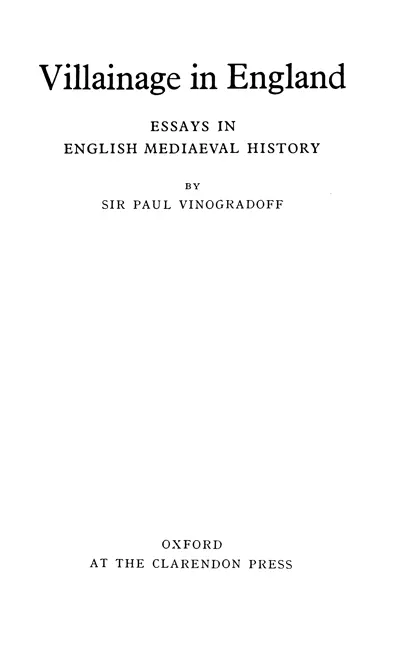
"Villainage in England: Essays in English Mediaeval History" by Sir Paul Vinogradoff is a scholarly historical account written in the late 19th century. The book delves into the complex social structures and legal status of the peasantry during the feudal period in England, particularly focusing on the concept of villainage, a form of servitude distinct from slavery. It examines the rights, disabilities, and socio-economic conditions of villains, offering a comprehensive analysis of how these factors shaped medieval agrarian society. The opening of the book presents a detailed preface where the author discusses his motivations for exploring such a nuanced topic as English social history, framed in the context of his Russian background. He articulates the significance of studying historical documents to uncover the dynamics of social classes, especially the relationship between lords and their peasant subjects. Vinogradoff emphasizes the importance of legal frameworks that defined villainage, arguing that understanding these relationships provides valuable insights into the broader historical narrative of agrarian development and social organization in medieval England. The initial portion sets the stage for an in-depth exploration of the peasantry's legal and economic positions, showcasing a methodical approach to historical inquiry that anticipates the detailed essays that follow.
Introduction adapted from the source catalogue; source summaries may be automatically generated.
Free to read · English · 173,596 words · No account needed
MAKE TIME FOR A GOOD BOOK
On by default. Untick to stop anonymous reading totals. Each page counts after 10 seconds in view. How this works.
Anonymous counting is on unless you have switched it off.
[Tenure in ancient demesne a kind of villainage.]
In many respects the position of the peasantry in ancient demesne is nearly allied to that of men holding in villainage at common law. They perform all kinds of agricultural services and are subject to duties quite analogous to those which prevail in other places; we may find on these ancient manors almost all the incidents of servile custom. Sometimes very harsh forms of distress are used against the tenants[143]; forfeiture for non-performance of services and non-payments of rents was always impending, in marked contrast with the considerate treatment of free tenantry in such cases[144]. We often come across such base customs as the payment of merchet in connexion with the 'villain socmen' of ancient demesne[145]. And such instances would afford ample proof of the fact that their status has branched off from the same stem as villainage, if such proof were otherwise needed.
[Privileges of ancient demesne.]
The side of privilege is not less conspicuous. The indications given by the law books must be largely supplemented from plea rolls and charters. The special favour shown to the population on soil of ancient demesne extends much further than a regulation of manorial duties would imply, it resolves itself to a large extent into an exemption from public burdens. The king's manor is treated as a franchise isolated from the surrounding hundred and shire, its tenants are not bound to attend the county court or the hundred moot[146], they are not assessed with the rest for danegeld or common amercements or the murder fine[147], they are exempted from the jurisdiction of the sheriff[148], and do not serve on juries and assizes before the king's justices[149]; they are free from toll in all markets and custom-houses[150]. Last, but not least, they do not get taxed with the country at large, and for this reason they have originally no representatives in parliament when parliament forms itself. On the other hand, they are liable to be tallaged by the king without consent of parliament, by virtue of his private right as opposed to his political right[151]. This last privilege gave rise to a very abnormal state of things, when ancient demesne land had passed from the crown to a subject. The rule was, that the new lord could not tallage his tenants unless in consequence of a royal writ, and then only at the same time and in the same proportion as the king tallaged the demesnes remaining in his hand[152]. This was an important limitation of the lord's power, and a consequence of the wish to guard against encroachments and arbitrary acts. But it was at the same time a curious perversion of sovereignty:--the person living on land of this description could not be taxed with the county[153], and if he was taxed with the demesnes, his lord received the tax, and not the sovereign. I need not say that all this got righted in time, but the anomalous condition described did exist originally. There are traces of a different view by which the power of imposing tallage would have been vested exclusively in the king, even when the manor to be taxed was one that had passed out of his hand[154]. But the general rule up to the fourteenth century was undoubtedly to relinquish the proceeds to the holder of the manor. Such treatment is eminently characteristic of the conception which lies at the bottom of the whole institution of ancient demesne. It is undoubtedly based on the private privilege of royalty. All the numerous exceptions and exemptions from public liabilities and duties flow from one source: the king does not want his land and his men to be subjected to any vexatious burdens which would lessen their power of yielding income[155]. Once fenced in by royal privilege, the ancient demesne manor keeps up its private immunity, even though it ceases to be royal. And this is the second fact, with which one has to reckon. If the privileged villainage of ancient demesne is founded on the same causes as villainage pure and simple, the distinguishing element of 'privilege' is supplied to it by the private interest of the king. This seems obvious enough, but it must be insisted upon, because it guards against any construction which would pick out one particular set of rights, or one particular kind of relations as characteristic of the institution. Legal practice and later theory concerned themselves mostly with peculiarities of procedure, and with the eventuality of a subject owning the manor. But the peculiar modes of litigation appropriate to the ancient demesne must not be disconnected from other immunities, and the ownership of a private lord is to be considered only as engrafted on the original right of the king. With this preliminary caution, we may proceed to an examination of those features which are undoubtedly entitled to attract most attention, namely, the special procedure which is put in action when questions arise in any way connected with the soil of ancient demesne.
Your reading position is saved on this browser. Take it to another device with a library code. Reading pages adapt to text, rather than matching a printed edition.
BEHIND THE BOOK
This eBook is for the use of anyone anywhere in the United States and most other parts of the world at no cost and with almost no restrictions whatsoever. You may copy it, give it away or re-use it under the terms of the Project Gutenberg License included with this eBook or online at www.gutenberg.org. If you are not located in the United States, you will have to check the laws of the country where you are located before using this eBook. Read the source licence.
The original source file, including credits and licence, is retained by this library. Request an original-format copy at no charge. Please include the book title and Project Gutenberg identifier #38876.
KEEP YOUR CURIOSITY GOING
Cécile Tormay

Moritz Busch
John L. Ransom
Frances Wright
Cécile Tormay

Mabel Potter Daggett