THE CLASSIC COLLECTION✦An outlaw’s diary: the CommuneCLASSIC FREE BOOKS
An outlaw’s diary: the Commune
Cécile Tormay
THE CLASSIC COLLECTION · 1892
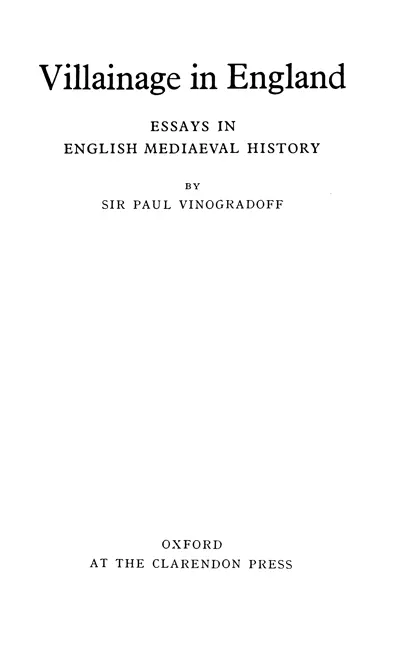
"Villainage in England: Essays in English Mediaeval History" by Sir Paul Vinogradoff is a scholarly historical account written in the late 19th century. The book delves into the complex social structures and legal status of the peasantry during the feudal period in England, particularly focusing on the concept of villainage, a form of servitude distinct from slavery. It examines the rights, disabilities, and socio-economic conditions of villains, offering a comprehensive analysis of how these factors shaped medieval agrarian society. The opening of the book presents a detailed preface where the author discusses his motivations for exploring such a nuanced topic as English social history, framed in the context of his Russian background. He articulates the significance of studying historical documents to uncover the dynamics of social classes, especially the relationship between lords and their peasant subjects. Vinogradoff emphasizes the importance of legal frameworks that defined villainage, arguing that understanding these relationships provides valuable insights into the broader historical narrative of agrarian development and social organization in medieval England. The initial portion sets the stage for an in-depth exploration of the peasantry's legal and economic positions, showcasing a methodical approach to historical inquiry that anticipates the detailed essays that follow.
Introduction adapted from the source catalogue; source summaries may be automatically generated.
Free to read · English · 173,596 words · No account needed
MAKE TIME FOR A GOOD BOOK
On by default. Untick to stop anonymous reading totals. Each page counts after 10 seconds in view. How this works.
Anonymous counting is on unless you have switched it off.
[Police in relation to villainage.]
It is curious that, as regards police, villains are grouped under an institution which, even by its name, according to the then accepted etymology, was essentially a free institution. The system of frank pledge (plegium liberale), which should have included every one 'worthy of his were and his wite,' is, as a matter of fact, a system which all through the feudal period is chiefly composed of villains[76]. Free men possessed of land are not obliged to join the tithing because they are amenable to law which has a direct hold on their land[77], and so the great mass of free men appear to be outside these arrangements, for the police representation of the free, or, putting it the other way, feudal serfs actually seem to represent the bulk of free society. The thirteenth-century arrangements do not afford a clue to such paradoxes, and one has to look for explanation to the history of the classes.
The frankpledge system is a most conspicuous link between both sections of society in this way also, that it directly connects the subjugated population with the hundred court, which is the starting-point of free judicial organisation. Twice a year the whole of this population, with very few exceptions, has to meet in the hundred in order to verify the working of the tithings. Besides this, the class of villains must appear by representatives in the ordinary tribunals of the hundred and the shire: the reeve and the four men, mostly unfree men[78], with their important duties in the administration of justice, serve as a counterpoise to the exclusive employment of 'liberi et legales homines' on juries.
[Civil disability of a villain as to his lord.]
And now I come to the most intricate and important part of the subject--to the civil rights and disabilities of the villain. After what has been said of the villain in other respects, one may be prepared to find that his disabilities were by no means so complete as the strict operation of general rules would have required. The villain was able in many cases to do valid civil acts, to acquire property and to defend it in his own name. It is true that, both in theory and in practice, it was held that whatever was acquired by the bondman was acquired by the lord. The bondman could not buy anything but with his lord's money, as he had no money or chattels of his own[79]. But the working of these rules was limited by the medieval doctrine of possession. Land or goods acquired by the serf do not eo ipso lapse into his lord's possession, but only if the latter has taken them into his hand[80]. If the lord has not done so for any reason, for want of time, or carelessness, or because he did not choose to do so, the bondman is as good as the owner in respect of third persons. He can give away[81] or otherwise alienate land or chattels, he has the assize of novel disseisin to defend the land, and leaves the assize of mort d'ancestor to his heirs. In this case it would be no good plea to object that the plaintiff is a villain. In fact this objection can be raised by a third person only with the addition that, as villain, the plaintiff does not hold in his own name, but in the name of his lord[82]. A third person cannot except against a plaintiff merely on the ground of his personal status. As to third persons, a villain is said to be free and capable to sue all actions[83]. This of course does not mean that he has any action for recovering or defending his possession of the tenements which he holds in villainage, but this disability is no consequence of his servile blood, for he shares it with the free man who holds in villainage; it is a consequence of the doctrine that the possession of the tenant in villainage is in law the possession of him who has the freehold. It may be convenient for a villain as defendant to shelter himself behind the authority of his lord[84], and it was difficult to prevent him from doing so, although some attempts were made by the courts even in this case to distinguish whether a person had been in possession as a dependant or not. But there was absolutely nothing to prevent a villain from acting in every respect like a free man if he was so minded and was not interrupted by his lord. There was no need of any accessory action to make his acts complete and legal[85]. Again we come to an anomaly: the slave is free against everybody but his lord.
Your reading position is saved on this browser. Take it to another device with a library code. Reading pages adapt to text, rather than matching a printed edition.
BEHIND THE BOOK
This eBook is for the use of anyone anywhere in the United States and most other parts of the world at no cost and with almost no restrictions whatsoever. You may copy it, give it away or re-use it under the terms of the Project Gutenberg License included with this eBook or online at www.gutenberg.org. If you are not located in the United States, you will have to check the laws of the country where you are located before using this eBook. Read the source licence.
The original source file, including credits and licence, is retained by this library. Request an original-format copy at no charge. Please include the book title and Project Gutenberg identifier #38876.
KEEP YOUR CURIOSITY GOING
Cécile Tormay

Moritz Busch
John L. Ransom
Frances Wright
Cécile Tormay

Mabel Potter Daggett