THE CLASSIC COLLECTION✦An outlaw’s diary: the CommuneCLASSIC FREE BOOKS
An outlaw’s diary: the Commune
Cécile Tormay
THE CLASSIC COLLECTION · 1892
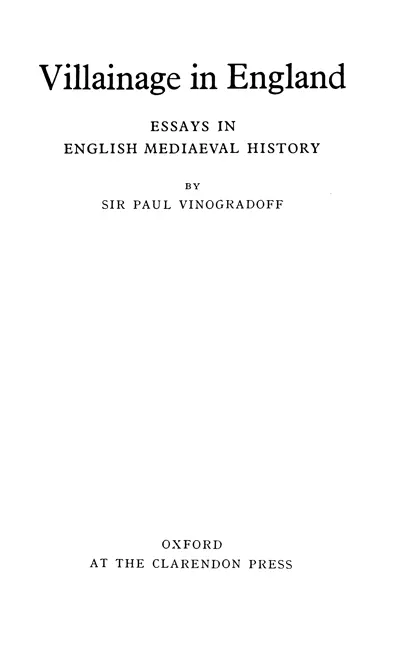
"Villainage in England: Essays in English Mediaeval History" by Sir Paul Vinogradoff is a scholarly historical account written in the late 19th century. The book delves into the complex social structures and legal status of the peasantry during the feudal period in England, particularly focusing on the concept of villainage, a form of servitude distinct from slavery. It examines the rights, disabilities, and socio-economic conditions of villains, offering a comprehensive analysis of how these factors shaped medieval agrarian society. The opening of the book presents a detailed preface where the author discusses his motivations for exploring such a nuanced topic as English social history, framed in the context of his Russian background. He articulates the significance of studying historical documents to uncover the dynamics of social classes, especially the relationship between lords and their peasant subjects. Vinogradoff emphasizes the importance of legal frameworks that defined villainage, arguing that understanding these relationships provides valuable insights into the broader historical narrative of agrarian development and social organization in medieval England. The initial portion sets the stage for an in-depth exploration of the peasantry's legal and economic positions, showcasing a methodical approach to historical inquiry that anticipates the detailed essays that follow.
Introduction adapted from the source catalogue; source summaries may be automatically generated.
Free to read · English · 173,596 words · No account needed
MAKE TIME FOR A GOOD BOOK
On by default. Untick to stop anonymous reading totals. Each page counts after 10 seconds in view. How this works.
Anonymous counting is on unless you have switched it off.
[The 'villain regardant' of the Year Books.]
Let us take up the Year Books, which, even in their present state, afford such an inestimable source of information for the history of legal conceptions in the fourteenth and fifteenth centuries[44]. An examination of the reports in the age of the Edwards will show at once that the terms regardant and in gross are used, or rather come into use, in the fourteenth century as definitions of the mode of pleading in particular cases. They are suggested by difference in title, but they do not coincide with it, and any attempt to make them coincide must certainly lead to misapprehension. I mean this--the term 'villain regardant' applied to a man does not imply that the person in question has any status superior to that of the 'villain in gross,' and it does not imply that the lord has acquired a title to him by some particular mode of acquisition, e.g. by prescription as contrasted with grant or confession; it simply implies that for the purpose of the matter then in hand, for the purpose of the case that is then being argued, the lord is asserting and hoping to prove a title to the villain by relying on a title to a manor with which the villain is or has been connected--title it must be remembered is one thing, proof of title is another. As the contrast is based on pleading and not on title, one and the same person may be taken and described in one case as a villain regardant to a manor, and in another as a villain in gross. And now for the proof.
The expression 'regardant' never occurs in the pleadings at all, but 'regardant to a manor' is used often. From Edward III's time it is used quite as a matter of course in the formula of the 'exceptio' or special plea of villainage[45]. That is, if the defendant pleaded in bar of an action that the plaintiff was his bondman he generally said, I am not bound to answer A, because he is my villain and I am seised of him as of my villain as regardant to my manor of C. Of course there are other cases when the term is employed, but the plea in bar is by far the most common one and may stand for a test. This manner of pleading is only coming gradually into use in the fourteenth century, and we actually see how it is taking shape and spreading. As a rule the Year Books of Edward I's time have not got it. The defendant puts in his plea unqualified. 'He ought not to be answered because he is our villain' (Y.B. 21/22 Edward I, p. 166, ed. Horwood). There is a case in 1313 when a preliminary skirmish between the counsel on either side took place as to the sufficiency of the defendant's plea in bar, the plaintiff contending that it was not precise enough. Here, if any where, we should expect the term 'regardant,' but it is not forthcoming[46]. What is more, and what ought to have prevented any mistake, the official records of trials on the Plea Rolls up to Edward II always use the plain assertion, 'villanus ... et tenet in villenagio[47].' The practice of naming the manor to which a villain belonged begins however to come in during the reign of Edward II, and the terminology is by no means settled at the outset; expressions are often used as equivalent to 'regardant' which could hardly have misled later antiquaries as to the meaning of the qualification[48]. In a case of 1322, for instance, we have 'within the manor' where we should expect to find 'regardant to the manor[49].' This would be very nearly equivalent to the Latin formula adopted by the Plea Rolls, which is simply ut de manerio[50]. Every now and then cases occur which gradually settle the terminology, because the weight of legal argumentation in them is made to turn on the fact that a particular person was connected with a particular manor and not with another. A case from 1317 is well in point. B.P. the defendant excepts against the plaintiff T.A. on the ground of villainage (qil est nostre vileyn, and nothing else). The plaintiff replies that he was enfranchised by being suffered to plead in an assize of mort d'ancestor against B.P.'s grandmother. By this the defendant's counsel is driven to maintain that his client's right against T.A. descended not from his grandmother but from his grandfather, who was seised of the manor of H. to which T.A. belonged as a villain[51]. The connexion with the manor is adduced to show from what quarter the right to the villain had descended, and, of course, implies nothing as to any peculiarity of this villain's status, or as to the kind of title, the mode of acquiring rights, upon which the lord relies--it was ground common to both parties that if the lord had any rights at all he acquired them by inheritance.
Your reading position is saved on this browser. Take it to another device with a library code. Reading pages adapt to text, rather than matching a printed edition.
BEHIND THE BOOK
This eBook is for the use of anyone anywhere in the United States and most other parts of the world at no cost and with almost no restrictions whatsoever. You may copy it, give it away or re-use it under the terms of the Project Gutenberg License included with this eBook or online at www.gutenberg.org. If you are not located in the United States, you will have to check the laws of the country where you are located before using this eBook. Read the source licence.
The original source file, including credits and licence, is retained by this library. Request an original-format copy at no charge. Please include the book title and Project Gutenberg identifier #38876.
KEEP YOUR CURIOSITY GOING
Cécile Tormay

Moritz Busch
John L. Ransom
Frances Wright
Cécile Tormay

Mabel Potter Daggett