THE CLASSIC COLLECTION✦An outlaw’s diary: the CommuneCLASSIC FREE BOOKS
An outlaw’s diary: the Commune
Cécile Tormay
THE CLASSIC COLLECTION · 1892
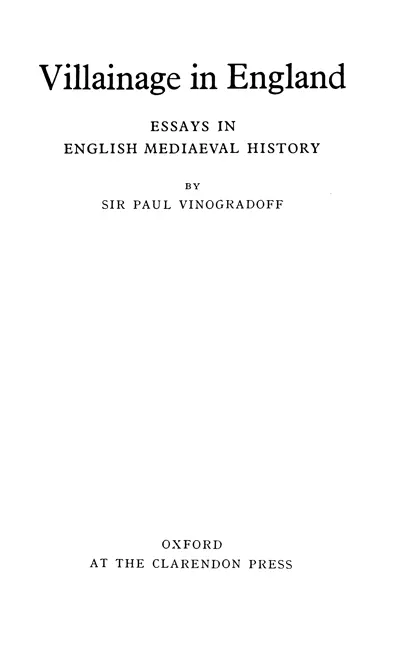
"Villainage in England: Essays in English Mediaeval History" by Sir Paul Vinogradoff is a scholarly historical account written in the late 19th century. The book delves into the complex social structures and legal status of the peasantry during the feudal period in England, particularly focusing on the concept of villainage, a form of servitude distinct from slavery. It examines the rights, disabilities, and socio-economic conditions of villains, offering a comprehensive analysis of how these factors shaped medieval agrarian society. The opening of the book presents a detailed preface where the author discusses his motivations for exploring such a nuanced topic as English social history, framed in the context of his Russian background. He articulates the significance of studying historical documents to uncover the dynamics of social classes, especially the relationship between lords and their peasant subjects. Vinogradoff emphasizes the importance of legal frameworks that defined villainage, arguing that understanding these relationships provides valuable insights into the broader historical narrative of agrarian development and social organization in medieval England. The initial portion sets the stage for an in-depth exploration of the peasantry's legal and economic positions, showcasing a methodical approach to historical inquiry that anticipates the detailed essays that follow.
Introduction adapted from the source catalogue; source summaries may be automatically generated.
Free to read · English · 173,596 words · No account needed
MAKE TIME FOR A GOOD BOOK
On by default. Untick to stop anonymous reading totals. Each page counts after 10 seconds in view. How this works.
Anonymous counting is on unless you have switched it off.
[790] Glastonbury Cart., Wood MSS. i. f. 100, b: 'Predictus Abbas consensit quod omnes homines eorum de predictis villis qui fuerint duodecim annorum et amplius faciant sectam ad predictum hundredum bis in annis perpetuum ... exceptis omnibus bercariis, carrucariis predictarum villarum et carrectariis cuiuscumque hominis fuerint et omnibus aliis hominibus tam de predictis villis quam aliunde qui sunt de manupastis ipsius abbatis qui nullam sectam facient ad predictum hundredum nisi ibidem fuerint implacitati vel alios implacitent.'
[791] Glastonbury Cart., Wood MSS. i. f. 112: '... ne soit a la peis le roi come tere tenaunt en diseine ou en fraunche pleivine.' f. 111: 'Serment de ceux qui entrent en diseine ... ne celeras chose qe apent a la pei le roi de engleterre.'
[792] Introduction to Seld. Soc. ii. p. xviii.
[793] Seld. Soc. ii. p. lxx.
[794] Rot. Hundr. ii. 143: 'Ermoldus de Boys dominus de Asynton solebat facere sectam ad Boxford ad Sockomanemot pro terra Ricardi Serle in Cornerche, nunc illa secta subtracta per 4 annos.' The expression 'frank-halimote' occurs often, but it is evidently an equivalent to 'libera curia,' and interchanges with 'liberum manerium.' See Rot. Hundr. ii. 69, 74, 127.
[795] Eynsham Inqu., Christ Church MSS. 15, a: 'Curia debet ibi teneri
si dominus voluerit.'
[796] Seld. Soc. ii. 49, etc.
[797] Beaulieu Cart., Harl. MSS. 748, f. 113: 'De sectatoribus intrinsecis ... et qui habent terram in campis ... et ad forciamentum curie omnes predicti tam liberi quam alii cum 12 burgensibus vel pluribus venient ad curiam per racionabilem summonicionem.' Glastonb. Cart., Wood MSS. i. 101, d: 'Ipse et heredes et homines sui de Acforde facient bis in anno sectam ad hundredum abbatis de Nywentone et ad afforciamentum curie.'
[798] Rot. Hundr. ii. 710, a; Ramsey Cart. i. 491.
[799] Warwick Hundred Roll, Exch. Q.R. Misc. Books, 29, p. 10: 'Quidam de tenentibus dicunt quod nunquam fecerunt sectam.'
[800] Gloucester Cart. iii. 208.
[801] Chapter-house Box 152, No. 14: 'Hereditas de qua una secta
debetur.'
[802] Ramsey Cart. i. 412: 'Prohibitum est in plena curia, ne quis ducat placitatores in curiam abbatis ad impediendum vel prorogandum judicium domini Abbatis.' Gesta Abbatum (St. Alban's), 455: 'Non permittatur quod in halimotis adventicii placitatores partes cum sollemnitate sustineant sed communiter per bundos (i.e. bondos) de curia veritas inquiratur, sine callumnia verborum.'
[803] Stoneleigh Reg. f. 75: 'Curia de Stonle ad quam sokemanni faciebant sectam solebat ab antiquo teneri super montem iuxta villam de Stonle vocatam Motstowehull, ideo sic dictum quia ibi placitabant sed postquam abbates de Stonle habuerunt dictam curiam et libertatem pro aysiamento tenencium et sectatorum fecerunt domum curie in medio ville de Stonle.'
[804] Selden Soc. ii. p. 67.
[805] Introduction to Seld. Soc. vol. ii. p. 76.
[806] The Durham halimot books (Surtees Society) supply some instances.
[807] Glastonbury Inqu. of 1189, p. 33: 'De dono 73 solidos sicut
homines ville illud statuunt.'
[808] Selden Soc. ii. 36, 168.
Your reading position is saved on this browser. Take it to another device with a library code. Reading pages adapt to text, rather than matching a printed edition.
BEHIND THE BOOK
This eBook is for the use of anyone anywhere in the United States and most other parts of the world at no cost and with almost no restrictions whatsoever. You may copy it, give it away or re-use it under the terms of the Project Gutenberg License included with this eBook or online at www.gutenberg.org. If you are not located in the United States, you will have to check the laws of the country where you are located before using this eBook. Read the source licence.
The original source file, including credits and licence, is retained by this library. Request an original-format copy at no charge. Please include the book title and Project Gutenberg identifier #38876.
KEEP YOUR CURIOSITY GOING
Cécile Tormay

Moritz Busch
John L. Ransom
Frances Wright
Cécile Tormay

Mabel Potter Daggett