THE CLASSIC COLLECTION✦An outlaw’s diary: the CommuneCLASSIC FREE BOOKS
An outlaw’s diary: the Commune
Cécile Tormay
THE CLASSIC COLLECTION · 1892
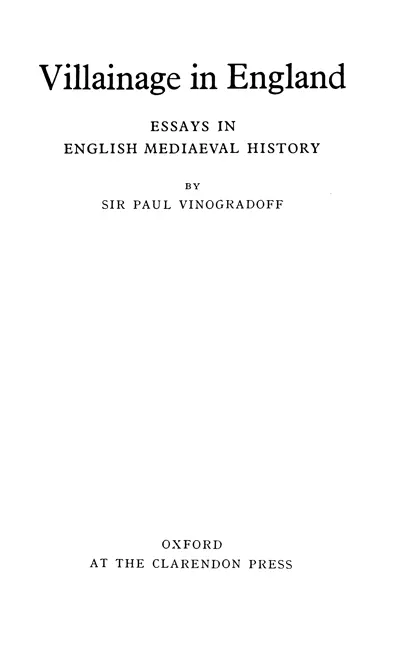
"Villainage in England: Essays in English Mediaeval History" by Sir Paul Vinogradoff is a scholarly historical account written in the late 19th century. The book delves into the complex social structures and legal status of the peasantry during the feudal period in England, particularly focusing on the concept of villainage, a form of servitude distinct from slavery. It examines the rights, disabilities, and socio-economic conditions of villains, offering a comprehensive analysis of how these factors shaped medieval agrarian society. The opening of the book presents a detailed preface where the author discusses his motivations for exploring such a nuanced topic as English social history, framed in the context of his Russian background. He articulates the significance of studying historical documents to uncover the dynamics of social classes, especially the relationship between lords and their peasant subjects. Vinogradoff emphasizes the importance of legal frameworks that defined villainage, arguing that understanding these relationships provides valuable insights into the broader historical narrative of agrarian development and social organization in medieval England. The initial portion sets the stage for an in-depth exploration of the peasantry's legal and economic positions, showcasing a methodical approach to historical inquiry that anticipates the detailed essays that follow.
Introduction adapted from the source catalogue; source summaries may be automatically generated.
Free to read · English · 173,596 words · No account needed
MAKE TIME FOR A GOOD BOOK
On by default. Untick to stop anonymous reading totals. Each page counts after 10 seconds in view. How this works.
Anonymous counting is on unless you have switched it off.
[609] Black Book of St. Augustine's, Cotton MSS. Faustina, A. 1, f. 186: 'Nihil debent averare ad tunc, nisi res que sunt ad opus conventus et que poni debent super ignem.'
[610] Glastonbury Inqu. of 1189, f. 65: 'W. Sp. tenet unum fordil pro 15 den. et operatur quolibet die lune per totum annum et (debet) ladiare cum alio ferdilario sicut dimidii virgatarii.' Domesday of St. Paul's, 19: 'Omnes isti (cotarii) debent operari semel ... Debent eciam portare et chariare.'
[611] Rot. Hundr. ii. 605, b: 'Et faciet averagium super dorsum suum ad
voluntatem domini.'
[612] Glastonbury Inqu. of 1189, f. 71: 'Portat et fugat aucas, et gallinas, et porcos Glastonie.' Domesday of St. Paul's, 27: '(Cotarii) isti debent singulis diebus Lune unam operacionem et portare et fugare porcos Londoniam.'
[613] Gloucester Cart. iii. 218: 'Item, quod nullus prepositus aliquid ab aliquo recipiat, ut ipsum ad firmam esse permittat vel ad levem ponat operationem mutando cariagia summagia debita in operibus manualibus.'
[614] See, for instance, Glastonbury Inqu. of 1189, pp. 22, 29; Gloucester Cart. iii. 17; Domesday of St. Paul's, 54.
[615] Cart. of Bury St. Edmunds, Harl. MSS. 3977, f. 82: '(Debet) metere pro porcis quilibet dimidiam acram siliginis.'
[616] Black Book of St. Augustine's, Cotton MSS. Faustina, A. 1, f. 44: 'Aratum hominum de N.' Cartul. of Battle, Augm. Off. Miscell. Books, N. 18, f. 2, a: 'Forinseca servicia ... arant ... seminant.'
[617] Domesday of St. Paul's, 38: '... et furem captum in curia custodiet et iudicatum suspendet et sparget fimum ad cibum domini.' Ibid. 62: 'G.G. tenet 5 acras ... (debet) qualibet septimana 2 opera et sequitur precarias in autumpno ... R.H. 5 acras per idem servicium et preterea defendit eas versus regem.'
[618] Gloucester Cart. iii. 54: 'Debet a festo S^{ti} Michaelis usque ad festum S^{ti} Petri ad Vincula qualibet septimana per 4 dies operari opus manuale cum uno homine, et valet quolibet dieta obolum.' Glastonbury Inqu. 28: 'Si est ad opus a festo S^{ti} Petri ad Vincula usque ad festum S^{ti} Michaelis nisi festum intercurrat qualibet die faciet unam dainam.'
[619] Add. MSS. 6159, f. 25, a; 53, b.
[620] Domesday of St. Paul's, 33: 'Singule virgate debent per annum ... de gavelsed 3 mensuras quarum 7 faciunt mensuram de Colcester.' Black Book of St. Augustine's, Cotton MSS., Faustina, A. i, 31, d: 'Sunt praeterea 5 sullungi et 50 acre in eadem hamiletto qui debent bladum de gabulo.'
[621] Domesday of St. Paul's, 6: 'Et unum quarterium de auena ad
foddercorn.'
[622] Add. MSS. 6159, 26, b: 'Et de gadercorn reddunt de quolibet swlinge 4 coppas de puro ordeo et de presenti gallum et gallinam de qualibet domo ... quas serviens curie debet circumeundo querere.'
[623] Ely Inqu., Cotton MSS., Claudius, C. xi. 185, b; Bury St. Edmunds Cart., Harl. MSS. 3977, f. 84, b.
Your reading position is saved on this browser. Take it to another device with a library code. Reading pages adapt to text, rather than matching a printed edition.
BEHIND THE BOOK
This eBook is for the use of anyone anywhere in the United States and most other parts of the world at no cost and with almost no restrictions whatsoever. You may copy it, give it away or re-use it under the terms of the Project Gutenberg License included with this eBook or online at www.gutenberg.org. If you are not located in the United States, you will have to check the laws of the country where you are located before using this eBook. Read the source licence.
The original source file, including credits and licence, is retained by this library. Request an original-format copy at no charge. Please include the book title and Project Gutenberg identifier #38876.
KEEP YOUR CURIOSITY GOING
Cécile Tormay

Moritz Busch
John L. Ransom
Frances Wright
Cécile Tormay

Mabel Potter Daggett