THE CLASSIC COLLECTION✦An outlaw’s diary: the CommuneCLASSIC FREE BOOKS
An outlaw’s diary: the Commune
Cécile Tormay
THE CLASSIC COLLECTION · 1892
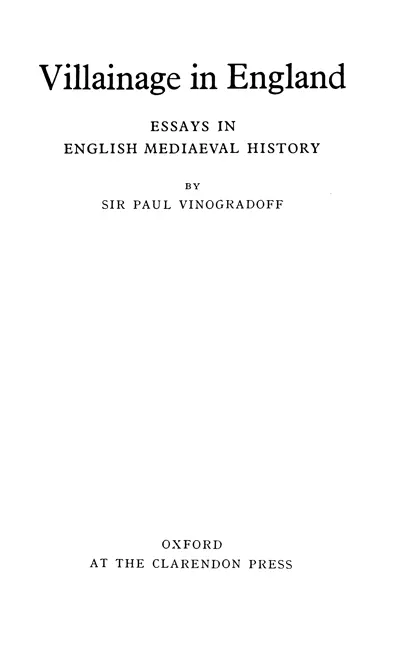
"Villainage in England: Essays in English Mediaeval History" by Sir Paul Vinogradoff is a scholarly historical account written in the late 19th century. The book delves into the complex social structures and legal status of the peasantry during the feudal period in England, particularly focusing on the concept of villainage, a form of servitude distinct from slavery. It examines the rights, disabilities, and socio-economic conditions of villains, offering a comprehensive analysis of how these factors shaped medieval agrarian society. The opening of the book presents a detailed preface where the author discusses his motivations for exploring such a nuanced topic as English social history, framed in the context of his Russian background. He articulates the significance of studying historical documents to uncover the dynamics of social classes, especially the relationship between lords and their peasant subjects. Vinogradoff emphasizes the importance of legal frameworks that defined villainage, arguing that understanding these relationships provides valuable insights into the broader historical narrative of agrarian development and social organization in medieval England. The initial portion sets the stage for an in-depth exploration of the peasantry's legal and economic positions, showcasing a methodical approach to historical inquiry that anticipates the detailed essays that follow.
Introduction adapted from the source catalogue; source summaries may be automatically generated.
Free to read · English · 173,596 words · No account needed
MAKE TIME FOR A GOOD BOOK
On by default. Untick to stop anonymous reading totals. Each page counts after 10 seconds in view. How this works.
Anonymous counting is on unless you have switched it off.
[552] Bracton, f. 226, b: 'Item dicere potest quod nulla communia pertinet ad tale tenementum, quia illud fuit aliquando foresta, boscus, et locus vastae solitudinis et communia, et iam inde efficitur assartum, vel redactum est in culturam, et non debet communia pertinere ad communiam, et ubi omnes de patria solebant communicare.'
[553] Bracton, f. 229, a: 'Hoc non erit intelligendum quod omni tempore, nisi tantum temporibus competentibus, scilicet post blada asportata et fena levata, vel quando tenementum iacet incultum et ad waractum.'
[554] Bracton, f. 228, b: 'Item eodem modo si ita feoffatus fuerit quis, sine expressione numeri vel generis, sed ita, cum pastura quantum pertinet ad tantum tenementum in eadem villa, talem ligat constitutio sicut prius cum expressione: quia cum constet de quantitate tenementi, de facili perpendi poterit de numero aueriorum, et etiam de genere, secundum consuetudinem locorum.'
[555] Scrutton, 55.
[556] Cartulary of Christ Church, Harl. MSS. 1006, p. 3: 'Prior et conventus est capitalis dominus commune pasture de B.'
[557] Ely Cart., Cotton MSS. Claudius, xi, f. iii, a: 'In L. debet villata communicare cum suis averiis propriis cum domino Episcopo. Et si dominus voluerit, ibidem possunt habere extranei bestias pro denariis. Set inde habebunt liberi homines de W. quemlibet septimum denarium preter decimum.'
[558] Registrum cellararii of Bury St. Edmunds, Cambr. Univ., Gg. iv. 4, f. 31, b: 'Et notandum quod inquisitio super calumpnia Egidii de Neketona clamantis quod abbas non haberet communam infra precinctum villate de Bertone scribitur in forma (tali),' etc.
[559] Cart. of Christ Church, Canterbury, Add. MSS. 6159, f. 21, b: 'Sciendum quod dominus potest habere in communia pasture de bosco cum aisiamento friscorum et dominicorum domini tempore apto e bidentes per maius centum.'
[560] Bracton, f. 228, b: 'Inprimis videndum est qualiter constitutio illa sit intelligenda, ne male intellecta trahat utentes ad abusum ... non omnes nec in omnibus per constitutionem restringuntur, et ideo videndum erit utrum feoffati fuerint large, scilicet per totum, et ubique, et in omnibus locis, et ad omnia averia et sine numero ... tales non ligat constitutio memorata, quia feoffamentum non tollit licet tollat abusum.'
[561] Note-book of Bracton, 1975.
[562] Note-book of Bracton, 1881. The marginal note runs: 'Nota quod nichil includi poterit de forestis et moris licet minimum quid et quamuis quaerens extra clausum habere possit ad sufficientiam.' And a little higher the decision is marked as 'contra constitutionem de Merton.'
[563] See Scrutton, 63, 64.
Your reading position is saved on this browser. Take it to another device with a library code. Reading pages adapt to text, rather than matching a printed edition.
BEHIND THE BOOK
This eBook is for the use of anyone anywhere in the United States and most other parts of the world at no cost and with almost no restrictions whatsoever. You may copy it, give it away or re-use it under the terms of the Project Gutenberg License included with this eBook or online at www.gutenberg.org. If you are not located in the United States, you will have to check the laws of the country where you are located before using this eBook. Read the source licence.
The original source file, including credits and licence, is retained by this library. Request an original-format copy at no charge. Please include the book title and Project Gutenberg identifier #38876.
KEEP YOUR CURIOSITY GOING
Cécile Tormay

Moritz Busch
John L. Ransom
Frances Wright
Cécile Tormay

Mabel Potter Daggett