THE CLASSIC COLLECTION✦An outlaw’s diary: the CommuneCLASSIC FREE BOOKS
An outlaw’s diary: the Commune
Cécile Tormay
THE CLASSIC COLLECTION · 1892
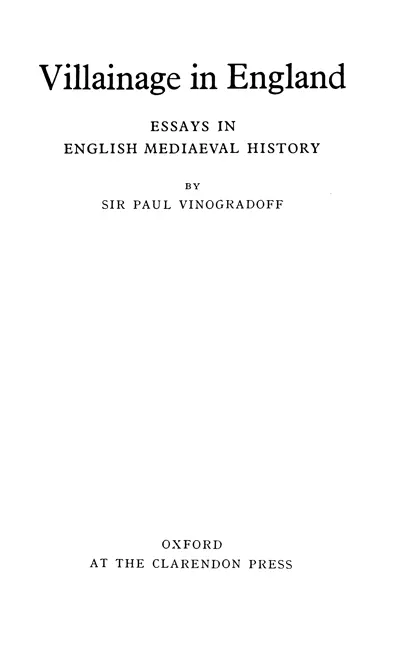
"Villainage in England: Essays in English Mediaeval History" by Sir Paul Vinogradoff is a scholarly historical account written in the late 19th century. The book delves into the complex social structures and legal status of the peasantry during the feudal period in England, particularly focusing on the concept of villainage, a form of servitude distinct from slavery. It examines the rights, disabilities, and socio-economic conditions of villains, offering a comprehensive analysis of how these factors shaped medieval agrarian society. The opening of the book presents a detailed preface where the author discusses his motivations for exploring such a nuanced topic as English social history, framed in the context of his Russian background. He articulates the significance of studying historical documents to uncover the dynamics of social classes, especially the relationship between lords and their peasant subjects. Vinogradoff emphasizes the importance of legal frameworks that defined villainage, arguing that understanding these relationships provides valuable insights into the broader historical narrative of agrarian development and social organization in medieval England. The initial portion sets the stage for an in-depth exploration of the peasantry's legal and economic positions, showcasing a methodical approach to historical inquiry that anticipates the detailed essays that follow.
Introduction adapted from the source catalogue; source summaries may be automatically generated.
Free to read · English · 173,596 words · No account needed
MAKE TIME FOR A GOOD BOOK
On by default. Untick to stop anonymous reading totals. Each page counts after 10 seconds in view. How this works.
Anonymous counting is on unless you have switched it off.
[466] Some of these expressions are interesting. Balk is the O.N. balkr; gora is the spear-head or its long triangular shape, O.E. gar, O.N. geirr. These linguistic affinities have been pointed out to me by Mr. F. York Powell.
[467] Alvingham Priory Cart., Laud MSS. 642 (Bodleian), f. 12. Cf. Malmesbury Cart. ii. 294; Madox, History of the Exchequer, 258.
[468] Eynsham Cart., 5, a: 'I.I. virgatarius ... Idem tenet unam selionem terre apud Blakelond non mensuratam.'
[469] Domesday of St. Paul's, 11: 'Laurencius de hospitale dimidiam virgatam pro 40 denariis; tres acre quas tenuit Laurencius sine servicio inveniri non possunt.'
[470] Dunstable Priory Cart., Harleian MSS. 1885, f. 7, d. See Appendix
xiii.
[471] Elton, English Historical Review, i. 435.
[472] The expressions are not identical, but they ought both to
correspond to the ploughteam.
[473] As to all this, see Seebohm, Village Community.
[474] Glastonbury Inqu. (Roxburghe Ser.), 144. v. Hide, virgate.
[475] Eynsham Cart., 4, a.
[476] Domesday of St. Paul's: 'Manerium istud secundum dictum juratorum continet octo hidas, et hida continet sexcies viginti acras, set antiqua inquisicio dixit, quod non consuevit continere nisi quater viginti, quia postmodum exquisite sunt terre et mensuratae.'
[477] Inqu. post mort. 30 Henry III, N. 36: 'Extensio de terris Roberti de Sancto Georgio (in com. Lincoln.) ... tenuit in capite de domino Rege 20 bovatas terre et dimidiam pro servicio sexte partis unius feodi militis.... Et Robertus de Drayton tenet 2 bovatas et quartam partem unius bovate terre de dicto Roberto per forinsecum servicium tantum, unde 16 carucate terre faciunt feodum militis.'
[478] Rot. Hundred. ii. 631, b: '... et ad dictam villam pertinent sex hide quarum quelibet continet 6 virgatas terre et quelibet virgata continet 30 acras.' Ramsey Survey, Galba, E. x. 41: 'In una hydarum istarum ... septem virgatae 4 acris minus.' Eynsham Cart., 21, a: 'Et abbas habet in eodem manerio 4 carucatas terre et continent 16 virgatas terre in dominico et in villenagio 16 virgatas terre.'
[479] Ramsey Cart. (Rolls Ser.), i. 55, 284, 295, 309, 333, 373, 380; Ely Inqu., Claudius, xi. 82, 95, 97, 121, 129, 186; Gloucester Cart., iii. 128, 142, 145, 196; Coram Rege, Hill. 3 Edw. I, 17, b; Eynsham Cart., 11, a; 88, a; Rot. Hundr., ii. 605, b.
[480] Chapter-house Boxes, A. 4/22, m. 31-33.
[481] Ramsey Cart. (Rolls Ser.), i. 354: 'Aliquando 48 acre faciunt virgatam et aliquando pauciores.'
[482] Rot. Hundr., ii. 628, b.
[483] Glastonbury Inqu. (Roxburghe Ser.), 134: '... R. de W. unam virgatam pro 4 solidis pro omni servicio quia terra parva est.'
[484] Ibid., 113: 'Super hanc virgatam terre fuerunt olim 2 domus et pro duabus virgatis computata fuit terra illa, sed quia non potuerant 2 homines ibi vivere, redacte ille 2 virgate ad unam, et sicut audierant dicere 7 solidi reddebantur, sed nunquam hoc viderunt et facit idem servitium quod alii faciunt virgarii.'
[485] O.C. Pell in the Transactions of the Cambridge Archaeological Society, vi. 17 sqq., 63 sqq.
[486] Ely Inqu., Claudius, C xi. 30, a.
Your reading position is saved on this browser. Take it to another device with a library code. Reading pages adapt to text, rather than matching a printed edition.
BEHIND THE BOOK
This eBook is for the use of anyone anywhere in the United States and most other parts of the world at no cost and with almost no restrictions whatsoever. You may copy it, give it away or re-use it under the terms of the Project Gutenberg License included with this eBook or online at www.gutenberg.org. If you are not located in the United States, you will have to check the laws of the country where you are located before using this eBook. Read the source licence.
The original source file, including credits and licence, is retained by this library. Request an original-format copy at no charge. Please include the book title and Project Gutenberg identifier #38876.
KEEP YOUR CURIOSITY GOING
Cécile Tormay

Moritz Busch
John L. Ransom
Frances Wright
Cécile Tormay

Mabel Potter Daggett