THE CLASSIC COLLECTION✦An outlaw’s diary: the CommuneCLASSIC FREE BOOKS
An outlaw’s diary: the Commune
Cécile Tormay
THE CLASSIC COLLECTION · 1892
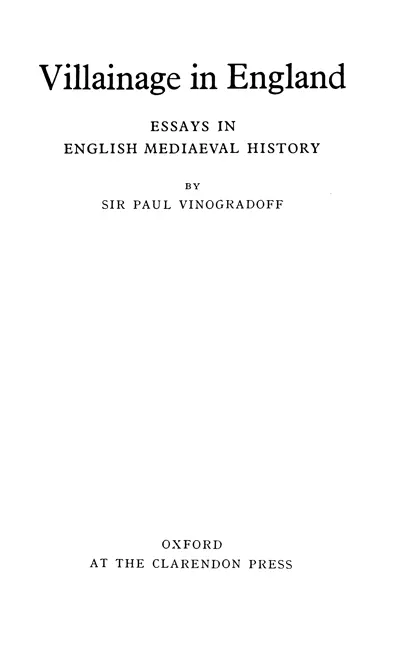
"Villainage in England: Essays in English Mediaeval History" by Sir Paul Vinogradoff is a scholarly historical account written in the late 19th century. The book delves into the complex social structures and legal status of the peasantry during the feudal period in England, particularly focusing on the concept of villainage, a form of servitude distinct from slavery. It examines the rights, disabilities, and socio-economic conditions of villains, offering a comprehensive analysis of how these factors shaped medieval agrarian society. The opening of the book presents a detailed preface where the author discusses his motivations for exploring such a nuanced topic as English social history, framed in the context of his Russian background. He articulates the significance of studying historical documents to uncover the dynamics of social classes, especially the relationship between lords and their peasant subjects. Vinogradoff emphasizes the importance of legal frameworks that defined villainage, arguing that understanding these relationships provides valuable insights into the broader historical narrative of agrarian development and social organization in medieval England. The initial portion sets the stage for an in-depth exploration of the peasantry's legal and economic positions, showcasing a methodical approach to historical inquiry that anticipates the detailed essays that follow.
Introduction adapted from the source catalogue; source summaries may be automatically generated.
Free to read · English · 173,596 words · No account needed
MAKE TIME FOR A GOOD BOOK
On by default. Untick to stop anonymous reading totals. Each page counts after 10 seconds in view. How this works.
Anonymous counting is on unless you have switched it off.
[410] I may be excused for again referring to the Stoneleigh Reg. f. 32, d: 'Quidam tenentes eiusdem manerii tenent terras et tenementa sua in Sokemannia in feodo et hereditate de qua quidem tenura talis habetur et omne tempore habebatur consuetudo videlicet quod quando aliquis tenens eiusdem tenure terram suam alicui alienare voluerit veniat in curiam coram ipso Abbate vel eius senescallo et per vergam sursum reddat in manum domini terram sic alienandam ad opus illius qui terram illam optinebit ... Et si aliquis terram aliquam huiusmodi tenure infra manerium predictum per cartam vel sine carta absque licentia dicti Abbatis alienaverit aliter quam per sursum reddicionem in curia in forma predicta, quod terra sic extra curia alienata domino dicti manerii erit forisfacta in perpetuum.'
[411] Madox, Exch. i. 724, e: 'Monstraverunt Regi homines et tenentes de soca de Oswald Kirke in Com. Nottinghamiae, quod cum soka illa dudum fuisset antiquum dominicum coronae Angliae et dominus Henricus quondam Rex Angliae progenitor Regis socam illam cum pertinenciis dedisset et concessisset Henrico de Hastyngges habendam et tenendam ad communem legem ... Ac licet homines et tenentes predicti et antecessores sui homines et tenentes de soca illa inter homines communitatis comitatus Nottinghamiae et non cum tenentibus de antiquis dominicis Coronae Regis a tempore escambii predicti talliari consueverunt, assessores tamen tallagii Regis in dominicis in Comitatu Nottinghamiae praedicto ... (eos) una cum illis de dominicis Regis praedictis talliari fecerunt.' Cf. 428, b, c.
[412] Rot. Hundr. ii. 608, a: 'Liberi tenentes ... liberi sokemanni.'
Cf. 752, a.
[413] Inquisit. post mortem 53 Henry III, n. 4 (Record Office): 'Libere tenentes ad voluntatem ... libere tenentes in socagio ... libere tenentes per cartam.' Rot. Hundr. ii. 471, a. See Appendix xii.
[414] Warwicksh. Hund. Roll. Q.R. Misc. books, xxix. p. 44, b: '(tenens) per antiquam tenuram sine carta.' Gloucester Cart. iii. 67: 'de liberis tenentibus dicunt quod haeredes O.G. tenent tres virgatas terrae de antiqua tenura.' Cf. iii. 47, 69. Christ Church Cart., Canterbury, Add. MSS. 6159, p. 70: 'isti tenent antiquo dominico ... isti tenent antiquum tenementum ... inferius notati sunt operarii.' Domesday of St. Paul's, 46, 47: 'de antiqua hereditate.' Cf. Pollock, Land-laws (2nd ed), p. 209.
[415] Rot. Hundr. ii. 501, b.
[416] Rot Hundr. ii. 774.
[417] Coram Rege, Hill. 30 Edw. I, m. 17 '(servicia sokemannorum) ...
merchet ad voluntatem.'
[418] Rot. Hundr. ii. 846, a.
[419] Rot. Hundr. ii. 781, b.
[420] Peterborough Cart., Cotton MSS., Faustina, B. iii. f. 97, 98.
[421] Spalding Priory Cart., Cole MSS., xliii. p. 296.
[422] Rot. Hundr. ii. 780 b.
[423] Spalding Cart. p. 295.
[424] Ibid. p. 283: 'bondus dat auxilium ... scil. omnes sokemanni
unam marcam.' Cf. 292.
[425] Ely Inqu., Cotton MS., Claudius, C. xi. 50, b: 'Tota villata tam liberi, quam alii debent facere 40 perticatas super Calcetum de Alderhe [Aldreth's Causeway] sine cibo et opere.' Cf. Domesday of St. Paul's, 75.
[426] Domesday of St. Paul's, 76, 77; Rot. Hundr. ii. 764, b.
Your reading position is saved on this browser. Take it to another device with a library code. Reading pages adapt to text, rather than matching a printed edition.
BEHIND THE BOOK
This eBook is for the use of anyone anywhere in the United States and most other parts of the world at no cost and with almost no restrictions whatsoever. You may copy it, give it away or re-use it under the terms of the Project Gutenberg License included with this eBook or online at www.gutenberg.org. If you are not located in the United States, you will have to check the laws of the country where you are located before using this eBook. Read the source licence.
The original source file, including credits and licence, is retained by this library. Request an original-format copy at no charge. Please include the book title and Project Gutenberg identifier #38876.
KEEP YOUR CURIOSITY GOING
Cécile Tormay

Moritz Busch
John L. Ransom
Frances Wright
Cécile Tormay

Mabel Potter Daggett