THE CLASSIC COLLECTION✦An outlaw’s diary: the CommuneCLASSIC FREE BOOKS
An outlaw’s diary: the Commune
Cécile Tormay
THE CLASSIC COLLECTION · 1892
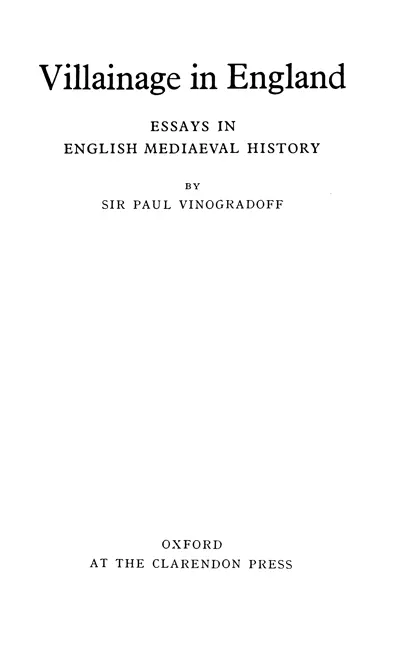
"Villainage in England: Essays in English Mediaeval History" by Sir Paul Vinogradoff is a scholarly historical account written in the late 19th century. The book delves into the complex social structures and legal status of the peasantry during the feudal period in England, particularly focusing on the concept of villainage, a form of servitude distinct from slavery. It examines the rights, disabilities, and socio-economic conditions of villains, offering a comprehensive analysis of how these factors shaped medieval agrarian society. The opening of the book presents a detailed preface where the author discusses his motivations for exploring such a nuanced topic as English social history, framed in the context of his Russian background. He articulates the significance of studying historical documents to uncover the dynamics of social classes, especially the relationship between lords and their peasant subjects. Vinogradoff emphasizes the importance of legal frameworks that defined villainage, arguing that understanding these relationships provides valuable insights into the broader historical narrative of agrarian development and social organization in medieval England. The initial portion sets the stage for an in-depth exploration of the peasantry's legal and economic positions, showcasing a methodical approach to historical inquiry that anticipates the detailed essays that follow.
Introduction adapted from the source catalogue; source summaries may be automatically generated.
Free to read · English · 173,596 words · No account needed
MAKE TIME FOR A GOOD BOOK
On by default. Untick to stop anonymous reading totals. Each page counts after 10 seconds in view. How this works.
Anonymous counting is on unless you have switched it off.
[319] Worcester Cartulary (Camden Series), 102: 'De antiquis consuetudinibus villanorum, quaelibet etiam virgata dabit iii heriet, sc. equum cum hernesio et duos boves, et dimidia virgata duos heriet, sc. equum cum hernesio et bovem. Alii autem dabunt equum vel bovem.'
[320] Glastonbury Inqu. (Roxburghe Series), 89, a: 'Item non vendet bovem vel equum de sua nutritura sine licencia domini, nec coronare faciet filium nec maritabit filiam sine licencia domini, dabit heriettum melius animal, faciet finem cum domino pro ingressu habendo ad voluntatem domini communiter per 40 solidos et omnia alia faciet que nativo incumbunt.' The relief ought to be discussed in connexion with the obligations of the holding. I speak of it here because the documents mention it almost always with the heriot.
[321] Cartulary of St. Mary of Beaulieu, Nero, A. xx. f. 84, b: 'Pro filio coronando, filia maritanda, fine terre ... secundum qualitatem personarum et quantitatem substancie et terre.'
[322] Rot. Hundred. ii. 747, a: 'Debet talliari ad voluntatem domini
quolibet anno.'
[323] Ibid. ii. 528, b: 'Et debet talliari ad voluntatem domini semel in anno et debet gersummare filiam et fieri prepositus ad voluntatem domini.'
[324] Cartulary of Battle, Augment. Off. Misc. Books, No. 57, f. 93, a: 'Amerciamenta tenentium, qui redditum tempore statuto non persoluerunt.' Reg. Cellararii of Bury St. Edmund's, Cambridge Univ., Gg. iv. 4. 52, b; cf. Eynsham Inqu. ii. a: (Inquisitio de statu villani): 'Subtraxerunt sectam curie a longo tempore dicendo se esse liberos.'
[325] Formulary of St. Alban's, Cambridge Univ., Ee. iv. 20, f. 165, a: 'Servilia--videlicet secta curie de tribus septimanis in tres et secta molendini.' We find it denied in the king's court that a free man can be bound to do suit to the lord's mill; Bracton's Note-book, p. 161: 'Nota quod liber homo non tenetur sequi molendinum domini sui nisi gratis velit.'
[326] Bury St. Edmund's, Registrum album, Cambridge Univ., Ee. iii. 60, f. 155, b: 'Liberi excepti a falda domini.'
[327] As to Scotale, see Stubbs, Const. Hist. Sec. 165.
[328] Reg. Cellararii of Bury St. Edmund's, Cambridge Univ., Gg. iv. 4. 30, b: 'Per fidelitatem custumarii ... et per alias consuetudines serviles.'
[329] Y.B. 20/21 Edward I, p. 41: 'Kar nent plus neit a dire, Jeo tenk les tenements en vileynage, ke neit a dire ke, Jeo tenk les tenements demendez ver moy a la volunte le Deen,' etc. See above, Chapter II.
[330] Chron. Mon. de Abingdon, ii. 25 (Rolls Series).
[331] Exch. Q.R., Misc. Books, No. 29, f. 8, a: 'Habet 22 servos tenentes 35 acras terre ad voluntatem domini in servagio.' f. 10, b: 'Habet ibidem 25 servos tenentes 12 virgatas terre et dimidiam in servagio ... et possunt omnes removeri pro voluntate domini.'
Your reading position is saved on this browser. Take it to another device with a library code. Reading pages adapt to text, rather than matching a printed edition.
BEHIND THE BOOK
This eBook is for the use of anyone anywhere in the United States and most other parts of the world at no cost and with almost no restrictions whatsoever. You may copy it, give it away or re-use it under the terms of the Project Gutenberg License included with this eBook or online at www.gutenberg.org. If you are not located in the United States, you will have to check the laws of the country where you are located before using this eBook. Read the source licence.
The original source file, including credits and licence, is retained by this library. Request an original-format copy at no charge. Please include the book title and Project Gutenberg identifier #38876.
KEEP YOUR CURIOSITY GOING
Cécile Tormay

Moritz Busch
John L. Ransom
Frances Wright
Cécile Tormay

Mabel Potter Daggett