THE CLASSIC COLLECTION✦An outlaw’s diary: the CommuneCLASSIC FREE BOOKS
An outlaw’s diary: the Commune
Cécile Tormay
THE CLASSIC COLLECTION · 1892
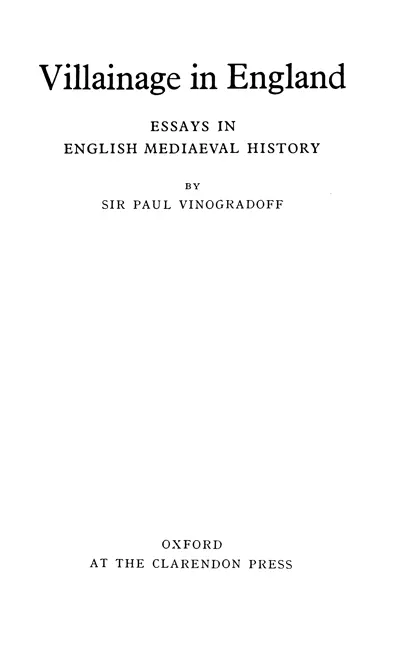
"Villainage in England: Essays in English Mediaeval History" by Sir Paul Vinogradoff is a scholarly historical account written in the late 19th century. The book delves into the complex social structures and legal status of the peasantry during the feudal period in England, particularly focusing on the concept of villainage, a form of servitude distinct from slavery. It examines the rights, disabilities, and socio-economic conditions of villains, offering a comprehensive analysis of how these factors shaped medieval agrarian society. The opening of the book presents a detailed preface where the author discusses his motivations for exploring such a nuanced topic as English social history, framed in the context of his Russian background. He articulates the significance of studying historical documents to uncover the dynamics of social classes, especially the relationship between lords and their peasant subjects. Vinogradoff emphasizes the importance of legal frameworks that defined villainage, arguing that understanding these relationships provides valuable insights into the broader historical narrative of agrarian development and social organization in medieval England. The initial portion sets the stage for an in-depth exploration of the peasantry's legal and economic positions, showcasing a methodical approach to historical inquiry that anticipates the detailed essays that follow.
Introduction adapted from the source catalogue; source summaries may be automatically generated.
Free to read · English · 173,596 words · No account needed
MAKE TIME FOR A GOOD BOOK
On by default. Untick to stop anonymous reading totals. Each page counts after 10 seconds in view. How this works.
Anonymous counting is on unless you have switched it off.
[302] Gloucester Cartulary (Rolls Series), iii. 218: 'Item quod non permittitur, quod aliquis vendat equum masculum vel bovem sibi vitulatum sine licentia, nisi consuetudo se habeat in contrarium.' Rot. Hundred. ii. 628, a: 'Si habeat equum pullanum, bovem vel vaccam ad vendendum, dominus propinquior erit omnibus aliis et vendere non debent sine licentia domini.' Rochester Cartulary (ed. Thorpe), 2, a: 'Si quis habuerit pullum de proprio jumento aut vitulum de propria vacca et pervenerit ad perfectam etatem, non poterit illos vendere, nisi prius ostendat domino suo et sciat utrum illos velit emere sicut alios.' Rot. Hundred. ii. 463, a: 'Item si ipse habeat pullum vel boviculum et laboraverit cum illo non potest vendere sine licentia domini, sed si non laboraverit licitum.'
[303] Cartulary of St. Mary of Beaulieu, Nero, A. xii. f. 93. b: 'Pro filio coronando et pro licencia recedendi faciet sicut illi.' Cartulary of St. Peter of Gloucester (Rolls Series), iii. 218: 'Item quod nullo masculo tribuatur licentia recedendi a terra domini sine licentia superioris hoc proviso, quod consuetudines a servis dominus debitas ad plenum recipiat, contradicentes attachiando ut inde respondeant ad curiam.'
[304] Duchy of Lancaster Court Rolls, Bundle 85, No. 1157 (Record Office): 'Et quia non sunt residentes dant chevagium.' Lancaster Court Rolls, Bundle 62, No. 750, m. 1: 'Johannes le Grust dat comiti ii solidos et ii capones ut possit manere ubi sibi placuerit.'
[305] Lancaster Court Rolls, Bundle 62, No. 750, m. 3: 'Capones de reditu ut custumarii possint manere super terram Radulfi de Wernore sed dictus Will. erit in visu franciplegii dom. comitis.'
[306] Suffolk Court Rolls (Bodleian), 3: 'Preceptum inquirere nomina eorum qui terram servilem vendiderunt per cartam et quibus, et qui sunt qui terram liberam adquisierunt et ibi resident et prolem suscitant et ob hoc libertatem sibi vindicant.' Cartulary of St. Alban's, 454: 'Ubi villani emunt terras liberorum de catallis nostris.'
[307] Cart. Glouc. (Rolls Ser.), iii. 217: 'Item, inhibeatur nativis domini manerii ne aliquid alicui dent per annum in recognitione, ut aliquo gaudeant patrocinio.'
[308] Lancaster Court Rolls, Bundle 62, No. 756, m. 1: 'Nativus receptatus apud Latfeld sine licentia domini.'
[309] Cartulary of Shaftesbury, Harl. MSS. 61, f. 59: 'Fugitivi domine, R. fil. Al. manet in Br. sub Willelmo.' Ramsey Inqu., Galba E. x. f. 27, b: 'Isti sunt nativi abbatis: E. et O. manent apud Gomcestre.' Ibid. 51: 'A. est nativus domini abbatis, sed dicit se esse hominem episcopi.' Cartulary of Shaftesbury, Harl. MSS. 61, f. 59: 'Nicholaus habet 4 nativos domine, partim terram tenentes in calumpnia domine partim super terram Nicholai.'
[310] Coram Rege, Pasch. 7 Edw. I, m. 7: 'Villanus fugitivus an in villenagio tenens et adventicius.'
[311] Eynsham Inqu. (Chapter of Christ Church, Oxford), 25, a: 'Quas Adam pater ipsius adquisivit et quia quicquid servis adquiritur domino adquiritur faciat inde dominus quod sibi videatur expediens.'
Your reading position is saved on this browser. Take it to another device with a library code. Reading pages adapt to text, rather than matching a printed edition.
BEHIND THE BOOK
This eBook is for the use of anyone anywhere in the United States and most other parts of the world at no cost and with almost no restrictions whatsoever. You may copy it, give it away or re-use it under the terms of the Project Gutenberg License included with this eBook or online at www.gutenberg.org. If you are not located in the United States, you will have to check the laws of the country where you are located before using this eBook. Read the source licence.
The original source file, including credits and licence, is retained by this library. Request an original-format copy at no charge. Please include the book title and Project Gutenberg identifier #38876.
KEEP YOUR CURIOSITY GOING
Cécile Tormay

Moritz Busch
John L. Ransom
Frances Wright
Cécile Tormay

Mabel Potter Daggett