THE CLASSIC COLLECTION✦An outlaw’s diary: the CommuneCLASSIC FREE BOOKS
An outlaw’s diary: the Commune
Cécile Tormay
THE CLASSIC COLLECTION · 1892
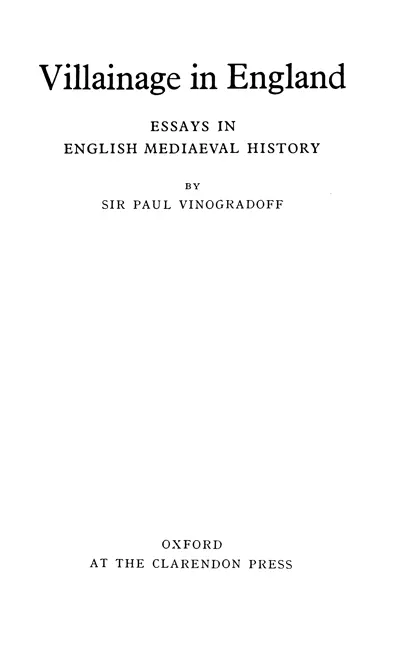
"Villainage in England: Essays in English Mediaeval History" by Sir Paul Vinogradoff is a scholarly historical account written in the late 19th century. The book delves into the complex social structures and legal status of the peasantry during the feudal period in England, particularly focusing on the concept of villainage, a form of servitude distinct from slavery. It examines the rights, disabilities, and socio-economic conditions of villains, offering a comprehensive analysis of how these factors shaped medieval agrarian society. The opening of the book presents a detailed preface where the author discusses his motivations for exploring such a nuanced topic as English social history, framed in the context of his Russian background. He articulates the significance of studying historical documents to uncover the dynamics of social classes, especially the relationship between lords and their peasant subjects. Vinogradoff emphasizes the importance of legal frameworks that defined villainage, arguing that understanding these relationships provides valuable insights into the broader historical narrative of agrarian development and social organization in medieval England. The initial portion sets the stage for an in-depth exploration of the peasantry's legal and economic positions, showcasing a methodical approach to historical inquiry that anticipates the detailed essays that follow.
Introduction adapted from the source catalogue; source summaries may be automatically generated.
Free to read · English · 173,596 words · No account needed
MAKE TIME FOR A GOOD BOOK
On by default. Untick to stop anonymous reading totals. Each page counts after 10 seconds in view. How this works.
Anonymous counting is on unless you have switched it off.
[277] Exch. Q.R. Misc. Alien Priories, 2/2. (Chilteham): '... Redditus villanorum de 126 villanis 41 libre, 14 s. 11 d. Item sunt 70 custumarii qui debent arare bis per annum cum 17 carucis.... Item sunt 25 villani qui debent herciare quilibet eorum per 2 dies,' etc.
[278] Cartulary of St. Peter of Gloucester (Rolls Series), iii. 203: 'Omnes consuetudinarii majores habebunt tempore falcationis prati unum multonem, farinam, et salem ad potagium. Et minores consuetudinarii habebunt quilibet eorum 1 panem et omnes 1 caseum in communi, unam acr. frumenti pejoris campi de dominico et unum carcasium multonis, et unum panem ad Natale.'
[279] Cartulary of Malmesbury (Rolls Series), i. 154, 155. Cf. i. 186, 187. Cartulary of St. Mary of Worcester (Camden Society), 43, b; Rot. Hundred. ii. 775, b.
[280] Rot. Hundred ii. 602, a. Cf. Exch. Q.R. Alien Priories, 2/2: 'Item sunt in eadem villata de Wardeboys 6 dimidias virgatas--que vocantur Akermannelondes, quorum W.L. tenet 1/2 virgatam pro qua ibit ad carucam Abbatis si placeat abbati vel dabit sicut illi qui tenent 6 Maltlondes preter 15 d.' Rot. Hundred, i. 208: 'Utrum akermanni debent servicium suum vel servicii redempcionem.'
[281] Registr. Cellararii of Bury St. Edmund's, Cambridge University, Gg. iv. 4, f. 26: 'Gersumarii (Custumarii).... Gersuma pro filia sua maritanda.' Ibid. 108, b: 'Tenentes 15 acrarum custumarii--omnes sunt gersumarii ad voluntatem domini.' Cartulary of Bury St. Edmund's, Harl. MSS. 3977, f. 87, d: 'Nichol. G gersumarius tenet 30 a. pro 8 sol. que solent esse custumarie.' I may add on the authority of Mr. F. York Powell that landsettus (land-seti), as well as akermannus (aker-maethr) and gersuma (goersemi), are certainly Danish loan-words, which accounts for their occurrence in Danish districts.
[282] Hale, Introduction to the Domesday of St. Paul's, xxv: 'If we compare the services due from the Hidarii with those of the libere tenentes on other manors, it will be evident, that the Hidarii of Adulvesnasa belonged to the ordinary class of villani, their distinction being probably only this, that they were jointly, as well as severally, bound to perform the services due from the hide of which they held part.'
[283] Eynsham Inquest, 49, a: 'Summa (prati) xvi a. et iv perticas que dimidebantur xi virgatariis et rectori ut uni eorum et quia jam supersunt tantummodo 4 virgatarii et rector, dominus habet in manu sua 7 porciones dicti prati.'
[284] Cartulary of Battle, Augmentation Office, Miscell. Books, 57, f. 35, s: 'Yherdlinges ... custumarii.' Ibid. 42, b: 'Majores Erdlinges scil. virgarii. Halferdlinges (majores cottarii) Minores cottarii.'
[285] Black Book of Peterborough, 164: 'In Scotere et in Scaletorp--24 plenarii villani et 2 dimidii villani--Plenarii villani operantur 2 diebus in ebdomada.'
[286] Glastonbury Inqu. (Roxburghe Series), 23: 'Operatur ut alii
ferlingseti.'
Your reading position is saved on this browser. Take it to another device with a library code. Reading pages adapt to text, rather than matching a printed edition.
BEHIND THE BOOK
This eBook is for the use of anyone anywhere in the United States and most other parts of the world at no cost and with almost no restrictions whatsoever. You may copy it, give it away or re-use it under the terms of the Project Gutenberg License included with this eBook or online at www.gutenberg.org. If you are not located in the United States, you will have to check the laws of the country where you are located before using this eBook. Read the source licence.
The original source file, including credits and licence, is retained by this library. Request an original-format copy at no charge. Please include the book title and Project Gutenberg identifier #38876.
KEEP YOUR CURIOSITY GOING
Cécile Tormay

Moritz Busch
John L. Ransom
Frances Wright
Cécile Tormay

Mabel Potter Daggett