THE CLASSIC COLLECTION✦An outlaw’s diary: the CommuneCLASSIC FREE BOOKS
An outlaw’s diary: the Commune
Cécile Tormay
THE CLASSIC COLLECTION · 1892
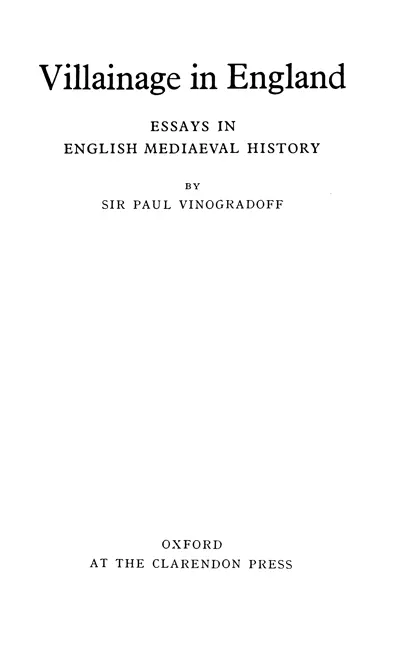
"Villainage in England: Essays in English Mediaeval History" by Sir Paul Vinogradoff is a scholarly historical account written in the late 19th century. The book delves into the complex social structures and legal status of the peasantry during the feudal period in England, particularly focusing on the concept of villainage, a form of servitude distinct from slavery. It examines the rights, disabilities, and socio-economic conditions of villains, offering a comprehensive analysis of how these factors shaped medieval agrarian society. The opening of the book presents a detailed preface where the author discusses his motivations for exploring such a nuanced topic as English social history, framed in the context of his Russian background. He articulates the significance of studying historical documents to uncover the dynamics of social classes, especially the relationship between lords and their peasant subjects. Vinogradoff emphasizes the importance of legal frameworks that defined villainage, arguing that understanding these relationships provides valuable insights into the broader historical narrative of agrarian development and social organization in medieval England. The initial portion sets the stage for an in-depth exploration of the peasantry's legal and economic positions, showcasing a methodical approach to historical inquiry that anticipates the detailed essays that follow.
Introduction adapted from the source catalogue; source summaries may be automatically generated.
Free to read · English · 173,596 words · No account needed
MAKE TIME FOR A GOOD BOOK
On by default. Untick to stop anonymous reading totals. Each page counts after 10 seconds in view. How this works.
Anonymous counting is on unless you have switched it off.
We have seen that it would be impossible to maintain that originally the steward was the only judge of the manorial tribunal; the whole court with its free and unfree suitors participates materially in the administration of justice, and its office is extended to questions of law as well as to issues of fact. On the other hand, it was clear that the steward and the lord were already preparing the position which they ultimately assumed in legal theory, that in the exercise of their functions they were beginning to monopolise the power of ultimate decision and to restrict the court to the duty of preliminary presentment. The same parties are in presence in the court of ancient demesne, but the right of the suitors has been summed up by legal theory in quite the opposite direction. The suitors are said to be the judges there; legal dogmatism has set up its hard and fast definitions, and drawn its uncompromising conclusions as if all the historical facts had always been arrayed against each other without the possibility of common origins and gradual development. Is it necessary to say that the historical reality was very far from presenting that neat opposition? The ancient demesne suitors are villains in the main, though privileged in many respects, and the lord and steward are not always playing such a subordinate part that one may not notice the transition to the state of things that exists in common law manors. It is curious, anyhow, that later jurisprudence was driven to set up as to the ancient demesne court a rule which runs exactly parallel to the celebrated theory that there must be a plurality of free tenants to constitute a manor. Coke expresses it in the following way: 'There cannot be ancient demesne unless there is a court and suitors. So if there be but one suitor, for that the suitors are the judges, and therefore the demandant must sue at common law, there being a failure of justice within the manor[822].' We shall have to speak of this rule again when treating of classes in regard to manorial organisation. But let us notice, even now, that in this view of the ancient demesne court the suitors are considered as the cardinal element of its constitution. The same notion may be found already in trials of the fourteenth and even of the thirteenth century. A curious case is reported in the Year Books of 11/12 Edw. III[823]. Herbert of St. Quentyn brought a writ of false judgment against John of Batteley and his wife, the judgment having been given in the court of Cookham, an ancient demesne manor. The suitors, or suit-holders as they were called there, sent up their record to the King's Bench, and many things were brought forward against the conduct of the case by the counsel for the plaintiff, the defendant trying to shield himself by pleading the custom of the manor to account for all unusual practices. The judges find, however, that one point at least cannot be defended on that ground. The suitors awarded default against the plaintiff because he had not appeared in person before them, and had sent an attorney, who had been admitted by the steward alone and not in full court. Stonor, C.J., remarks, 'that it is against law that the person who holds the court is not suffered to record an attorney for a plea which will be discussed before him.' The counsel for the plaintiff offer to prove that the custom of the manor did not exclude an attorney appointed before the steward, on condition that the steward should tell it to the suitors in the next court after receiving him. The case is interesting, not merely because it exhibits the suit-holders in the undisputed position of judges, but also because it shows the difficulties created by the presence of the second element of the manorial system, the seignorial element, which would neither fit exactly into an entirely communal organisation nor be ousted from it[824]. The difficulty stands quite on the same line with that which meets us in the common law manor, where the element of the communal assessors has been ultimately suppressed and conjured away, as it were, by legal theory. The results are contradictory, but on the same line, as I say. And the more we go back in time, the more we find that both elements, the lord and the community, are equally necessary to the constitution of the court. In the thirteenth century we find already that the manorial bailiffs are made responsible for the judgment along with the suitors and even before them[825].
Your reading position is saved on this browser. Take it to another device with a library code. Reading pages adapt to text, rather than matching a printed edition.
BEHIND THE BOOK
This eBook is for the use of anyone anywhere in the United States and most other parts of the world at no cost and with almost no restrictions whatsoever. You may copy it, give it away or re-use it under the terms of the Project Gutenberg License included with this eBook or online at www.gutenberg.org. If you are not located in the United States, you will have to check the laws of the country where you are located before using this eBook. Read the source licence.
The original source file, including credits and licence, is retained by this library. Request an original-format copy at no charge. Please include the book title and Project Gutenberg identifier #38876.
KEEP YOUR CURIOSITY GOING
Cécile Tormay

Moritz Busch
John L. Ransom
Frances Wright
Cécile Tormay

Mabel Potter Daggett