THE CLASSIC COLLECTION✦An outlaw’s diary: the CommuneCLASSIC FREE BOOKS
An outlaw’s diary: the Commune
Cécile Tormay
THE CLASSIC COLLECTION · 1892
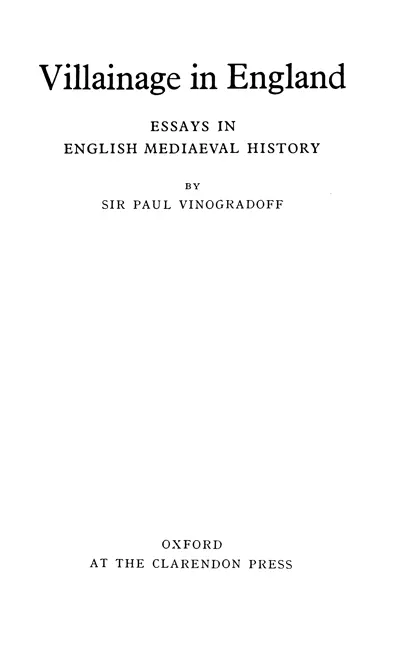
"Villainage in England: Essays in English Mediaeval History" by Sir Paul Vinogradoff is a scholarly historical account written in the late 19th century. The book delves into the complex social structures and legal status of the peasantry during the feudal period in England, particularly focusing on the concept of villainage, a form of servitude distinct from slavery. It examines the rights, disabilities, and socio-economic conditions of villains, offering a comprehensive analysis of how these factors shaped medieval agrarian society. The opening of the book presents a detailed preface where the author discusses his motivations for exploring such a nuanced topic as English social history, framed in the context of his Russian background. He articulates the significance of studying historical documents to uncover the dynamics of social classes, especially the relationship between lords and their peasant subjects. Vinogradoff emphasizes the importance of legal frameworks that defined villainage, arguing that understanding these relationships provides valuable insights into the broader historical narrative of agrarian development and social organization in medieval England. The initial portion sets the stage for an in-depth exploration of the peasantry's legal and economic positions, showcasing a methodical approach to historical inquiry that anticipates the detailed essays that follow.
Introduction adapted from the source catalogue; source summaries may be automatically generated.
Free to read · English · 173,596 words · No account needed
MAKE TIME FOR A GOOD BOOK
On by default. Untick to stop anonymous reading totals. Each page counts after 10 seconds in view. How this works.
Anonymous counting is on unless you have switched it off.
[The rod and the festuca.]
I am even inclined to go further: it seems to me that the manorial ceremony of surrender and admittance, as considered from the point of view of legal archaeology, may have gone back to a practice which has nothing to do with the lord's ownership, although it was ultimately construed to imply this notion. The tenant enfeoffed of his holding on the conditions of base tenure was technically termed tenant by copy of court roll or tenant by the rod--par la verge. This second denomination is connected with the fact that, in cases of succession as well as in those of alienation, the holding passed by the ceremonial action of the steward handing a rod to the person who was to have the land. Now, this formality looks characteristic enough; it is exactly the same as the action of the 'salman' in Frankish law where the transmission of property is effected by the handing of a rod called 'festuca.' The important point is, that the 'salman' was by no means a representative of lordship or ownership, but the necessary middleman prescribed by customary law, in order to give the transaction its consecration against all claims of third persons. The Salic law, in its title 'de affatomire,' presents the ceremony in a still earlier stage: when a man wants to give his property to another, he has to call in a middleman and witnesses; into the hands of this middleman he throws a rod to show that he relinquishes all claim to the property in question. The middleman then behaves as owner and host, and treats the witnesses to a meal in the house and on the land which has been entrusted to him. The third and last act is, that this intermediate person passes on the property to the donee designated by the original owner, and this by the same formal act of throwing the rod[814]. The English practice has swerved from the original, because the office of the middleman has lapsed into the hands of the steward. But the characteristic handing of the rod has well preserved the features of the ancient 'laisuwerpitio' ('the throwing on to the bosom'), and, indeed, it can hardly be explained on any other supposition but that of a survival of the practice. I beg the reader to notice two points which look decisive to me: the steward when admitting a tenant does not use the rod as a symbol of his authority, because he does not keep it--he gives it to the person admitted. Still more, in the surrender the rod goes from the peasant-holder to the steward. Can there be a doubt that it symbolises the plot of land, or rather the right over the plot, and that in its passage from hand to hand there is nothing to show that the steward as middleman represents absolute ownership, while the peasants at both ends are restricted to mere occupation on sufferance[815]? Is it necessary to explain that these ceremonial details are not trifles from a historical point of view? Their arrangement is not a matter of chance but of tradition, and if later generations use their symbols mechanically, they do not invent them at haphazard. Symbols and ceremonies are but outward expressions of ideas, and therefore their combinations are ruled by a certain logic and are instinct with meaning. In a sense their meaning is deeper and more to be studied than that supplied by theories expressed in so many words: they give an insight into a more ancient order of things. It may be asked, in conclusion, why a Frankish form should be found prevalent in the customary arrangement of the English manorial system? The fact will hardly appear strange when we consider, firstly, that the symbolical acts of investiture and conveyancing were very similar in Old English and Old Frankish law[816], and that many practices of procedure were imported into England from France, through the medium of Normandy. It is impossible at the present date to trace conclusively the ceremonies of surrender and admittance in all their varieties and stages of development, but the most probable course of progress seems to have been a passage from symbolical investiture in the folk-law of free English ceorls through the Frankish practice of 'affatomire,' to the feudal ceremony of surrender and admittance by the steward.
Your reading position is saved on this browser. Take it to another device with a library code. Reading pages adapt to text, rather than matching a printed edition.
BEHIND THE BOOK
This eBook is for the use of anyone anywhere in the United States and most other parts of the world at no cost and with almost no restrictions whatsoever. You may copy it, give it away or re-use it under the terms of the Project Gutenberg License included with this eBook or online at www.gutenberg.org. If you are not located in the United States, you will have to check the laws of the country where you are located before using this eBook. Read the source licence.
The original source file, including credits and licence, is retained by this library. Request an original-format copy at no charge. Please include the book title and Project Gutenberg identifier #38876.
KEEP YOUR CURIOSITY GOING
Cécile Tormay

Moritz Busch
John L. Ransom
Frances Wright
Cécile Tormay

Mabel Potter Daggett