THE CLASSIC COLLECTION✦An outlaw’s diary: the CommuneCLASSIC FREE BOOKS
An outlaw’s diary: the Commune
Cécile Tormay
THE CLASSIC COLLECTION · 1892
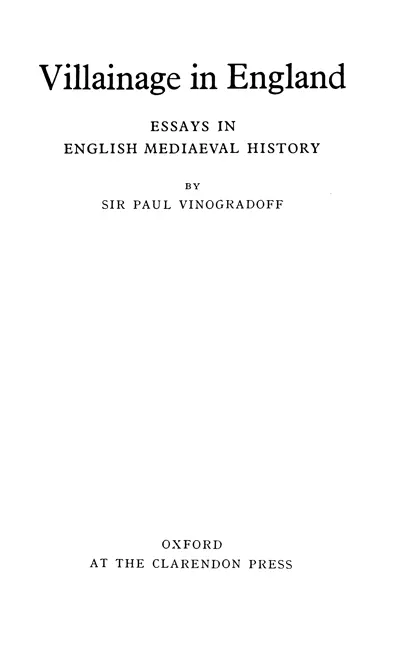
"Villainage in England: Essays in English Mediaeval History" by Sir Paul Vinogradoff is a scholarly historical account written in the late 19th century. The book delves into the complex social structures and legal status of the peasantry during the feudal period in England, particularly focusing on the concept of villainage, a form of servitude distinct from slavery. It examines the rights, disabilities, and socio-economic conditions of villains, offering a comprehensive analysis of how these factors shaped medieval agrarian society. The opening of the book presents a detailed preface where the author discusses his motivations for exploring such a nuanced topic as English social history, framed in the context of his Russian background. He articulates the significance of studying historical documents to uncover the dynamics of social classes, especially the relationship between lords and their peasant subjects. Vinogradoff emphasizes the importance of legal frameworks that defined villainage, arguing that understanding these relationships provides valuable insights into the broader historical narrative of agrarian development and social organization in medieval England. The initial portion sets the stage for an in-depth exploration of the peasantry's legal and economic positions, showcasing a methodical approach to historical inquiry that anticipates the detailed essays that follow.
Introduction adapted from the source catalogue; source summaries may be automatically generated.
Free to read · English · 173,596 words · No account needed
MAKE TIME FOR A GOOD BOOK
On by default. Untick to stop anonymous reading totals. Each page counts after 10 seconds in view. How this works.
Anonymous counting is on unless you have switched it off.
[Remuneration of the class.]
The officers and servants were remunerated in various ways. Sometimes they were allowed to share in the profits connected with their charges. The swine-herd of Glastonbury Abbey, for instance, received one sucking-pig a year, the interior parts of the best pig, and the tails of all the others which were slaughtered in the abbey[705]. The chief scullion (scutellarius) had a right to all remnants of viands,--but not of game,--to the feathers and the bowels of geese[706]. Again, all the household and workmen constantly employed had certain quantities of food, drink, and clothing assigned to them[707]. Of one of the Glastonbury clerks we hear that he received one portion (liberacio) as a monk and a second as a servant, and that by reason of this last he was bound to provide the monastery with a goldsmith[708].
Those of the foremen and labourers of estates who did not belong to the immediate following of the lord and did not live in his central court received a gratification of another kind. They were liberated from the labour and payments which they would have otherwise rendered from their tenements[709]. The performance of the specific duties of administration took the place of the ordinary rural work or rent, and in this way the service of the lord was feudalised on the same principle as the king's service--it was indissolubly connected with land-holding.
[Importance of the 'ministeriality.']
In manorial extents we come constantly across such exempted tenements conceded without any rural obligations or with the reservation of a very small rent. It is important to notice, that such exemptions, though temporary and casual at first, were ultimately consolidated by custom and even confirmed by charters. A whole species of free tenements, and a numerous one, goes back to such privileges and exemptions granted to servants[710]. And so this class of people, in the formation of which unfree elements are so clearly apparent, became one of the sources in the development of free society. Such importance and success are to be explained, of course, by the influence of this class in the administration and economic management of the estates belonging to the secular and ecclesiastical aristocracy. It is very difficult at the present time to realise the responsibility and strength of this element. We live in a time of free contract, credit, highly mobilised currency, easy means of communication, and powerful political organisation. There is no necessity for creating a standing class of society for the purpose of mediating between lord and subject, between the military order and the industrial order. Every feature of the medieval system which tended to disconnect adjoining localities, to cut up the country into a series of isolated units, contributed at the same time to raise a class which acted as a kind of nervous system, connecting the different parts with a common centre and establishing rational intercourse and hierarchical relations. The libertini had to fulfil kindred functions in the ancient world, but their importance was hardly so great as that of medieval sergeants or ministeriales. We may get some notion of what that position was by looking at the personal influence and endowments of the chief servants in a great household of the thirteenth century. The first cook and the gatekeeper of a celebrated abbey were real magnates who held their offices by hereditary succession, and were enfeoffed with considerable estates[711]. In Glastonbury five cooks shared in the kitchen-fee[712]. The head of the cellar, the gatekeeper, and the chief shepherd enter into agreements in regard to extensive plots of land[713]. They appear as entirely free to dispose of such property, and at every step we find in the cartularies of Glastonbury Abbey proofs of the existence of a numerous and powerful 'sergeant' class. John of Norwood, Abbot of Bury St. Edmund's, had to resort to a regular coup d'etat in order to displace the privileged families which had got hold of the offices and treated them as hereditary property[714]. In fact the great 'sergeants' ended by hampering their lords more than serving them. And the same fact of the rise of a 'ministerial' class may be noticed on every single estate, although it is not so prominent there as in the great centres of feudal life. The whole arrangement was broken by the substitution of the 'cash nexus' for more ancient kinds of economic relationship, and by the spread of free agreements: it is not difficult to see that both these facts acted strongly in favour of driving out hereditary and customary obligations.
Your reading position is saved on this browser. Take it to another device with a library code. Reading pages adapt to text, rather than matching a printed edition.
BEHIND THE BOOK
This eBook is for the use of anyone anywhere in the United States and most other parts of the world at no cost and with almost no restrictions whatsoever. You may copy it, give it away or re-use it under the terms of the Project Gutenberg License included with this eBook or online at www.gutenberg.org. If you are not located in the United States, you will have to check the laws of the country where you are located before using this eBook. Read the source licence.
The original source file, including credits and licence, is retained by this library. Request an original-format copy at no charge. Please include the book title and Project Gutenberg identifier #38876.
KEEP YOUR CURIOSITY GOING
Cécile Tormay

Moritz Busch
John L. Ransom
Frances Wright
Cécile Tormay

Mabel Potter Daggett