THE CLASSIC COLLECTION✦An outlaw’s diary: the CommuneCLASSIC FREE BOOKS
An outlaw’s diary: the Commune
Cécile Tormay
THE CLASSIC COLLECTION · 1892
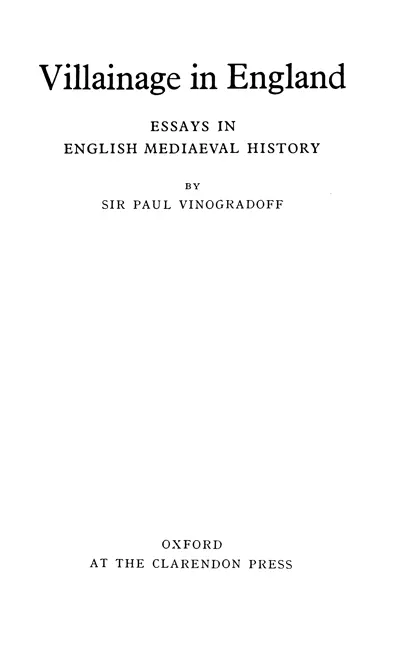
"Villainage in England: Essays in English Mediaeval History" by Sir Paul Vinogradoff is a scholarly historical account written in the late 19th century. The book delves into the complex social structures and legal status of the peasantry during the feudal period in England, particularly focusing on the concept of villainage, a form of servitude distinct from slavery. It examines the rights, disabilities, and socio-economic conditions of villains, offering a comprehensive analysis of how these factors shaped medieval agrarian society. The opening of the book presents a detailed preface where the author discusses his motivations for exploring such a nuanced topic as English social history, framed in the context of his Russian background. He articulates the significance of studying historical documents to uncover the dynamics of social classes, especially the relationship between lords and their peasant subjects. Vinogradoff emphasizes the importance of legal frameworks that defined villainage, arguing that understanding these relationships provides valuable insights into the broader historical narrative of agrarian development and social organization in medieval England. The initial portion sets the stage for an in-depth exploration of the peasantry's legal and economic positions, showcasing a methodical approach to historical inquiry that anticipates the detailed essays that follow.
Introduction adapted from the source catalogue; source summaries may be automatically generated.
Free to read · English · 173,596 words · No account needed
MAKE TIME FOR A GOOD BOOK
On by default. Untick to stop anonymous reading totals. Each page counts after 10 seconds in view. How this works.
Anonymous counting is on unless you have switched it off.
The liabilities of the peasantry take the shape of produce, labour, and money-rents. Almost in every manor all three kinds of impositions are to be found split up into a confusing variety of customary obligations. It is out of the question to trace at the present time, with the help of fragmentary and later material, what the original ideas were which underlie these complicated arrangements. But although a reduction to simple guiding principles accounting for every detail cannot be attempted, it is easy to perceive that chance and fancy were not everything in these matters. The several duties are brought together so as to form a certain whole, and some of the aims pursued in the grouping may be perceived even now.
[Farm-system.]
The older surveys often show the operation of a system which is adapted by its very essence to a very primitive state of society; it may be called the farm-system, the word farm being used in the original sense of the Saxon feorm, food, and not in the later meaning of fixed rent, although these two meanings appear intimately connected in history. The farm is a quantity of produce necessary for the maintenance of the lord's household during a certain period: it may be one night's or week's or one fortnight's farm accordingly. A very good instance of the system may be found in an ancient cartulary of Ramsey, now at the British Museum, which though compiled in the early thirteenth century, constantly refers to the order of Henry II's time. The estates of the abbey were taxed in such a way as to yield thirteen full farms of a fortnight, and each of these was to be used for the maintenance of the monks through a whole month. The extension of the period is odd enough, and we do not see its reason clearly; it followed probably on great losses in property and income at the time of Abbot Walter. However this may be, the thirteen fortnights' farms were made to serve all the year round, and to cover fifty-two weeks instead of twenty-six. A very minute description of the single farm is given as it was paid by the manor of Ayllington (i.e. Elton). Every kind of produce is mentioned: flour and bread, beer and honey, bacon, cheese, lambs, geese, chicken, eggs, butter, &c. The price of each article is mentioned in pence, and it is added, that four pounds have to be paid in money. By the side of the usual farm there appears a 'lent' farm with this distinction, that only half as much bacon and cheese has to be given as usual, and the deficiency is to be made up by a money payment. Some of the manors of the abbey have to send a whole farm, some others only one half, that is one week's farm, but all are assessed to pay sixteen pence for every acre to be used as alms for the poor[666]. This description may be taken as a standard one, and it would be easy to supplement it in many particulars from the records of other monastic institutions. The records of St. Paul's, London, supply information as to a distribution of the farms at the close of the eleventh century, which covered fifty-two weeks, six days, and five-sixths of a day[667]. The firmae of St. Alban's were reckoned to provide for the fifty-two weeks of the year, and one in advance[668]. The practice of arranging the produce-rents according to farms was by no means restricted to ecclesiastical management; it occurs also on the estates of the Crown, and was probably in use on those of lay lords generally. Every person a little conversant with Domesday knows the firmae unius noctis, at which some of the royal manors were assessed[669]. In the period properly called feudal, that is in the twelfth and thirteenth centuries, the food-revenue had very often become only the starting-point for a reckoning of money-rents. The St. Alban's farms, for example, are no longer delivered in kind; their equivalent in money has taken their place. But the previous state of things has left a clear trace in the division by weeks. Altogether it seems impossible to doubt that the original idea was to provide really the food necessary for consumption. One cannot help thinking that such practice must have come from the very earliest times when a Saxon or a Celtic chieftain got his income from the territory under his sway by moving from one place to another with his retinue and feeding on the people for a certain period. This very primitive mode of raising income and consuming it at the same time may occasionally strike our eye even in the middle of the thirteenth century. The tenants of the Abbot of Osulveston in Donington and Byker are bound to receive their lord during one night and one day when he comes to hold his court in their place. They find the necessary food and beverage for him and for his men, provender for his horses, and so forth. If the abbot does not come in person, the homage may settle about a commutation of the duties with the steward or the sergeant sent for the purpose. If he refuses to take money, they must bring everything in kind[670].
Your reading position is saved on this browser. Take it to another device with a library code. Reading pages adapt to text, rather than matching a printed edition.
BEHIND THE BOOK
This eBook is for the use of anyone anywhere in the United States and most other parts of the world at no cost and with almost no restrictions whatsoever. You may copy it, give it away or re-use it under the terms of the Project Gutenberg License included with this eBook or online at www.gutenberg.org. If you are not located in the United States, you will have to check the laws of the country where you are located before using this eBook. Read the source licence.
The original source file, including credits and licence, is retained by this library. Request an original-format copy at no charge. Please include the book title and Project Gutenberg identifier #38876.
KEEP YOUR CURIOSITY GOING
Cécile Tormay

Moritz Busch
John L. Ransom
Frances Wright
Cécile Tormay

Mabel Potter Daggett