THE CLASSIC COLLECTION✦An outlaw’s diary: the CommuneCLASSIC FREE BOOKS
An outlaw’s diary: the Commune
Cécile Tormay
THE CLASSIC COLLECTION · 1892
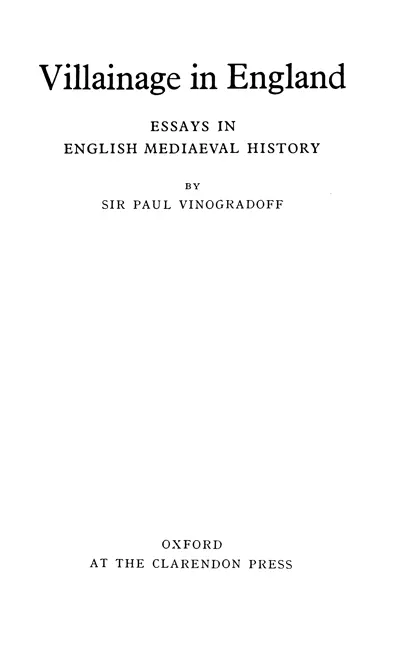
"Villainage in England: Essays in English Mediaeval History" by Sir Paul Vinogradoff is a scholarly historical account written in the late 19th century. The book delves into the complex social structures and legal status of the peasantry during the feudal period in England, particularly focusing on the concept of villainage, a form of servitude distinct from slavery. It examines the rights, disabilities, and socio-economic conditions of villains, offering a comprehensive analysis of how these factors shaped medieval agrarian society. The opening of the book presents a detailed preface where the author discusses his motivations for exploring such a nuanced topic as English social history, framed in the context of his Russian background. He articulates the significance of studying historical documents to uncover the dynamics of social classes, especially the relationship between lords and their peasant subjects. Vinogradoff emphasizes the importance of legal frameworks that defined villainage, arguing that understanding these relationships provides valuable insights into the broader historical narrative of agrarian development and social organization in medieval England. The initial portion sets the stage for an in-depth exploration of the peasantry's legal and economic positions, showcasing a methodical approach to historical inquiry that anticipates the detailed essays that follow.
Introduction adapted from the source catalogue; source summaries may be automatically generated.
Free to read · English · 173,596 words · No account needed
MAKE TIME FOR A GOOD BOOK
On by default. Untick to stop anonymous reading totals. Each page counts after 10 seconds in view. How this works.
Anonymous counting is on unless you have switched it off.
We have considered till now the different aspects assumed by common of pasture, when it arises within the manor, and as a consequence of the arrangement of its holdings. But this is not the only way in which common of pasture may arise. It may originate in an express and special grant by the lord either to a tenant or to a stranger[542]; it may also proceed from continuous use from time beyond legal memory[543]: it must have been difficult in many cases to prevent strangers from establishing such a claim by reason of long occupation in some part of a widely stretching moor or wood pasture[544]. It was not less difficult in such cases to draw exact boundaries between adjoining communities, and we find that large tracts of country are used as a common pasture-ground by two villages, and even by more[545]. Neighbours deem it often advantageous to establish a certain reciprocity in this respect[546]. By special agreement or by tacit allowance lords and tenants intercommon on each other's lands: this practice extends mostly to the waste only, but in some cases the arable and meadow are included after the removal of the crop and of the hay. The procedure of the writ 'quo jure' was partly directed to regulate these rights and to prevent people from encroaching wantonly upon their neighbours[547]. When land held in one fee or one manor was broken up for some reason into smaller units, the rights of pasture were commonly kept up according to the old arrangements[548].
These different modes of treating the pasture present rather an incongruous medley, and may be classified in several ways and deduced from divers sources.
[Modern classification of commons.]
The chief distinctions of modern law are well known: 'Common Appendant is the right which every freehold tenant of the manor possesses, to depasture his commonable cattle, levant and couchant on his freehold tenement anciently arable, on the wastes of the manor, and originally on all (common) pasture in the manor. Common appurtenant on the other hand is against common right, becoming appurtenant to land either by long user or by grant express or implied. Thus it covers a right to common with animals that are not commonable, such as pigs, donkeys, goats, and geese; or a right to common claimed for land not anciently arable, such as pasture, or land reclaimed from the waste within the time of legal memory, or for land that is not freehold, but copyhold[549].' Common in gross is a personal right to common pasture in opposition to the praedial rights. Mr. Scrutton has shown from the Year Books that these terms and distinctions emerge gradually during the fourteenth century, and appear substantially settled only in Littleton's treatise. Bracton and his followers, Fleta and Britton, do not know them. These are important facts, but they hardly warrant the inferences which have been drawn from them. The subject has been in dispute in connexion with discussions as to the free village community. Joshua Williams, in his Rights of Common[550], had assumed common appendant to originate in ancient customary right bestowed by the village community and not by the lord's grant; Scrutton argues that such a right is not recognised by the documents. He lays stress on the fact, that Bracton speaks only of two modes of acquiring common, namely, express grant by the lord, and long usage understood as constant sufferance on the part of the lord amounting to an express grant. But this is only another way of saying that Bracton's exposition is based on feudal notions, that his land law is constructed on the principle 'nulle terre sans seigneur,' and that every tenement, as well as every right to common, is considered in theory as granted by the lord of the manor. It may be admitted that Bracton does not recognise just that kind of title which later lawyers knew as appendancy, does not recognise that a man can claim common by showing merely that he is a freeholder of the manor. Unless he relies on long continued user, he must rely upon grant or feoffment. But the distinction between saying 'I claim common because I am a freeholder of the manor' and saying 'I claim common because I or my ancestors have been enfeoffed of a freehold tenement of the manor and the right of common passed by the feoffment,' though it may be of juristic interest and even of some practical importance as regulating the burden of proof and giving rise to canons for the interpretation of deeds, is still a superficial distinction which does not penetrate deeply into the substance of the law. On the whole we find that the freeholder of Bracton's time and of earlier times does normally enjoy these rights which in after time were described as 'appendant' to his freehold; and it is well worth while to ask whether behind the general assumptions of feudal theory there do not lie certain data which, on the one hand, prepare and explain later terminology, and are connected, on the other, with the historical antecedents of the feudal system.
Your reading position is saved on this browser. Take it to another device with a library code. Reading pages adapt to text, rather than matching a printed edition.
BEHIND THE BOOK
This eBook is for the use of anyone anywhere in the United States and most other parts of the world at no cost and with almost no restrictions whatsoever. You may copy it, give it away or re-use it under the terms of the Project Gutenberg License included with this eBook or online at www.gutenberg.org. If you are not located in the United States, you will have to check the laws of the country where you are located before using this eBook. Read the source licence.
The original source file, including credits and licence, is retained by this library. Request an original-format copy at no charge. Please include the book title and Project Gutenberg identifier #38876.
KEEP YOUR CURIOSITY GOING
Cécile Tormay

Moritz Busch
John L. Ransom
Frances Wright
Cécile Tormay

Mabel Potter Daggett