THE CLASSIC COLLECTION✦An outlaw’s diary: the CommuneCLASSIC FREE BOOKS
An outlaw’s diary: the Commune
Cécile Tormay
THE CLASSIC COLLECTION · 1892
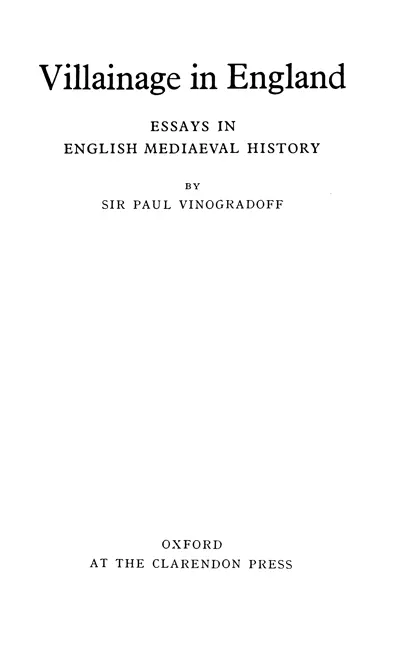
"Villainage in England: Essays in English Mediaeval History" by Sir Paul Vinogradoff is a scholarly historical account written in the late 19th century. The book delves into the complex social structures and legal status of the peasantry during the feudal period in England, particularly focusing on the concept of villainage, a form of servitude distinct from slavery. It examines the rights, disabilities, and socio-economic conditions of villains, offering a comprehensive analysis of how these factors shaped medieval agrarian society. The opening of the book presents a detailed preface where the author discusses his motivations for exploring such a nuanced topic as English social history, framed in the context of his Russian background. He articulates the significance of studying historical documents to uncover the dynamics of social classes, especially the relationship between lords and their peasant subjects. Vinogradoff emphasizes the importance of legal frameworks that defined villainage, arguing that understanding these relationships provides valuable insights into the broader historical narrative of agrarian development and social organization in medieval England. The initial portion sets the stage for an in-depth exploration of the peasantry's legal and economic positions, showcasing a methodical approach to historical inquiry that anticipates the detailed essays that follow.
Introduction adapted from the source catalogue; source summaries may be automatically generated.
Free to read · English · 173,596 words · No account needed
MAKE TIME FOR A GOOD BOOK
On by default. Untick to stop anonymous reading totals. Each page counts after 10 seconds in view. How this works.
Anonymous counting is on unless you have switched it off.
[Feudal oppression in the direction of servitude.]
The passage from one great class of society to the other was rendered easy in this way by the variety of combinations in which the distinguishing features of both classes appear. No wonder that we hear constantly of oppression which tended to substitute one form of subjection for another, and thus to lower the social standing of intermediate groups. The free socmen of Swaffham Prior, in Cambridgeshire[433], complain that they are made to bind sheaves while they did not do it before; they used to pay thirty-two pence for licence to marry a daughter, and to give a twofold rent on entering an inheritance, and now the lord fines them at will. One of the tenants of the Bishop of Lincoln[434] declares to the Hundred Roll Commissioners that his ancestors were free socmen and did service to the king for forty days at their own cost, whereas now the Bishop has appropriated the royal rights. The same grievances come from ancient demesne people. In Weston, Bedfordshire[435], the tenantry complain of new exactions on the part of the lord; in King's Ripton[436], Hunts, merchet is introduced which was never paid before; in Collecot, Berks[437], the lord has simply dispossessed the socmen. In some instances the claims of the peasantry may have been exaggerated, but I think that in all probability the chances were rather against the subjected people than for them, and their grievances are represented in our documents rather less than fairly[438].
[Law of Kent.]
In speaking of those classes of peasants who were by no means treated as serfs to be exploited at will, I must not omit to mention one group which appears, not as a horizontal layer spread over England, but in the vertical cut, as it were. I mean the Kentish gavelkind tenantry. The Domesday Survey speaks of the population of this county quite in the same way as of the people of neighbouring shires; villains form the great bulk of it, socmen are not even mentioned, and to judge by such indications, we have here plain serfdom occupying the whole territory of the county. On the other hand the law of the thirteenth century puts the social standing of Kentish men in the most decided opposition to that of the surrounding people. The 'Consuetudines Kanciae,' the well-known list of special Kentish customs[439], is reported to have been drawn up during an eyre of John of Berwick in the twenty-first year of Edward I. Be its origin what it may, we come across several of its rules at much earlier times[440], and they are always considered of immemorial custom. The basis of Kentish social law is the assumption that every man born in the county is entitled to be considered as personally free, and the Common Law Courts recognised the notion to the extent of admitting the assertion that a person was born in Kent as a reply against the 'exceptio villenagii.' The contrast with other counties did not stop there. The law of tenure was as different as the law of status. It would be needless to enumerate all the points set forth as Kentish custom. They show conclusively that the lord was anything but omnipotent in this county. Interference with the proprietary right of the peasantry is not even thought of; the tenants may even alienate their plots freely; the lord can only claim the accustomed rents and services; if the tenants are negligent in performing work or making payments, distress and forfeiture are awarded by the manorial court according to carefully graduated forms; wardship in case of minority goes to the kin and not to the lord, and heiresses cannot be forced to marry against their wish. As a case of independence the Kentish custom is quite complete, and manorial documents show on every page that it was anything but a dead letter. The Rochester Custumal, the Black Book of St. Augustine, the customs of the Kentish possessions of Battle Abbey, the registers of Christ Church, Canterbury, all agree in showing the Kentish tenantry as a privileged one, both as to the quantity and as to the quality of their services[441]. And so the great bulk of the Kentish peasantry actually appears in the same general position as the free socmen of other counties, and sometimes they are even called by this name[442].
Your reading position is saved on this browser. Take it to another device with a library code. Reading pages adapt to text, rather than matching a printed edition.
BEHIND THE BOOK
This eBook is for the use of anyone anywhere in the United States and most other parts of the world at no cost and with almost no restrictions whatsoever. You may copy it, give it away or re-use it under the terms of the Project Gutenberg License included with this eBook or online at www.gutenberg.org. If you are not located in the United States, you will have to check the laws of the country where you are located before using this eBook. Read the source licence.
The original source file, including credits and licence, is retained by this library. Request an original-format copy at no charge. Please include the book title and Project Gutenberg identifier #38876.
KEEP YOUR CURIOSITY GOING
Cécile Tormay

Moritz Busch
John L. Ransom
Frances Wright
Cécile Tormay

Mabel Potter Daggett