THE CLASSIC COLLECTION✦The fatal marriageCLASSIC FREE BOOKS
The fatal marriage
Emma Dorothy Eliza Nevitte Southworth
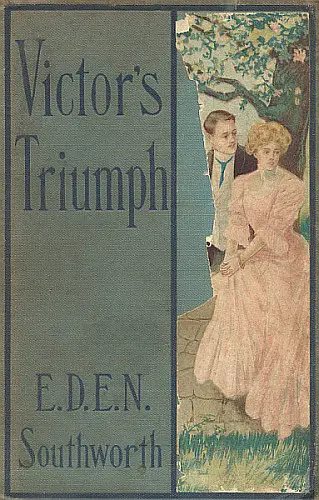
THE CLASSIC COLLECTION · 1900
"Victor's Triumph" by Emma Dorothy Eliza Nevitte Southworth is a novel written in the late 19th century. The narrative likely revolves around themes of love, deception, and societal expectations, focusing on characters entangled in complex relationships. Central to the story is Mary Grey, a young woman with a troubled past who attempts to secure her place in society while navigating the consequences of her earlier choices, which continue to haunt her. The opening portion establishes a dramatic atmosphere, beginning with a conversation between Mary Grey and an aged clergyman who is aware of her tumultuous history. As Mary seeks to manipulate the clergyman's affections and secure his silence about her past, the reader learns of her vulnerability and desperation. Concurrently, Laura Lytton, a close friend of Mary, prepares to return to her family, highlighting the contrasting dynamics between their lives. Through these interactions, the setting is established as one of both kindness and underlying tension, foreshadowing potential conflicts that revolve around identity, concealment, and the search for redemption.
Introduction adapted from the source catalogue; source summaries may be automatically generated.
Free to read · English · 97,879 words · No account needed
MAKE TIME FOR A GOOD BOOK
On by default. Untick to stop anonymous reading totals. Each page counts after 10 seconds in view. How this works.
Anonymous counting is on unless you have switched it off.
"Well," said the old lady, "as she is here, though sorely against my approbation--still, as she is here we must give her a becoming welcome, I suppose. You may bring her to my room to-morrow morning."
"Thank you, grandma, dear; that is just what I would like to do,"
replied the young lady.
Accordingly, the next morning Mrs. Fanning was conducted by Emma to the "Throne Room," as Electra had saucily designated the old lady's apartment.
Madam Cavendish was dressed with great care, in a fine black cashmere wrapper, lined and trimmed with black silk, and a fine white lace cap, trimmed with white piping.
And old Moll, also in her best clothes, stood behind her mistress's
chair.
The old lady meant to impress "the tavern-keeper's widow" with a due
sense of reverence.
But the gentlewoman's heart was a great deal better than her head. And so, when she saw the girl whom she had once known a brilliant, rich-complexioned brunette, with raven hair and sparkling eyes and queenly form changed into a woman, old before her time, pale, thin, gray and sorrow-stricken, her heart melted with pity, and she held out her hand, saying, kindly:
"How do you do, Katie, my dear? I am very sorry to see you looking in such ill-health. You have changed very much from the child I knew you, twenty-five years ago."
"Yes," said Mrs. Fanning, as she took and pressed the venerable hand that was held out to her. "I have changed. But there is only one more change that awaits me--the last great one."
"Moll, wheel forward that other easy-chair. Sit down at once, my poor Katie. You look ready to drop from weakness. Emma, my child, pour out a glass of that old port wine and bring it to your aunt. You will find it in that little cabinet," said Madam Cavendish, speaking to one and another in her hurry to be hospitable and to atone for the hard thoughts she had cherished and expressed toward this poor suffering and desolate woman.
And Mrs. Fanning was soon seated in the deep, soft "sleepy hollow," and sipping with comfort the rich old port wine.
"Yes, Katie," said the old lady, resuming the thread of the conversation, "that last great change awaits us all--a glorious change, Katie, that I for one look forward to with satisfaction and desire always--with rapture and longing sometimes. What will the next life be like, I wonder? We don't know. 'Eye hath not seen--ear heard,'" mused the old lady.
The interview was not a long one. Soon Emma Cavendish took her aunt from
the room.
Your reading position is saved on this browser. Take it to another device with a library code. Reading pages adapt to text, rather than matching a printed edition.
Emma Dorothy Eliza Nevitte Southworth
Emma Dorothy Eliza Nevitte Southworth
Emma Dorothy Eliza Nevitte Southworth
Emma Dorothy Eliza Nevitte Southworth
BEHIND THE BOOK
This eBook is for the use of anyone anywhere in the United States and most other parts of the world at no cost and with almost no restrictions whatsoever. You may copy it, give it away or re-use it under the terms of the Project Gutenberg License included with this eBook or online at www.gutenberg.org. If you are not located in the United States, you will have to check the laws of the country where you are located before using this eBook. Read the source licence.
The original source file, including credits and licence, is retained by this library. Request an original-format copy at no charge. Please include the book title and Project Gutenberg identifier #29729.
KEEP YOUR CURIOSITY GOING
Coulson Kernahan

Maurice Baring
Frances Wright
Cécile Tormay

Frederic Jesup Stimson

W. H. P. (William Henry Pope) Jarvis