THE CLASSIC COLLECTION✦The fatal marriageCLASSIC FREE BOOKS
The fatal marriage
Emma Dorothy Eliza Nevitte Southworth
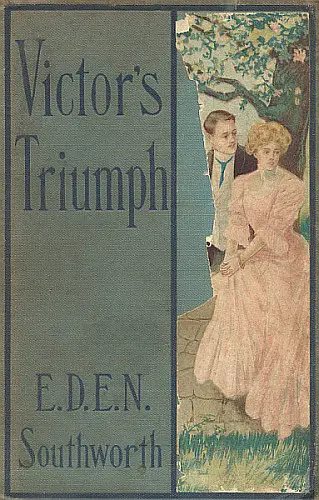
THE CLASSIC COLLECTION · 1900
"Victor's Triumph" by Emma Dorothy Eliza Nevitte Southworth is a novel written in the late 19th century. The narrative likely revolves around themes of love, deception, and societal expectations, focusing on characters entangled in complex relationships. Central to the story is Mary Grey, a young woman with a troubled past who attempts to secure her place in society while navigating the consequences of her earlier choices, which continue to haunt her. The opening portion establishes a dramatic atmosphere, beginning with a conversation between Mary Grey and an aged clergyman who is aware of her tumultuous history. As Mary seeks to manipulate the clergyman's affections and secure his silence about her past, the reader learns of her vulnerability and desperation. Concurrently, Laura Lytton, a close friend of Mary, prepares to return to her family, highlighting the contrasting dynamics between their lives. Through these interactions, the setting is established as one of both kindness and underlying tension, foreshadowing potential conflicts that revolve around identity, concealment, and the search for redemption.
Introduction adapted from the source catalogue; source summaries may be automatically generated.
Free to read · English · 97,879 words · No account needed
MAKE TIME FOR A GOOD BOOK
On by default. Untick to stop anonymous reading totals. Each page counts after 10 seconds in view. How this works.
Anonymous counting is on unless you have switched it off.
She ran down-stairs briskly enough now, and ran out of the front door.
"Any letters to-day, Jerome?" she inquired.
"No, miss," answered Jerome, shaking his head.
"Oh, dear, how depressing!" sighed Emma, as she turned to go into the
house.
But a sound arrested her steps--the opening of the carriage-door. She turned and saw Jerome standing before it and in the act of helping some one to alight from the carriage.
Another moment and a tall, thin, dark-eyed woman, with very white hair, and clad in the deepest widow's weeds, stood before Miss Cavendish.
By instinct Emma recognized her aunt. And she felt very much relieved, and very much rejoiced to see her, even while wondering that she should have come unannounced either by letter or telegram.
As for Jerome, he stood wickedly enjoying his young lady's astonishment, and looking as if he himself had performed a very meritorious action.
"Miss Emma Cavendish, I presume?" said the stranger, a little
hesitatingly.
"Yes, madam. And you are my Aunt Fanning, I am sure. And I am very glad to see you," answered Emma Cavendish.
And she put her arms around the stranger's neck and kissed her.
"Dat's better'n letters, a'n't it, Miss Emmer?" inquired Jerome, grinning from ear to ear, and showing a double row of the strongest and whitest ivories, as he proceeded to take from the carriage various packages, boxes and traveling-bags and so forth.
"Yes, better than letters, Jerome. Follow us into the house with that luggage. Come, dear aunt, let us go in. Lean on my arm. Don't be afraid to lean heavily. I am very strong," said Emma; and drawing the poor lady's emaciated hand through her own arm she led her into the house.
She took her first into the family sitting-room, where there was a cheerful fire burning, which the chilly mountain air, in this spring weather, made very acceptable.
She placed her in a comfortable cushioned rocking-chair and proceeded to take off the traveling-bonnet and shawl with her own hands, saying:
"You must get well rested and refreshed here before you go up to your room. You look very tired."
"I am very weak, my dear," answered the lady, in a faint voice.
"I see that you are. I am very sorry to see you so feeble; but we will make you stronger here in our exhilarating mountain air. If I had known that you would come by this train I should have gone to the railway station in person to meet you," said Emma, kindly.
Mrs. Fanning turned her great black eyes upon the young lady and stared
at her in surprise.
Your reading position is saved on this browser. Take it to another device with a library code. Reading pages adapt to text, rather than matching a printed edition.
Emma Dorothy Eliza Nevitte Southworth
Emma Dorothy Eliza Nevitte Southworth
Emma Dorothy Eliza Nevitte Southworth
Emma Dorothy Eliza Nevitte Southworth
BEHIND THE BOOK
This eBook is for the use of anyone anywhere in the United States and most other parts of the world at no cost and with almost no restrictions whatsoever. You may copy it, give it away or re-use it under the terms of the Project Gutenberg License included with this eBook or online at www.gutenberg.org. If you are not located in the United States, you will have to check the laws of the country where you are located before using this eBook. Read the source licence.
The original source file, including credits and licence, is retained by this library. Request an original-format copy at no charge. Please include the book title and Project Gutenberg identifier #29729.
KEEP YOUR CURIOSITY GOING
Coulson Kernahan

Maurice Baring
Frances Wright
Cécile Tormay

Frederic Jesup Stimson

W. H. P. (William Henry Pope) Jarvis