THE CLASSIC COLLECTION✦The fatal marriageCLASSIC FREE BOOKS
The fatal marriage
Emma Dorothy Eliza Nevitte Southworth
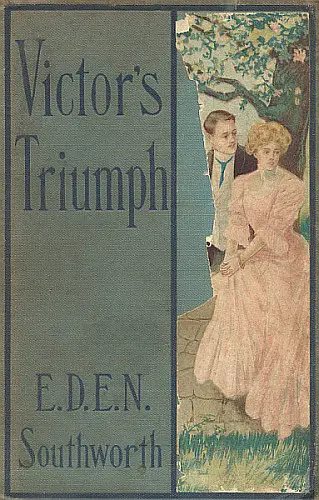
THE CLASSIC COLLECTION · 1900
"Victor's Triumph" by Emma Dorothy Eliza Nevitte Southworth is a novel written in the late 19th century. The narrative likely revolves around themes of love, deception, and societal expectations, focusing on characters entangled in complex relationships. Central to the story is Mary Grey, a young woman with a troubled past who attempts to secure her place in society while navigating the consequences of her earlier choices, which continue to haunt her. The opening portion establishes a dramatic atmosphere, beginning with a conversation between Mary Grey and an aged clergyman who is aware of her tumultuous history. As Mary seeks to manipulate the clergyman's affections and secure his silence about her past, the reader learns of her vulnerability and desperation. Concurrently, Laura Lytton, a close friend of Mary, prepares to return to her family, highlighting the contrasting dynamics between their lives. Through these interactions, the setting is established as one of both kindness and underlying tension, foreshadowing potential conflicts that revolve around identity, concealment, and the search for redemption.
Introduction adapted from the source catalogue; source summaries may be automatically generated.
Free to read · English · 97,879 words · No account needed
MAKE TIME FOR A GOOD BOOK
On by default. Untick to stop anonymous reading totals. Each page counts after 10 seconds in view. How this works.
Anonymous counting is on unless you have switched it off.
Thither, full fraught with mischievous revenge,
Accursed and in a cursed hour, she hies.
--MILTON.
On that Wednesday morning the fine steamer "Pocahontas" lay at her wharf receiving freight and passengers for Washington and Alexandria.
Her decks were crowded with men, women and children, all either going on the voyage or "seeing off" departing friends and acquaintances.
Among the passengers on the forward deck stood a slight, elegant, graceful woman, clothed in widow's weeds and deeply veiled.
This was, of course, Mary Grey, bound upon her baleful errand.
She had spent the intervening Tuesday with her infatuated instrument, Craven Kyte. But when he pleaded to attend her to the boat and see her off she forbid his doing so on pain of an eternal separation from her.
But she renewed their agreement that he should precede her by twelve hours, and meet her at a designated place in Philadelphia on Friday morning.
And she stayed with him until quite late in the evening, and finally left him comforted with the hope of a speedy meeting and a certain marriage.
For the edification of her landladies, the precise Misses Crane, she trumped up a story that at once explained the necessity of her sudden journey North, and, as usual, redounded to her own credit.
She had received a telegram, she said, from a friend who had just lost her father, and who was in great affliction. And she must go on immediately to comfort that bereaved soul.
The Misses Crane, as usual, thought she was an angel in woman's form, and bade her heaven speed on her benevolent errand.
And now she stood upon the deck of the "Pocahontas," waiting for that traveling companion whom she had fatally beguiled to be her escort.
The boat was getting up her steam, and yet he had not made his
appearance.
What if he should not come, after all?
Just as she asked this question it was answered by his rapid approach.
He came up, traveling-bag in hand, happy, smiling, radiant.
"Mrs. Grey, I have been looking for you all over the boat. I feared that I had missed you," he said, gayly, holding out his hand.
"I have been waiting for you here," she answered, with a smile.
"I am glad to find you at last. But will you not come into the cabin? The deck is not a pleasant place while the boat is at the wharf," he said, as he offered her his arm.
She thanked him with a smile, took his arm and let him lead her into the
saloon.
It was at that moment empty of other visitors. And those two were
tete-a-tete.
Your reading position is saved on this browser. Take it to another device with a library code. Reading pages adapt to text, rather than matching a printed edition.
Emma Dorothy Eliza Nevitte Southworth
Emma Dorothy Eliza Nevitte Southworth
Emma Dorothy Eliza Nevitte Southworth
Emma Dorothy Eliza Nevitte Southworth
BEHIND THE BOOK
This eBook is for the use of anyone anywhere in the United States and most other parts of the world at no cost and with almost no restrictions whatsoever. You may copy it, give it away or re-use it under the terms of the Project Gutenberg License included with this eBook or online at www.gutenberg.org. If you are not located in the United States, you will have to check the laws of the country where you are located before using this eBook. Read the source licence.
The original source file, including credits and licence, is retained by this library. Request an original-format copy at no charge. Please include the book title and Project Gutenberg identifier #29729.
KEEP YOUR CURIOSITY GOING
Coulson Kernahan

Maurice Baring
Frances Wright
Cécile Tormay

Frederic Jesup Stimson

W. H. P. (William Henry Pope) Jarvis