THE CLASSIC COLLECTION✦The fatal marriageCLASSIC FREE BOOKS
The fatal marriage
Emma Dorothy Eliza Nevitte Southworth
THE CLASSIC COLLECTION · 1900
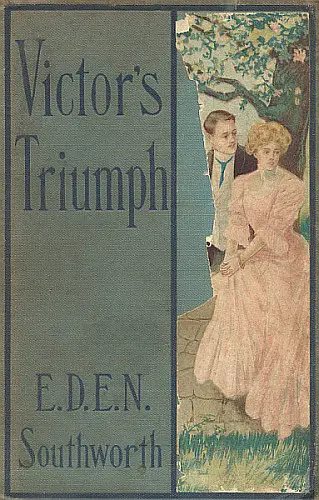
"Victor's Triumph" by Emma Dorothy Eliza Nevitte Southworth is a novel written in the late 19th century. The narrative likely revolves around themes of love, deception, and societal expectations, focusing on characters entangled in complex relationships. Central to the story is Mary Grey, a young woman with a troubled past who attempts to secure her place in society while navigating the consequences of her earlier choices, which continue to haunt her. The opening portion establishes a dramatic atmosphere, beginning with a conversation between Mary Grey and an aged clergyman who is aware of her tumultuous history. As Mary seeks to manipulate the clergyman's affections and secure his silence about her past, the reader learns of her vulnerability and desperation. Concurrently, Laura Lytton, a close friend of Mary, prepares to return to her family, highlighting the contrasting dynamics between their lives. Through these interactions, the setting is established as one of both kindness and underlying tension, foreshadowing potential conflicts that revolve around identity, concealment, and the search for redemption.
Introduction adapted from the source catalogue; source summaries may be automatically generated.
Free to read · English · 97,879 words · No account needed
MAKE TIME FOR A GOOD BOOK
On by default. Untick to stop anonymous reading totals. Each page counts after 10 seconds in view. How this works.
Anonymous counting is on unless you have switched it off.
The sinful woman, already a prey to the horrors of remorse and superstition, dreading the darkness and solitude of the night, fearing almost to see the dripping specter of the drowned man standing over her bed, gratefully accepted their offer, and begged, at the same time, for morphia.
Her kind attendants were afraid to administer a dangerous opiate without the advice of a physician; so they sent for one immediately, who, on his arrival and his examination of the terribly excited patient, gave her a dose that soon sent her to sleep.
The two ladies took their places by her bed and watched her.
She slept well through the night, and awoke quite calmly in the morning. The composing influence of the morphia had not yet left her.
And with the returning daylight much of her remorse and all of her superstition vanished for the time being.
She thanked the ladies who had watched her during the night, and, in reply to their inquiries, assured them that she felt better, but begged them to keep her room dark.
They expressed their gratification to hear her say so. One of them bathed her face and hands and combed her hair, while the other one rang the bell, and ordered tea and toast to be brought to the room.
And they tenderly pressed her to eat and drink, and they waited on her while she partook slightly of this light breakfast.
Then they rang and sent the breakfast service away, and they put her room in order, and smoothed her pillows and the coverlet of her bed, and finally they kissed her and bade her good-morning for a while, promising to return again in the course of the afternoon, and begging that she would send for them, at the address they gave her, in case she should require their services sooner.
When she was left alone, Mary Grey slipped out of bed, locked the door after the ladies, and then, having secured herself from intrusion, she opened her traveling-bag and took from it a small white envelope, from which she drew a neatly-folded white paper.
This was the marriage certificate, setting forth that on the fifteenth day of September, eighteen hundred and ----, at the parish church of St. ----, in the city of Philadelphia, Alden Lytton, attorney at law, of the city of Richmond, and Mary Grey, widow, of the same city, were united in the holy bonds of matrimony by the Rev. Mr. Borden, rector of the church, in the presence of John Martin, sexton, and Sarah Martin, his daughter.
The certificate was duly signed by the Rev. Mr. Borden and by John
Martin and Sarah Martin.
Your reading position is saved on this browser. Take it to another device with a library code. Reading pages adapt to text, rather than matching a printed edition.
Emma Dorothy Eliza Nevitte Southworth
Emma Dorothy Eliza Nevitte Southworth
Emma Dorothy Eliza Nevitte Southworth
Emma Dorothy Eliza Nevitte Southworth
BEHIND THE BOOK
This eBook is for the use of anyone anywhere in the United States and most other parts of the world at no cost and with almost no restrictions whatsoever. You may copy it, give it away or re-use it under the terms of the Project Gutenberg License included with this eBook or online at www.gutenberg.org. If you are not located in the United States, you will have to check the laws of the country where you are located before using this eBook. Read the source licence.
The original source file, including credits and licence, is retained by this library. Request an original-format copy at no charge. Please include the book title and Project Gutenberg identifier #29729.
KEEP YOUR CURIOSITY GOING
Coulson Kernahan

Maurice Baring
Frances Wright
Cécile Tormay

Frederic Jesup Stimson

W. H. P. (William Henry Pope) Jarvis