THE CLASSIC COLLECTION✦The fatal marriageCLASSIC FREE BOOKS
The fatal marriage
Emma Dorothy Eliza Nevitte Southworth
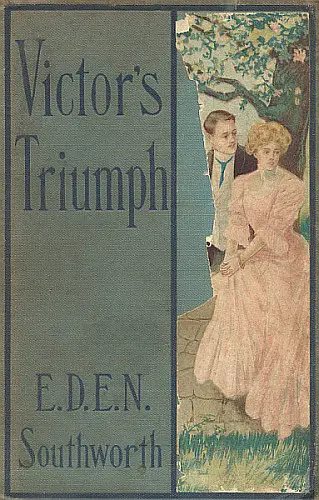
THE CLASSIC COLLECTION · 1900
"Victor's Triumph" by Emma Dorothy Eliza Nevitte Southworth is a novel written in the late 19th century. The narrative likely revolves around themes of love, deception, and societal expectations, focusing on characters entangled in complex relationships. Central to the story is Mary Grey, a young woman with a troubled past who attempts to secure her place in society while navigating the consequences of her earlier choices, which continue to haunt her. The opening portion establishes a dramatic atmosphere, beginning with a conversation between Mary Grey and an aged clergyman who is aware of her tumultuous history. As Mary seeks to manipulate the clergyman's affections and secure his silence about her past, the reader learns of her vulnerability and desperation. Concurrently, Laura Lytton, a close friend of Mary, prepares to return to her family, highlighting the contrasting dynamics between their lives. Through these interactions, the setting is established as one of both kindness and underlying tension, foreshadowing potential conflicts that revolve around identity, concealment, and the search for redemption.
Introduction adapted from the source catalogue; source summaries may be automatically generated.
Free to read · English · 97,879 words · No account needed
MAKE TIME FOR A GOOD BOOK
On by default. Untick to stop anonymous reading totals. Each page counts after 10 seconds in view. How this works.
Anonymous counting is on unless you have switched it off.
It frightened her, of course--everything frightened her now.
"Who is that?" she nervously inquired.
"Only me, ma'am. The ladies are waiting luncheon for you. Miss Emma sends her compliments and says will you come down?" spoke the voice of Sarah, the lady's maid.
"Love to Miss Cavendish, and ask her to excuse me. I do not want any luncheon," answered Mary Grey, without opening the door.
Then she sank back in her chair with throbbing pulses, waiting for the issue of this crisis. She was really ill with intense anxiety and dread. She grew so weak at last that she lay down upon her sofa.
Then came another rap at the door.
"Who is that?" she asked again, faintly.
"It is I, dear," answered the voice of Emma Cavendish.
Mrs. Grey arose trembling and opened the door.
"I was afraid that you were not well. I came up to see," said Emma, kindly, as she entered the room.
"I--no, I am not quite well," faltered Mary Grey, as she retreated to the sofa and sat down, with her back purposely to the light and her face in the shadow.
"You really look pale and ill. What is the matter, dear?"
"I--think I have taken cold. But by keeping to my room for a few days I hope to be better. A cold always affects the action of my heart and makes me very nervous," said Mary Grey, in explanation of the tremors for which she could not otherwise account.
Then Emma expressed sympathy and sorrow, and begged the pretended
invalid to have some tea and cream-toast, or some wine-whey or
chicken-broth.
But Mary Grey declined all these offers, declaring that a cold always
took her appetite away.
And again Emma expressed regret.
And, as Miss Cavendish talked, Mary Grey grew more composed.
It was evident, she thought, that Emma as yet knew nothing of that strange rencounter on the stairs.
Presently, Miss Cavendish said:
"I am sorry to tell you that we shall lose Laura Lytton for a few days. Her uncle, Mr. Lytton of Lytton Lodge, has sent a messenger for her. She goes to visit her relations there to-morrow morning."
"Indeed--a messenger?" exclaimed Mary Grey, pricking up her ears.
"Yes; a queer genius, who signalized his entrance into the house by a scene," added Emma, smiling.
"Indeed!"
"Oh, yes! Why, you might have heard the commotion in the front hall! Did you hear nothing of it?"
"No, dear; I have remained shut up in my room ever since breakfast--have not stirred from it," answered Mary Grey, lying without the least hesitation.
Your reading position is saved on this browser. Take it to another device with a library code. Reading pages adapt to text, rather than matching a printed edition.
Emma Dorothy Eliza Nevitte Southworth
Emma Dorothy Eliza Nevitte Southworth
Emma Dorothy Eliza Nevitte Southworth
Emma Dorothy Eliza Nevitte Southworth
BEHIND THE BOOK
This eBook is for the use of anyone anywhere in the United States and most other parts of the world at no cost and with almost no restrictions whatsoever. You may copy it, give it away or re-use it under the terms of the Project Gutenberg License included with this eBook or online at www.gutenberg.org. If you are not located in the United States, you will have to check the laws of the country where you are located before using this eBook. Read the source licence.
The original source file, including credits and licence, is retained by this library. Request an original-format copy at no charge. Please include the book title and Project Gutenberg identifier #29729.
KEEP YOUR CURIOSITY GOING
Coulson Kernahan

Maurice Baring
Frances Wright
Cécile Tormay

Frederic Jesup Stimson

W. H. P. (William Henry Pope) Jarvis