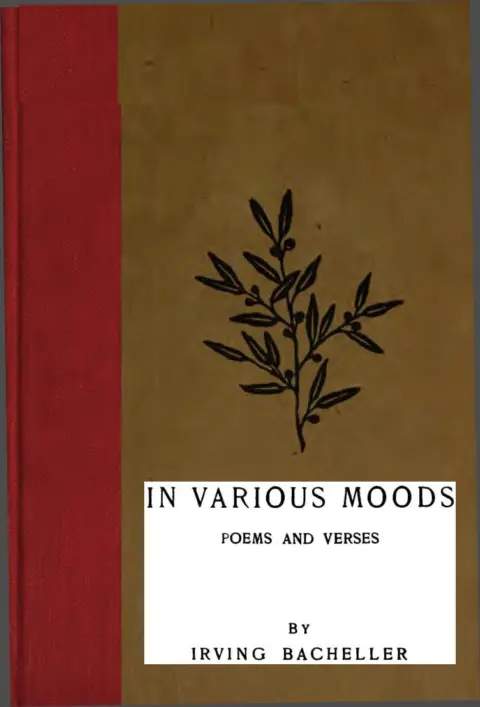
In Various Moods: Poems and Verses
Irving Bacheller
THE CLASSIC COLLECTION · 1904
"Vergilius: A Tale of the Coming of Christ" by Irving Bacheller is a historical novel written in the early 20th century. The narrative is set in ancient Rome, exploring themes of love, faith, and the transition from a world of paganism to one of emerging Christianity. The story primarily follows Vergilius, a young Roman knight, as he navigates the complexities of love and duty amid a backdrop of moral decay in the empire. The opening of "Vergilius" introduces readers to a richly depicted Rome, presenting a stark contrast between its opulent surface and the spiritual discontent of its people. As Rome grapples with excess and corruption, Vergilius is portrayed as a sincere and noble youth who is enamored with Arria, the daughter of a noble. Their budding romance unfolds with challenges, societal expectations, and hints of political intrigue, particularly as Vergilius is drawn into the machinations of powerful figures, including the emperor Augustus. The early chapters set the stage for a grand journey, reflecting on themes of love, virtue, and the search for truth as the empire stands on the brink of significant change.
Introduction adapted from the source catalogue; source summaries may be automatically generated.
Free to read · English · 41,356 words · No account needed
MAKE TIME FOR A GOOD BOOK
On by default. Untick to stop anonymous reading totals. Each page counts after 10 seconds in view. How this works.
Anonymous counting is on unless you have switched it off.
"He is more honored than Jupiter these days," the philosopher was saying as Vergilius re-entered.
"Who?" inquired the young man.
"Who else but Caesar, and it is well. The gods--who are they?"
"The adopted children of Vergil and Homer," said Appius, brother of Arria, who had just returned from the baths.
"But our great father Augustus--who can doubt that he deserves our worship?" said the philosopher, a subtle irony in his voice. It was this learned man who had long been the instructor of Vergilius.
"Who, indeed?" was the remark of another.
"But these gods!"
"At least they are not likely to cut off one's head," said Aulus.
"Speak not lightly of the gods," said Vergilius. "They are still a power with the people, and the people have great need of them. What shall become of Rome when the gods fall?"
"It shall sicken," said the philosopher, with a lift of his hand. "You that are young may live to see the end. It shall be like the opening of the underworld. Our republic is false, our gods are false, and, indeed, I know but one truth."
"And what may it be?" said another.
"We are all liars," he quickly answered.
"O tempora!" said the Lady Lucia. "It is an evil day, especially among men. When Quinta Claudia went with her noble sisters to meet the Idaean mother at Terracina they were able to find in Rome one virtuous man to escort them. But that was more than two hundred years ago."
"If one were to find him now, and he were to go," said the philosopher, "by the gods above us! I fear he would return a sad rake indeed."
"'Tis not a pleasant theme," said the Lady Lucia, by way of introducing
another.
"The dear old girl!" said young Gracus, in a low tone, as he turned to the senator. "Her hair is a lie, her complexion is a lie, her lips are a lie."
"And her life is a lie," said the other.
"You enjoyed your walk?" asked the mother of Arria, addressing
Vergilius.
"The walk was a delight to me and its end a sorrow," he answered.
"And you obeyed me?"
"To the letter." It is true, he thought, we are a generation of liars, but how may one help it? Then, quickly, a way seemed to suggest itself, and he added: "Madame, forgive me. I do now remember we had a word or two about love; but, you see, I was telling the legend of this coin. It has the power to show one if he be loved."
"By tossing?"
"By tossing. Head, yes; the reverse, no."
Your reading position is saved on this browser. Take it to another device with a library code. Reading pages adapt to text, rather than matching a printed edition.
Irving Bacheller
Irving Bacheller
Irving Bacheller
Irving Bacheller
BEHIND THE BOOK
This eBook is for the use of anyone anywhere in the United States and most other parts of the world at no cost and with almost no restrictions whatsoever. You may copy it, give it away or re-use it under the terms of the Project Gutenberg License included with this eBook or online at www.gutenberg.org. If you are not located in the United States, you will have to check the laws of the country where you are located before using this eBook. Read the source licence.
The original source file, including credits and licence, is retained by this library. Request an original-format copy at no charge. Please include the book title and Project Gutenberg identifier #16491.
KEEP YOUR CURIOSITY GOING
Cécile Tormay

Moritz Busch
Coulson Kernahan
John L. Ransom

Maurice Baring
Frances Wright