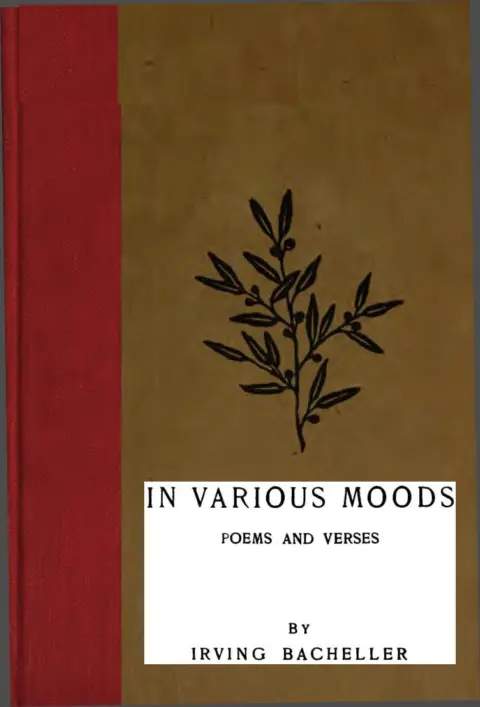
In Various Moods: Poems and Verses
Irving Bacheller
THE CLASSIC COLLECTION · 1904
"Vergilius: A Tale of the Coming of Christ" by Irving Bacheller is a historical novel written in the early 20th century. The narrative is set in ancient Rome, exploring themes of love, faith, and the transition from a world of paganism to one of emerging Christianity. The story primarily follows Vergilius, a young Roman knight, as he navigates the complexities of love and duty amid a backdrop of moral decay in the empire. The opening of "Vergilius" introduces readers to a richly depicted Rome, presenting a stark contrast between its opulent surface and the spiritual discontent of its people. As Rome grapples with excess and corruption, Vergilius is portrayed as a sincere and noble youth who is enamored with Arria, the daughter of a noble. Their budding romance unfolds with challenges, societal expectations, and hints of political intrigue, particularly as Vergilius is drawn into the machinations of powerful figures, including the emperor Augustus. The early chapters set the stage for a grand journey, reflecting on themes of love, virtue, and the search for truth as the empire stands on the brink of significant change.
Introduction adapted from the source catalogue; source summaries may be automatically generated.
Free to read · English · 41,356 words · No account needed
MAKE TIME FOR A GOOD BOOK
On by default. Untick to stop anonymous reading totals. Each page counts after 10 seconds in view. How this works.
Anonymous counting is on unless you have switched it off.
"Let me try." She flung it to the oaken beams and it fell on the great
rug beside her.
"Madame, the hand is up," said Vergilius. "I fear it is not
infallible."
"Let me see," she answered, stooping gravely to survey the coin. Something passed between her and her pleasure, and for one second a shadow wavered across her face.
"It is Death's hand, of course," she remarked, sadly. "Love is for the young and death is for the old."
"Old, madame! Why, your cheeks have roses in them."
"Good youth, you are too frank," said she, with a quick glance about her. "Did the coin say that she loved you?"
"It did."
"And what did she say?"
The young man hesitated.
"Come, you innocent! Of course, I knew that you would talk of nothing but love. What said she?"
"That she does not love me; but I am sure it is mere coquetry."
"Dear youth! You have a cunning eye. This very day speak, my brave Vergilius--speak to her brother Appius. To-night take him to dine with you."
"I had so planned."
A gong of silver rang in the palace halls. It was the signal to prepare for dinner, and the guests made their farewells. Soon Appius and the young lover walked side by side in the direction of the Palatine.
"And what have you been doing?" the former inquired, presently.
"Only dreaming."
"Of what?"
"Of love and happiness, and your sister."
"My sister?"
"Yes; I love her and wish to make her my wife."
"You have wealth and birth and wit and good prospects. I can see no objection to you. But love--love is a thing for women to talk about."
"You are wrong, Appius. I can feel it in my soul. And, believe me, I am no longer in Rome. I have found the gateway of a better world--like that heaven they speak of in the Trastevere--full of peace and beauty."
"You have, indeed, been dreaming," said the other. "But, Vergilius, there is one higher than I who shall choose her husband--the imperator. Does he know you?"
"I have met him, of course, but do much fear he would not remember me."
"We may know shortly. Every seventh day this year he has sat, like a beggar, at his gate asking for alms. To-day we shall see him there."
"It is an odd whim."
"Hush! you know the people as well as I, and he must please them," the other whispered. "He must conceal his power if he would live out his time. I will present you, and perhaps he may be gracious--ay, may even bid you to his banquet."
"A modest home," said young Vergilius.
Your reading position is saved on this browser. Take it to another device with a library code. Reading pages adapt to text, rather than matching a printed edition.
Irving Bacheller
Irving Bacheller
Irving Bacheller
Irving Bacheller
BEHIND THE BOOK
This eBook is for the use of anyone anywhere in the United States and most other parts of the world at no cost and with almost no restrictions whatsoever. You may copy it, give it away or re-use it under the terms of the Project Gutenberg License included with this eBook or online at www.gutenberg.org. If you are not located in the United States, you will have to check the laws of the country where you are located before using this eBook. Read the source licence.
The original source file, including credits and licence, is retained by this library. Request an original-format copy at no charge. Please include the book title and Project Gutenberg identifier #16491.
KEEP YOUR CURIOSITY GOING
Cécile Tormay

Moritz Busch
Coulson Kernahan
John L. Ransom

Maurice Baring
Frances Wright