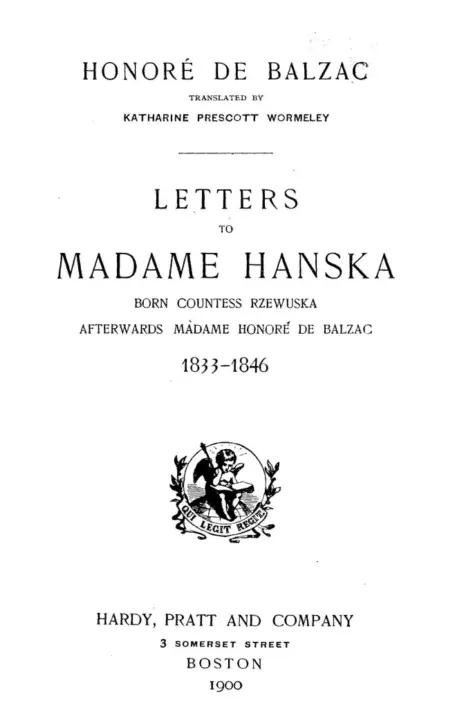
Letters to Madame Hanska, born Countess Rzewuska, afterwards Madame Honoré de Balzac, 1833-1846
Honoré de Balzac
THE CLASSIC COLLECTION · 1840
"Vautrin: A Drama in Five Acts" by Honoré de Balzac is a play written in the mid-19th century that explores complex themes of identity, motherhood, and the interplay of moral and social dilemmas in a post-revolutionary France. The narrative revolves around Jacques Collin, known as Vautrin, and his intricate schemes that entangle the lives of the aristocratic Duc de Montsorel, his wife, the Duchesse de Montsorel, and their son, the Marquis Albert. As secrets unfold, the characters are propelled towards a dramatic confrontation with their pasts and ambitions. The opening of the play introduces us to a world of uncertainty and intrigue, primarily through the perspective of the Duchesse de Montsorel, who displays a rare glimmer of hope upon believing she has found traces of her long-lost son, Fernand. Conversations between her and her aunt reveal her deep emotional turmoil, hinting at a significant family mystery that haunts her. The scene shifts to Vautrin, who appears both shadowy and charismatic, establishing his connections to the Montsorel family and hinting at deeper, intertwining plots as he interacts with the household. His arrival sets the stage for the potential unearthing of latent family secrets, as Vautrin maneuvers through the delicate social norms of the aristocratic circles, sparking anticipation for the conflicts ahead.
Introduction adapted from the source catalogue; source summaries may be automatically generated.
Free to read · English · 28,430 words · No account needed
MAKE TIME FOR A GOOD BOOK
On by default. Untick to stop anonymous reading totals. Each page counts after 10 seconds in view. How this works.
Anonymous counting is on unless you have switched it off.
Saint-Charles A sense of your danger brings me here. I am paid to be your enemy. You can keep silence as well as I; prove that your protection is more advantageous to me than the hollow promises of the duke, and I can assure you the victory. But time presses, the duke will soon be here, and if he finds us together, the success of our undertaking would be endangered.
The Duchess (to Mademoiselle de Vaudrey) Ah! we may still hope! (To Saint-Charles) And what were you going to do at the house of Monsieur de Frescas?
Saint-Charles
That which, at present, I am doing at yours.
The Duchess
Silence, sir.
Saint-Charles
Your grace has given me no answer; the duke has my word, and he is
very powerful.
The Duchess And I, sir, am immensely rich; but do not expect to take advantage of me. (She rises) I will never be the dupe of Monsieur de Montsorel, I recognize his trickery in this secret interview, which you had asked for. (With emphasis) Let me complete your information. Monsieur de Frescas is not a wretch; his servants are not assassins; he belongs to a family as rich as it is noble, and he is about to marry the Princesse d'Arjos.
Saint-Charles Yes, madame, a Mexican envoy has produced letters from Monsieur de Christoval, and documents remarkably authentic. You have sent for a secretary of the Spanish legation, who has endorsed them: seals, stamps, authentications--ah! all are flawless.
The Duchess
Yes, sir, the documents are unassailable.
Saint-Charles
You are very much interested, madame, in their being proved forgeries,
I presume?
The Duchess (to Mademoiselle de Vaudrey) Never has such torture as this wrung the heart of a mother!
Saint-Charles (aside)
Whose side shall I take, husband's or wife's?
The Duchess
Sir, any sum you may ask shall be yours, if you can prove to me that
Monsieur Raoul de Frescas--
Saint-Charles
Is a criminal?
The Duchess
No, but a child--
Saint-Charles
You mean your child, don't you?
The Duchess (forgetting herself)
Yes, yes! Be my deliverer, and I will be your eternal protector. (To
Mademoiselle de Vaudrey) Ah me! What have I said? (To Saint-Charles)
Where is Raoul?
Saint-Charles He has disappeared, and this steward of his, who procured the forged deeds in Rue Oblin, and doubtless played the part of the Mexican envoy, is one of the most astute of criminals. (The duchess starts.) Oh, you need not be alarmed; he is too clever to shed blood; but he is more formidable than those who shed it recklessly; and such a man is the guardian of Raoul.
The Duchess
My whole fortune for his life!
Your reading position is saved on this browser. Take it to another device with a library code. Reading pages adapt to text, rather than matching a printed edition.
Honoré de Balzac
Honoré de Balzac
Honoré de Balzac
Honoré de Balzac
BEHIND THE BOOK
This eBook is for the use of anyone anywhere in the United States and most other parts of the world at no cost and with almost no restrictions whatsoever. You may copy it, give it away or re-use it under the terms of the Project Gutenberg License included with this eBook or online at www.gutenberg.org. If you are not located in the United States, you will have to check the laws of the country where you are located before using this eBook. Read the source licence.
The original source file, including credits and licence, is retained by this library. Request an original-format copy at no charge. Please include the book title and Project Gutenberg identifier #6861.
KEEP YOUR CURIOSITY GOING
Maurice Baring
W. B. (William Butler) Yeats
Edward Martyn

John Brougham & Charlotte Brontë
Marguerite Merington
Leonid Andreyev