THE CLASSIC COLLECTION✦My diaries, being a personal narrative of events 1888-1914, Part 2 (1900-1914)CLASSIC FREE BOOKS
My diaries, being a personal narrative of events 1888-1914, Part 2 (1900-1914)
Wilfrid Scawen Blunt
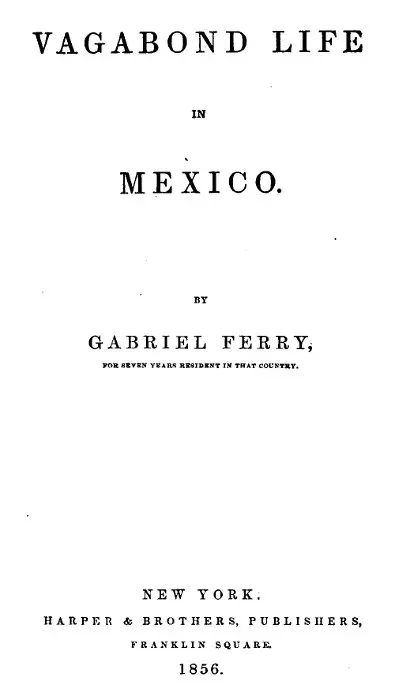
THE CLASSIC COLLECTION · 1856
"Vagabond Life in Mexico" by Gabriel Ferry is a narrative work likely written in the mid-19th century. The text immerses readers in the vibrant and tumultuous life of Mexico, exploring themes of societal contrasts, particularly focusing on the experiences of its lower classes and vagabonds. Central to this exploration is the character of Perico, a Mexican vagabond, and his interactions with various individuals in a society rife with both beauty and brutality. The opening of the narrative introduces the author’s first impressions of Mexico City, emphasizing its grandeur and the chaotic life within its streets. The protagonist’s fascination with the "léperos," or ragged street dwellers, sets the stage for his connection with Perico, hinting at adventures to come. As the protagonist navigates the complexities of Mexican society, including attending a bullfight with a Franciscan monk, the prose reveals the stark contrasts between opulence and destitution, innocence and vice. The text promises a vivid portrait of a city teeming with life, where every character presents a story intricately weaved into the fabric of its culture.
Introduction adapted from the source catalogue; source summaries may be automatically generated.
Free to read · English · 104,519 words · No account needed
MAKE TIME FOR A GOOD BOOK
On by default. Untick to stop anonymous reading totals. Each page counts after 10 seconds in view. How this works.
Anonymous counting is on unless you have switched it off.
We set out. The travelers we were in pursuit of could not be more than an hour in advance of us, and the unusual color of their horses would aid us in tracking them easily. I flattered myself that if we pushed on we could overtake them without difficulty in two hours, and if that were beyond our power, a couple of fresh horses would not take long to cover the six leagues between Mexico and Cuantitlan. I thus set out with the intention of returning before sunset. The difference of speed, however, between my horse and that of my servant, forced me to slacken my pace. Two hours had already rolled away without catching the slightest glimpse of the man I was in quest of, and the spire of Cuantitlan had not even come in sight. I almost feared that the inn-keeper had sent us the wrong road, when some muleteers, returning to Mexico, told me that they had met two horsemen, one mounted on an iron-gray, the other on a peach-blossom. We reached Cuantitlan in a short time, and I was directed to the hostelry where the two horsemen had stopped. I had not been long in coming hither, and was at last soon to know what I was burning to learn. I went to the inn which had been pointed out to me, and my foot had no sooner reached the ground than I began questioning the huesped with the air of one who is sure of finding what he wants.
"Are your horses tired?" said the host, when I had finished.
"No."
"Well, that's something, for the travelers only entered my house for refreshment and then left, and it will be fresh horses alone that can overtake them."
And the host, who interested himself as much, if that could be, with the horsemen that passed his house as with those that lived within it, turned his back upon me with the politeness peculiar to his class. I vaulted again into my saddle. A quarter of an hour more, thought I, would explain to me a certain defiant raillery which Cecilio had taken little pains to suppress. To my great mortification, however, the time rolled away; night was coming on, and the shades of evening were falling insensibly around. Night at last fell; and I would have given up this long-protracted chase, had not wounded self-esteem goaded me as much as curiosity. A solemn silence brooded over the road we were pursuing. Sometimes I stopped, fancying I heard before me the stamp of horses' feet, and then redoubled my pace with ardor, till the unbroken stillness which reigned around showed that I had been under a delusion. Still, the certainty of being on the traces of the unknown kept up my spirits, for, from Mexico to the place where we now were, not even a bridle-path joined our road. All the probabilities were in my favor. However, after a six hours' ride we required rest, and a twelve leagues' gallop rendered a halt necessary for our horses. It was, besides, time to set about looking for a place to put up, for in Mexico there are two requisites for getting into an inn; the first is, that the inn please the travelers; and the second, that the hour and the travelers please the inn-keeper. Luckily, I was not long in discovering a light in a cabin standing by itself, toward which we spurred our horses. Our host informed us that two horsemen had passed his house about half an hour before we came up, but the night was so dark that he could not distinguish the color of their horses. As he was sure that they must stop a short way off to pass the night, we decided to stay where we were till dawn, hoping to overtake them on the following morning. I considered that if we were off before sunrise we could easily make up for lost time. Unfortunately, Cecilio did not rise next morning till late, and the sun was high in the heavens ere we found ourselves on the road. I had, however, gone too far to recede, and, besides, I had now a definite aim to pursue. Cecilio did not view the case in the same light as myself, and it was with a slight feeling of despair that every now and then he informed me of the number of leagues we had traveled since we left Mexico. But, though seen by so many people, the travelers seemed to slip from me as if by magic at the very moment I was flattering myself that I had overtaken them. I had already passed through the rocky defile of the Cañada, and had left behind me the hacienda of St. Francisco. During my journey I had inquired at every rancho, and at all the ordinary halting-places, and every one concurred in saying that two mounted travelers, one on an iron-gray, the other on a peach-blossom, could be only a short distance in advance.
Your reading position is saved on this browser. Take it to another device with a library code. Reading pages adapt to text, rather than matching a printed edition.
BEHIND THE BOOK
This eBook is for the use of anyone anywhere in the United States and most other parts of the world at no cost and with almost no restrictions whatsoever. You may copy it, give it away or re-use it under the terms of the Project Gutenberg License included with this eBook or online at www.gutenberg.org. If you are not located in the United States, you will have to check the laws of the country where you are located before using this eBook. Read the source licence.
The original source file, including credits and licence, is retained by this library. Request an original-format copy at no charge. Please include the book title and Project Gutenberg identifier #50620.
KEEP YOUR CURIOSITY GOING
Wilfrid Scawen Blunt
Wilfrid Scawen Blunt

E. W. (Edgar Watson) Howe
Coulson Kernahan

Maurice Baring
Frances Wright