THE CLASSIC COLLECTION✦My diaries, being a personal narrative of events 1888-1914, Part 2 (1900-1914)CLASSIC FREE BOOKS
My diaries, being a personal narrative of events 1888-1914, Part 2 (1900-1914)
Wilfrid Scawen Blunt
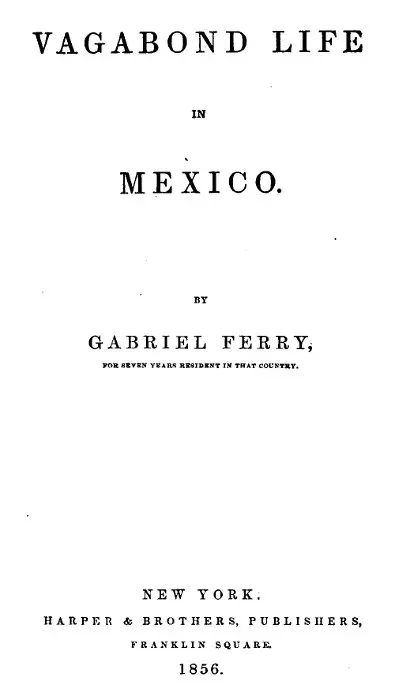
THE CLASSIC COLLECTION · 1856
"Vagabond Life in Mexico" by Gabriel Ferry is a narrative work likely written in the mid-19th century. The text immerses readers in the vibrant and tumultuous life of Mexico, exploring themes of societal contrasts, particularly focusing on the experiences of its lower classes and vagabonds. Central to this exploration is the character of Perico, a Mexican vagabond, and his interactions with various individuals in a society rife with both beauty and brutality. The opening of the narrative introduces the author’s first impressions of Mexico City, emphasizing its grandeur and the chaotic life within its streets. The protagonist’s fascination with the "léperos," or ragged street dwellers, sets the stage for his connection with Perico, hinting at adventures to come. As the protagonist navigates the complexities of Mexican society, including attending a bullfight with a Franciscan monk, the prose reveals the stark contrasts between opulence and destitution, innocence and vice. The text promises a vivid portrait of a city teeming with life, where every character presents a story intricately weaved into the fabric of its culture.
Introduction adapted from the source catalogue; source summaries may be automatically generated.
Free to read · English · 104,519 words · No account needed
MAKE TIME FOR A GOOD BOOK
On by default. Untick to stop anonymous reading totals. Each page counts after 10 seconds in view. How this works.
Anonymous counting is on unless you have switched it off.
Hardly a century ago, Guanajuato was a town of very little importance. Before the sudden change in its fortune, which resulted from the rich yield of silver in the Valenciana and Rayas mines, the mining industry of Mexico had concentrated its activity in the works of Tasco, Pachuca, and Zacatecas. The title of ciudad (city) had been borne by Zacatecas since 1588, while Guanajuato, though founded in 1554, did not attain that rank till seventy-eight years later, in 1741. It was not known that the mountains inclosing it on all sides, and on the slope of which it was built, held within their stony bosom the Veta Madre (Mother Vein), the richest lode of silver in the world. The situation of Guanajuato is, besides, doubly advantageous. The city is situated at once in the richest mining district in Mexico, and in the best cultivated part of the fertile plains of the Bajio.[32] It is thus the inhabitants call that large extent of country, about eighty leagues in circumference, which is bounded toward the side of Guanajuato by the Cordillera.
Alternately parched and inundated, the Bajio presents at all seasons an aspect singularly picturesque. During the rainy season, the winter of those favored climes, the sky, which loses its blue without losing its softness, floods the plains with fertilizing torrents. For several hours a day the Bajio is a vast lake, studded with tufts of verdure, with blue hills, with groups of white houses and enameled cupolas. On this sheet of water the green summits of the trees alone reveal to the traveler the capricious meanderings of the inundated road. Soon, however, the thirsty soil has imbibed the moisture through the innumerable cracks that eight months' drought has left in its surface. A layer of slime, deposited by the heavy rains and the torrents from the Cordillera, has enriched the impoverished earth. The heavens are clear and cloudless as before. The springs, freed from the crust which obstructed them, gush out more abundantly from the foot of the ahuehuetl.[33] The Peruvian-tree, the gum-tree, the golden-flowered huisache, amid whose blossoms the scarlet-plumed parrots scream, shade and perfume the now consolidated roads. The songs of muleteers and the bells of mules resound in the blue distance, mingled with the shrill creaking of cart-wheels. It is the time when the Indian laborer returns to his toils. Like the shepherd in the Georgics, with his leathern buskins, his short tunic, and bare legs, he lazily goads the oxen at the plow. And such is the fertility of this soil, that splendid crops cover the ground which the plow has scarcely furrowed. Still, it is not in the rich plain alone that nature has been most indulgent to the happy dwellers in the Bajio. Over the fertile valleys in the vicinity of Guanajuato, the Cordillera rears its metalliferous crest, whose sides are veined with lodes of gold and silver, and which delivers to the mattock of the miner the immense treasures of the Veta Madre.[34] The striking contrast that is visible between the laborer and the miner is nowhere so strongly apparent as in this part of the Bajio. Humble and submissive, the Indian husbandman is at every one's mercy. The miner, haughty and independent, takes a higher rank; and this claim is justified, we must admit, by the importance of the duty he performs. Obliged to submit to labor which yields him only limited results, the husbandman finishes his work in silence, while the pickaxe of the miner resounds, so to speak, to the end of the world, and is constantly adding, at every stroke, to the riches of mankind. Prosperity is not long in coming to the indefatigable miner. The slopes of the hills, the ravines, and the summits of the mountains swarm with a dense population, among whom the lucky finders of a new lode scatter their hard-earned money with thoughtless liberality, and squander in one day the earnings of six months. From the French miner Laborde, who lavished thousands upon Cathedrals, down to the meanest peon, the history of this bold workman has been always the same. Fortune is the only god he worships. He goes to his dangerous occupation as if specially sent thither by Divine Providence; and this proud thought is favored by the laws of the country, old privileges according the title of nobility to the worker in the mines. Even at this day he can not be dispossessed by his creditors of his mine, if he can afford to work it. It appears that there is a tendency to respect the descendants of a privileged race. Besides a knowledge of metals to guide him in his search, the miner must be endowed with a number of rare qualities; from that vigorous strength indispensable to one who has to raise heavy burdens, and support all day, on scanty wages, the enervating fatigue of under-ground work, down to activity and pliancy of limb, united with undaunted resolution and coolness. These qualities, it must be owned, are never found in the same man without corresponding defects. A capricious and undisciplined being, the miner only employs all his tact and energy if interested in the success of his enterprise. Sometimes, after toiling for a month, during which he has hardly earned enough to live upon--in a week, or even in a day, he recompenses himself for his long privations. The miner then thanks Dame Fortune. He scatters his gold with a lavish hand, and returns to his work only after all his gains are exhausted. At times he enriches himself by secretly pilfering the ore which really belongs to the proprietor of the mine, and the miners are but too expert at this species of theft.
Your reading position is saved on this browser. Take it to another device with a library code. Reading pages adapt to text, rather than matching a printed edition.
BEHIND THE BOOK
This eBook is for the use of anyone anywhere in the United States and most other parts of the world at no cost and with almost no restrictions whatsoever. You may copy it, give it away or re-use it under the terms of the Project Gutenberg License included with this eBook or online at www.gutenberg.org. If you are not located in the United States, you will have to check the laws of the country where you are located before using this eBook. Read the source licence.
The original source file, including credits and licence, is retained by this library. Request an original-format copy at no charge. Please include the book title and Project Gutenberg identifier #50620.
KEEP YOUR CURIOSITY GOING
Wilfrid Scawen Blunt
Wilfrid Scawen Blunt

E. W. (Edgar Watson) Howe
Coulson Kernahan

Maurice Baring
Frances Wright