THE CLASSIC COLLECTION✦My diaries, being a personal narrative of events 1888-1914, Part 2 (1900-1914)CLASSIC FREE BOOKS
My diaries, being a personal narrative of events 1888-1914, Part 2 (1900-1914)
Wilfrid Scawen Blunt
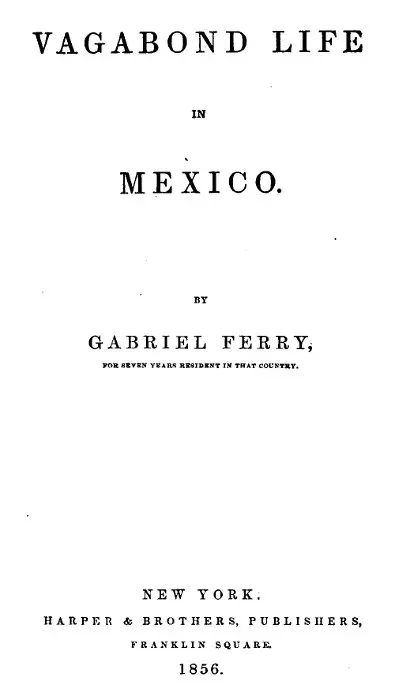
THE CLASSIC COLLECTION · 1856
"Vagabond Life in Mexico" by Gabriel Ferry is a narrative work likely written in the mid-19th century. The text immerses readers in the vibrant and tumultuous life of Mexico, exploring themes of societal contrasts, particularly focusing on the experiences of its lower classes and vagabonds. Central to this exploration is the character of Perico, a Mexican vagabond, and his interactions with various individuals in a society rife with both beauty and brutality. The opening of the narrative introduces the author’s first impressions of Mexico City, emphasizing its grandeur and the chaotic life within its streets. The protagonist’s fascination with the "léperos," or ragged street dwellers, sets the stage for his connection with Perico, hinting at adventures to come. As the protagonist navigates the complexities of Mexican society, including attending a bullfight with a Franciscan monk, the prose reveals the stark contrasts between opulence and destitution, innocence and vice. The text promises a vivid portrait of a city teeming with life, where every character presents a story intricately weaved into the fabric of its culture.
Introduction adapted from the source catalogue; source summaries may be automatically generated.
Free to read · English · 104,519 words · No account needed
MAKE TIME FOR A GOOD BOOK
On by default. Untick to stop anonymous reading totals. Each page counts after 10 seconds in view. How this works.
Anonymous counting is on unless you have switched it off.
At the commencement of the year 1835 I happened to be in Mexico, engaged in the prosecution of a troublesome piece of business. This concerned the somewhat problematical recovery of a very considerable sum of money due me by an individual of whom I could not find the slightest trace. The business demanded the most energetic measures, and I addressed myself, in consequence, to several lawyers, well known for their success in dealing with such difficult cases. They all at first promised their assistance, but when I mentioned my debtor's name (he was called Don Dionisio Peralta), one and all of them excused themselves from having any share in the business. One said he could never pardon himself if he gave the slightest cause of uneasiness to so gallant a man as Señor Peralta; a second, that he was attached to him by a compadrazgo[17] of long standing; a third suddenly remembered that he had been a bosom friend of his in his youth. A fourth, more communicative than the others, enlightened me as to the cause of such friendly scruples; these gentlemen had the fear of a dagger before their eyes, a mode of procedure of which Señor Peralta had availed himself more than once, to shake himself free of creditors who had been too pressing. "I don't know," he added, "a single person who will undertake your business, if the licentiate Don Tadeo Cristobal refuse: he has a heart of rock and a hand of iron; he is the man for you." I ran immediately to the Calle de los Batanes, where I was told he lived; but another check awaited me there. Don Tadeo had quitted that place, and no one could tell me his present abode.
Wearied and dejected in the evening, after a whole day spent in running up and down to no purpose, I was walking listlessly to and fro in the Merchants' Arcades (Portales de los Mercadores), which stands on the grand square of Mexico. Despairing of success, I resolved to ask for some information about Don Tadeo from some of the numerous public writers, whose stalls under the gallery are so many public intelligence offices; but, once there, I completely forgot the motive which had brought me into this kind of bazar, the daily resort of all the idlers of Mexico, and my attention was completely distracted by the animated picture which was unrolled before my eyes. The spectator will be less astonished at this if he figure to himself the almost magical appearance the Plaza Mayor presents an hour before sunset. The Portales de los Mercadores occupy, in fact, almost one complete side of this immense square. The Cathedral, the Ayuntamiento, and the President's palace form, as the reader already knows, the other three sides. The most beautiful streets in Mexico debouch between those buildings; there is the street Primeria Monterilla, crowded with elegant shops; another, called los Plateros (the street of the goldsmiths), whose shops are almost exclusively occupied by jewelers or lapidaries, while the petty Mexican merchant seems to have chosen, for the display of European commodities, the dark arcades of the los Mercadores. At the time of my stay in Mexico, French innovation had not yet ventured to alter the picturesque appearance of these arcades, which, in their general aspect, bore a remarkable resemblance to the Piliers des Halles in Paris. The heavy arches are supported on one side by vast warehouses, on the other by pillars, at the foot of which are ranged shops (alacenas) well stocked with religious books, rosaries, daggers, and spurs. Close by these shops, as if to represent all the grades of trafficking, léperos, in rags, hawk about articles of glassware, and, sticking one of them on the tip of their finger, they search for customers with great eagerness. Every now and then the venders of wild duck ragouts, or tamales,[18] seated in the shade of the arches, strike in, amid the din of the crowd, with their well-known cry,[19] Aqui hay poto grande, mi alma; senorito venga sted, or that as popular but shorter call, Tamales[20] queretanos. The passers-by and purchasers are as worthy of observation as the sellers. The ever-varying color of gowns and tapalos,[21] the gold of the mangas, and the motley color of the serapes, form, under the dim, hazy light which prevail in the pilastera, a brilliant mixture of different colors, which reminds one strongly of the most fantastical Venetian masquerades. In the evening, when the stalls and shops are closed, the Merchants' Arcades become a kind of political club. Seated on the threshold of the gates, or striding along in this kind of cloister, officers and townsmen talk about revolutions that have been effected, or are to be effected, till the time when the almost deserted galleries serve only as a retreat for lovers, and their low whispers is all that is heard beneath the silent arcades.
Your reading position is saved on this browser. Take it to another device with a library code. Reading pages adapt to text, rather than matching a printed edition.
BEHIND THE BOOK
This eBook is for the use of anyone anywhere in the United States and most other parts of the world at no cost and with almost no restrictions whatsoever. You may copy it, give it away or re-use it under the terms of the Project Gutenberg License included with this eBook or online at www.gutenberg.org. If you are not located in the United States, you will have to check the laws of the country where you are located before using this eBook. Read the source licence.
The original source file, including credits and licence, is retained by this library. Request an original-format copy at no charge. Please include the book title and Project Gutenberg identifier #50620.
KEEP YOUR CURIOSITY GOING
Wilfrid Scawen Blunt
Wilfrid Scawen Blunt

E. W. (Edgar Watson) Howe
Coulson Kernahan

Maurice Baring
Frances Wright