THE CLASSIC COLLECTION✦My diaries, being a personal narrative of events 1888-1914, Part 2 (1900-1914)CLASSIC FREE BOOKS
My diaries, being a personal narrative of events 1888-1914, Part 2 (1900-1914)
Wilfrid Scawen Blunt
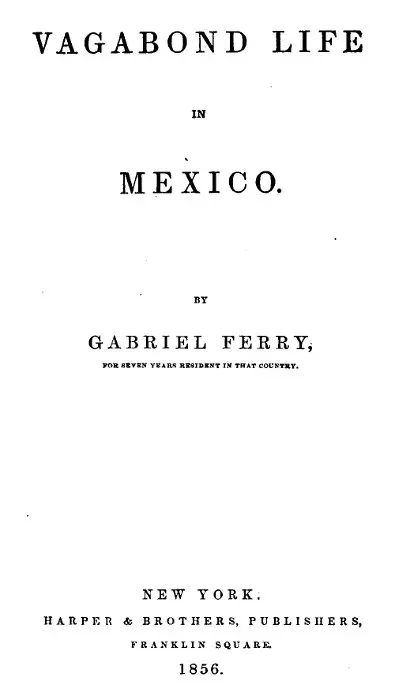
THE CLASSIC COLLECTION · 1856
"Vagabond Life in Mexico" by Gabriel Ferry is a narrative work likely written in the mid-19th century. The text immerses readers in the vibrant and tumultuous life of Mexico, exploring themes of societal contrasts, particularly focusing on the experiences of its lower classes and vagabonds. Central to this exploration is the character of Perico, a Mexican vagabond, and his interactions with various individuals in a society rife with both beauty and brutality. The opening of the narrative introduces the author’s first impressions of Mexico City, emphasizing its grandeur and the chaotic life within its streets. The protagonist’s fascination with the "léperos," or ragged street dwellers, sets the stage for his connection with Perico, hinting at adventures to come. As the protagonist navigates the complexities of Mexican society, including attending a bullfight with a Franciscan monk, the prose reveals the stark contrasts between opulence and destitution, innocence and vice. The text promises a vivid portrait of a city teeming with life, where every character presents a story intricately weaved into the fabric of its culture.
Introduction adapted from the source catalogue; source summaries may be automatically generated.
Free to read · English · 104,519 words · No account needed
MAKE TIME FOR A GOOD BOOK
On by default. Untick to stop anonymous reading totals. Each page counts after 10 seconds in view. How this works.
Anonymous counting is on unless you have switched it off.
"Capa de Dios!" cried he. "Whether is it my person or my cloak you
are fancying, Sir Robber?"
I thought I knew the voice, and I hastened to reply:
"I am neither a robber nor assassin, Señor Don--"
I thought the unknown was going to assist my memory, and state his name. He did nothing of the kind; but, putting his back to the door of a house, he said, roughly,
"Who are you, and what do you want?"
"I am seeking for the dwelling of Don Tadeo the licentiate," I replied; "and, if I am not greatly deceived, we are standing before it at this very moment."
"Ah! who told you he lived here?"
"Tio Lucas, the public scribe. I wish to consult Don Tadeo on a very
important affair."
"Don Tadeo! It is he that is speaking to you just now."
The costume of this man I could not distinguish; his features were precisely similar to the bull-fight amateur, with whose name Tio Lucas had acquainted me. I hastened to reply to Don Tadeo, counting myself happy in having met him, and begged a few minutes' private conversation.
"With the greatest pleasure," he replied. "I am quite ready to take up your affair; but let us first enter the house; we can then speak more at our ease." At the same time, he struck the pommel of his sword against the door behind him. "My profession," added he, "obliges me to employ many precautions. You will immediately comprehend why. Do not be astonished at my queer domicile. You may think me an original, and may have reason."
Don Tadeo paused, and the door of the mysterious house opened with a great clanking of chains. The porter, with a huge lantern in his hand, bowed respectfully to the licentiate, who motioned me to follow him. We walked rapidly along the zaguan or lobby, and, after mounting a very steep stair, stopped before a serge curtain, surmounted by a transparent lantern, on which was inscribed, in large letters, Sociedad Filarmonica. Voices and confused cries escaped from the hall which bore this ambitious title. "Are those your clients who are making such a great noise, Señor Licentiate?" I inquired. Without a word, he lifted the curtain of green serge, and we found ourselves in an immense hall, indifferently lighted. A long table, covered with green baize, and surrounded with players, stood in the middle of the room. Besides the lamps which hung from the walls, the place was lighted up by four candles stuck into tin holders. Some small tables, with refreshments, placed at regular distances from each other, furnished the players with infusions of tamarinds, rose water, or Barcelona brandy. At the bottom of the hall rose a high estrade, ornamented with some size-color paintings, representing, for the purpose, no doubt, of showing the original design of the establishment, a confused group of bassoons, hunting-horns, and clarionets. My surprise may be easily conceived when I found myself in a gambling-house like this at the very time I fancied I was stepping into a lawyer's office. I contemplated my companion as if I were looking upon him for the first time. He was assuredly the very man I had met in the circus and in the Merchants' Arcades. With this strange costume, long rapier, and thick, black curly hair, his appearance partook more of the bandit than of the lawyer. He had taken only a few steps in the hall when he was accosted by two individuals--worthy habituès of such a den. The first was a tall, awkward, shambling fellow, with a ferocious air, who held out to the licentiate a hand large as a shoulder of mutton, and said, in Spanish, with strong English accent, "How is Señor Don Tadeo to-day?"
Your reading position is saved on this browser. Take it to another device with a library code. Reading pages adapt to text, rather than matching a printed edition.
BEHIND THE BOOK
This eBook is for the use of anyone anywhere in the United States and most other parts of the world at no cost and with almost no restrictions whatsoever. You may copy it, give it away or re-use it under the terms of the Project Gutenberg License included with this eBook or online at www.gutenberg.org. If you are not located in the United States, you will have to check the laws of the country where you are located before using this eBook. Read the source licence.
The original source file, including credits and licence, is retained by this library. Request an original-format copy at no charge. Please include the book title and Project Gutenberg identifier #50620.
KEEP YOUR CURIOSITY GOING
Wilfrid Scawen Blunt
Wilfrid Scawen Blunt

E. W. (Edgar Watson) Howe
Coulson Kernahan

Maurice Baring
Frances Wright