THE CLASSIC COLLECTION✦My diaries, being a personal narrative of events 1888-1914, Part 2 (1900-1914)CLASSIC FREE BOOKS
My diaries, being a personal narrative of events 1888-1914, Part 2 (1900-1914)
Wilfrid Scawen Blunt
THE CLASSIC COLLECTION · 1856
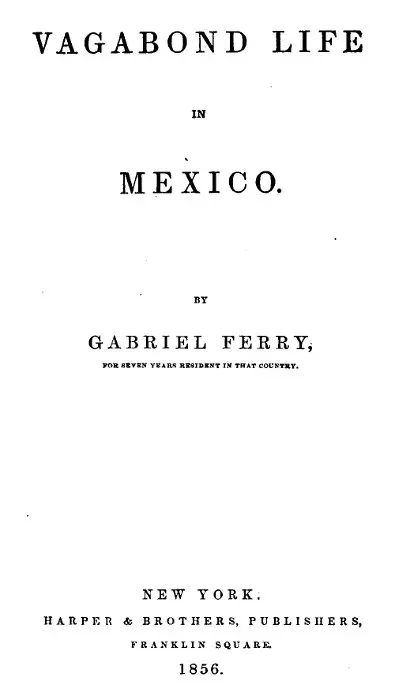
"Vagabond Life in Mexico" by Gabriel Ferry is a narrative work likely written in the mid-19th century. The text immerses readers in the vibrant and tumultuous life of Mexico, exploring themes of societal contrasts, particularly focusing on the experiences of its lower classes and vagabonds. Central to this exploration is the character of Perico, a Mexican vagabond, and his interactions with various individuals in a society rife with both beauty and brutality. The opening of the narrative introduces the author’s first impressions of Mexico City, emphasizing its grandeur and the chaotic life within its streets. The protagonist’s fascination with the "léperos," or ragged street dwellers, sets the stage for his connection with Perico, hinting at adventures to come. As the protagonist navigates the complexities of Mexican society, including attending a bullfight with a Franciscan monk, the prose reveals the stark contrasts between opulence and destitution, innocence and vice. The text promises a vivid portrait of a city teeming with life, where every character presents a story intricately weaved into the fabric of its culture.
Introduction adapted from the source catalogue; source summaries may be automatically generated.
Free to read · English · 104,519 words · No account needed
MAKE TIME FOR A GOOD BOOK
On by default. Untick to stop anonymous reading totals. Each page counts after 10 seconds in view. How this works.
Anonymous counting is on unless you have switched it off.
Here the narrator paused. We were gradually approaching the mouth of the tiro, as I could discover by the light shining through the fog which still enveloped us; besides, the higher we got, the gulf below appeared more frightful.
"Do you know what distance we are from the bottom of the mine?" cried the guide. "Five and a half times the height of the towers of the Cathedral of Mexico."
To confirm this assertion, the miner drew from his belt a bundle of tow steeped in pitch, which he lighted at his torch. My strained eye could scarcely follow it as it slowly descended the pit like a globe of fire, till it gradually became small as one of those pale stars whose light scarcely reaches our earth. The voice of the miner, who again began his recital, turned my mind away from this reflection.
"From that night on which Osorio showed himself at the betrothal, Felipe was annoyed in a thousand ways by some unknown hand. On the very next day a blast was fired close to him, and covered him with fragments of rock; another time, when he was at a considerable height in one of the galleries, the rope to which he was suspended broke suddenly. These attempts being unsuccessful, vague assertions began to be bruited abroad, accusing poor Felipe as the thief who had stolen the monstrance. The brave young man was unwilling to recognize in Osorio the author of these foul calumnies. His eyes could hardly have been opened to the evidence that he was his calumniator, had not a young miner, who constantly watched Osorio, and who had lately entered the mine, apprised Felipe of the snares that were laid for him. Felipe resolved to seek his revenge. On the evening of the day on which the marriage was to take place (for all this had passed in less than a week), Osorio and Felipe met in the subterranean galleries of the mine. Felipe reproached Osorio with his treachery; Osorio replied by recounting the injuries he had suffered; the two then drew their knives. They were alone and almost naked; their frazadas were their only shields. Osorio was the stronger, Felipe the more agile; the issue of the combat was therefore uncertain. All at once the young miner of whom I have spoken threw himself between the two combatants. 'Allow me,' said he, to Felipe, 'to punish this sacrilegious robber; my claim is anterior to yours.' Osorio gnashed his teeth and threw himself on the young miner, who stood grimly on his defense. The two then began to fight by the light of Felipe's torch, who had now become a spectator instead of an actor. With their frazadas wound round their left arms to hide their lunges, they commenced the combat. Perhaps the struggle would have been a long-protracted one had not the young miner adopted the following stratagem: he took such a position as allowed the covering on his arm to sweep the ground; then, behind the veil which masked his movements, he slipped his knife into his other hand, and gave his adversary a mortal wound. Osorio fell. He was drawn up by the grand shaft in a costal.[37] By chance a padre happened to be passing the mine at that moment. They besought him to come and confess the wounded man; but scarcely had the dying man and the padre looked at one another than a cry of horror broke from the priest. The holy father had recognized in the wounded man the passer of the Rio Atotonilco. Osorio discovered in the priest the man he thought he had drowned, but who had escaped as if by a miracle from almost certain death. After that, by the investigations of justice, many mysteries were cleared up. The passer of the Rio Atotonilco, the sacrilegious robber, the miner of Zacatecas, and also of Rayas, were one and the same person. The garrote did justice to the crimes of this wretch, and it was his hand you saw nailed to the wall in the grand square of Guanajuato. I must now tell you what became of Felipe. The providential recognition of the victim and his assassin was soon noised abroad, and a few hours afterward a band of alguazils appeared to arrest the miner who had stabbed Osorio. Unluckily, on that day Felipe had quitted his work sooner than ordinary. I do not know by what fatal mistake he had been pointed out as the murderer of Osorio; perhaps it was an additional token of good-heartedness on that caitiff's part--at any rate, the alguazils came to seize him. The victorious combatant had escaped, and I need not tell you that this mortal enemy of Osorio's was no other than the young man whom he had ill used, and who was a witness of the crime he had committed on the Rio Atotonilco. Had Felipe remained under ground, the alguazils would not have ventured into the inner workings of the mine, for the miners would not have suffered any injury to be inflicted on a comrade in their fueros. The alguazils perceived the young man in one of the courts of the mine buildings, and immediately set off in pursuit. Felipe saw he was lost; but he resolved to die a miner's death, and not suffer himself to be dishonored by the touch of the bailiffs. Having arrived at the brink of this very shaft quite out of breath, 'I will not be insulted as if I were a vile lépero,' he cried; 'a miner is more than man; he is the instrument whom God delights to employ!' Then, with pale face and gleaming eyes, he leaped over the balustrade surrounding the shaft, and disappeared in the black gulf which now yawns beneath your feet."
Your reading position is saved on this browser. Take it to another device with a library code. Reading pages adapt to text, rather than matching a printed edition.
BEHIND THE BOOK
This eBook is for the use of anyone anywhere in the United States and most other parts of the world at no cost and with almost no restrictions whatsoever. You may copy it, give it away or re-use it under the terms of the Project Gutenberg License included with this eBook or online at www.gutenberg.org. If you are not located in the United States, you will have to check the laws of the country where you are located before using this eBook. Read the source licence.
The original source file, including credits and licence, is retained by this library. Request an original-format copy at no charge. Please include the book title and Project Gutenberg identifier #50620.
KEEP YOUR CURIOSITY GOING
Wilfrid Scawen Blunt
Wilfrid Scawen Blunt

E. W. (Edgar Watson) Howe
Coulson Kernahan

Maurice Baring
Frances Wright