THE CLASSIC COLLECTION✦Search-Light LettersCLASSIC FREE BOOKS
Search-Light Letters
Robert Grant
THE CLASSIC COLLECTION · 1900
"Unleavened Bread" by Robert Grant is a novel written in the early 20th century. The story revolves around Selma White, a young schoolteacher navigating her path in a rapidly changing American society, following her marriage to Lewis Babcock, a varnish manufacturer. The narrative explores themes of personal development, ambition, and the evolving role of women during a time of social transformation. The opening of the novel introduces Selma and Babcock as they depart from a wedding, setting the stage for their developing relationship. Selma reflects on her previous life and the constraints she feels from her small-town upbringing and societal expectations, contrasting her aspirations of achieving something greater in a burgeoning city like Benham. Babcock, on the other hand, is portrayed as a devoted husband who yearns for Selma's affection while harboring dreams of a prosperous future. Their early interactions signal Selma's ambivalence toward traditional domestic roles and foreshadow the complexities of her character as she grapples with her desires for independence and influence in a changing world.
Introduction adapted from the source catalogue; source summaries may be automatically generated.
Free to read · English · 122,633 words · No account needed
MAKE TIME FOR A GOOD BOOK
On by default. Untick to stop anonymous reading totals. Each page counts after 10 seconds in view. How this works.
Anonymous counting is on unless you have switched it off.
At the close of the fortnight of her stay in Washington subsequent to the reception at the White House, Selma found herself in the same frame of mind as when she parted from Mr. Elton. During this fortnight her time was spent either in sight seeing or at the hotel. The exercises at the Capitol were purely formal, preliminary to a speedy adjournment of Congress. Consequently her husband had no opportunity to distinguish himself by addressing the house. Of Flossy she saw nothing, though the two men had several meetings. Apparently both Lyons and Williams were content with a surface reconciliation between their wives which did not bar family intercourse. At least her husband made no suggestion that she should call on Mrs. Williams, and Flossy's cards did not appear. Beyond making the acquaintance of a few more wives and daughters in the hotel, who seemed as solitary as herself, Selma received no overtures from her own sex. She knew no one, and no one sought her out or paid her attention. She still saw fit to believe that if she were to establish herself in Washington and devote her energies to rallying these wives and daughters about her, she might be able to prove that Flossy and Mr. Elton were mistaken. But she realized that the task would be less simple than she had anticipated. Besides she yearned to return to Benham, and take up again the thread of active life there. Benham would vindicate her, and some day Benham would send her back to Washington to claim recognition and her rightful place.
Lyons himself was in a cheerful mood and found congenial occupation in visiting with his wife the many historical objects of interest, and in chatting in various hotel corridors with the public men of the country, his associates in Congress. His solicitude in regard to the account which Williams was carrying for him had been relieved temporarily by an upward turn in the stock market, and the impending prompt adjournment of Congress had saved him from the necessity of taking action in regard to the railroad bill which Williams had solicited him to support. Moreover Selma had repeated to him Horace Elton's prophecy that it was not unlikely that some day he would become Senator. To be sure he recognized that a remark like this uttered to a pretty woman by an astute man of affairs such as Elton was not to be taken too seriously. There was no vacancy in the office of Senator from his state, and none was likely to occur. At the present time, if one should occur, his party in the state legislature was in a minority. Hence prophecy was obviously a random proceeding. Nevertheless he was greatly pleased, for, after all, Elton would scarcely have made the speech had he not been genuinely well disposed. A senatorship was one of the great prizes of political life, and one of the noblest positions in the world. It would afford him a golden opportunity to leave the impress of his convictions on national legislation, and defend the liberties of the people by force of the oratorical gifts which he possessed. Elton had referred to these gifts in complimentary terms. Was it not reasonable to infer that Elton would be inclined to promote his political fortunes? Such an ally would be invaluable, for Elton was a growing power in the industrial development of the section of the country where they both lived. He had continued to find him friendly in spite of his own antagonism on the public platform to corporate power. A favorite and conscientious hope in his political outlook was that he might be able to make capital as well as labor believe him to be a friend without alienating either; that he might obtain support at the polls from both factions, and thus be left free after election to work out for their mutual advantage appropriate legislation. He had avowed himself unmistakably the champion of popular principles in order to win the confidence of the common people, but his policy of reasonable conciliation led him to cast sheep's eyes at vested interests when he could do so without exposing himself to the charge of inconsistency. Many of his friends were wealthy men, and his private ambition was to amass a handsome fortune. That had been the cause of his speculative ventures in local enterprises which promised large returns, and in the stock market. Horace Elton was a friend of but three years' standing; one of the men who had consulted him occasionally in regard to legal matters since he had become a corporation attorney. He admired Elton's strong, far-reaching grasp of business affairs, his capacity to formulate and incubate on plans of magnitude without betraying a sign of his intentions, and his power to act with lightning despatch and overwhelming vigor when the moment for the consummation of his purposes arrived. He also found agreeable Elton's genial, easy-going ways outside of business hours, which frequently took the form of social entertainment at which expense seemed to be no consideration and gastronomic novelties were apt to be presented. Lyons attended one of these private banquets while in Washington--a dinner party served to a carefully chosen company of public men, to which newspaper scribes were unable to penetrate. This same genial, easy-going tendency of Elton's to make himself acceptable to those with whom he came in contact took the form of a gift to Mrs. Lyons of a handsome cameo pin which he presented to her a day or two after their dialogue at the President's reception, and for which, as he confidentially informed Selma, he had been seeking a suitable wearer ever since he had picked it up in an out-of-the-way store in Brussels the previous summer.
Your reading position is saved on this browser. Take it to another device with a library code. Reading pages adapt to text, rather than matching a printed edition.
Robert Grant
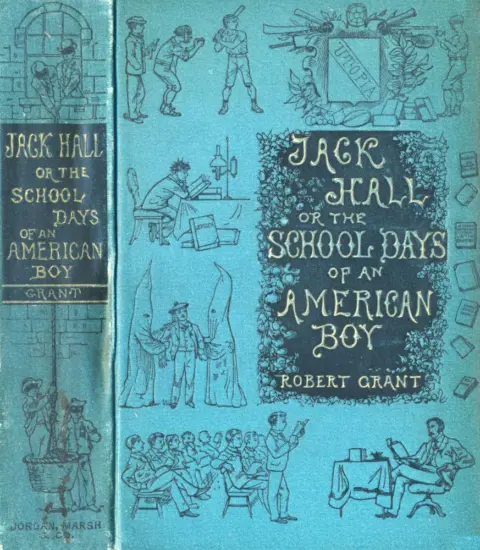
Robert Grant

Robert Grant
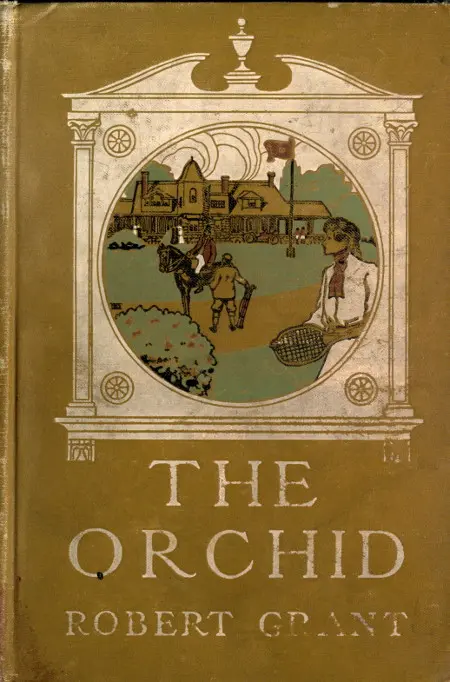
Robert Grant
BEHIND THE BOOK
This eBook is for the use of anyone anywhere in the United States and most other parts of the world at no cost and with almost no restrictions whatsoever. You may copy it, give it away or re-use it under the terms of the Project Gutenberg License included with this eBook or online at www.gutenberg.org. If you are not located in the United States, you will have to check the laws of the country where you are located before using this eBook. Read the source licence.
The original source file, including credits and licence, is retained by this library. Request an original-format copy at no charge. Please include the book title and Project Gutenberg identifier #14645.
KEEP YOUR CURIOSITY GOING
Coulson Kernahan

Maurice Baring
Frances Wright
Cécile Tormay

Frederic Jesup Stimson

W. H. P. (William Henry Pope) Jarvis