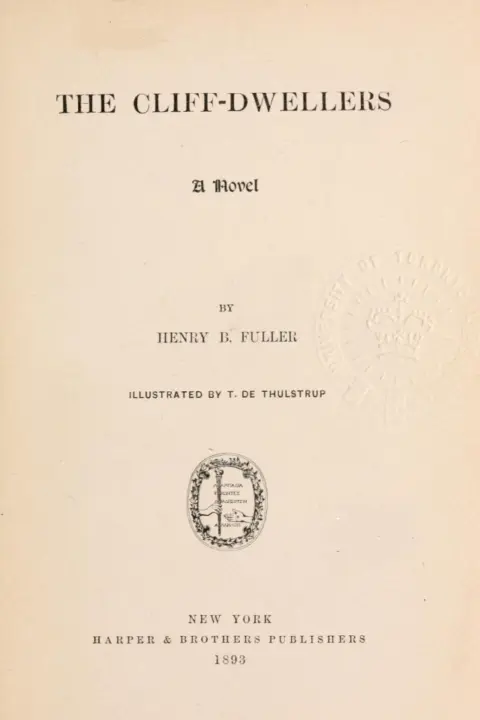
The Cliff-Dwellers: A Novel
Henry Blake Fuller
THE CLASSIC COLLECTION · 1901
"Under the Skylights" by Henry Blake Fuller is a novel written in the late 19th century. The book revolves around Abner Joyce, a passionate young writer whose earnestness and socially conscious perspectives on rural life and community reform shape his literary works. At its core, the narrative explores Abner's interactions with various city denizens—ranging from affluent society members to fellow artists and reformers—as he grapples with issues of social justice and personal identity. The opening of the story establishes Abner Joyce's character as a driven, idealistic individual who has recently gained attention with his first book, "This Weary World." His intense earnestness is juxtaposed with the superficiality he perceives in the urban social scene, which he navigates with a mixture of intrigue and disdain. As the chapters progress, the text introduces a colorful cast of characters, including Mrs. Palmer Pence, a wealthy society woman, and Leverett Whyland, a man of influence, setting the stage for Abner's internal and external conflicts between his humble origins and the seductive allure of urban intellectual life. The beginning effectively captures the tension between idealism and pragmatism, hinting at the shifts Abner will experience as he attempts to find his place among the contrasts of his rural upbringing and the modern city culture.
Introduction adapted from the source catalogue; source summaries may be automatically generated.
Free to read · English · 71,902 words · No account needed
MAKE TIME FOR A GOOD BOOK
On by default. Untick to stop anonymous reading totals. Each page counts after 10 seconds in view. How this works.
Anonymous counting is on unless you have switched it off.
"Well, Pence," said Whyland, "how has the Amalgamated Association of
Non-Dancers been doing?"
"Pence," Whyland had said. Yes, this was the Trust man, after all.
"First-rate," returned the other briefly, rising to go. "That's a fine, serious young fellow," he added, for Whyland's ear alone. "There's stuff in him."
"Been getting on with him, eh?" said Whyland ruefully. "Well, you're in
luck."
Abner glowered gloomily across the thinning floor. Another dance had just ended and Whyland had skimmed away once again. Abner, forgetful of the presence of Edith Whyland, made indignant moan to himself over the perverse fate that had led him on toward friendliness with a man whose principles and whose public influence he could not approve.
There was a sudden stir about the distant doorway. Abner heard the clapping of hands and a few hearty, jubilant yaps frankly emitted by young barytone voices. "What now?" he wondered, with a sidelong glance at Edith Whyland.
Mrs. Whyland, herself half-risen, was looking toward the door, like everybody else. "Finally!" she said, with a pleased smile, and sank back into her place.
A tall, stalwart figure came through the crowd amidst a storm of hand-clapping and of cheers. The maids of mediaeval France fluttered their long veils, and their young male contemporaries waved their velvet caps.
It was a gentleman of sixty with a bunch of white whiskers on either jaw and a pair of flashing steel-gray eyes. He nodded brusquely here and there and looked about with a tight, fierce smile. "Hurrah! hurrah!" cried all the students, from the life class down to the cubes and cones.
"Who is he?" asked Abner.
"Why, that's Dr. Gowdy," replied his companion. "The ball would hardly be a ball without him here. He has led the grand march more than once----"
"A man of his age and dignity!" mumbled Abner.
"--but he is late to-night, for some reason. He is one of the Academy
trustees," she added.
"Perhaps his patients kept him." Abner's tone implied that professional duties would set much more gracefully on such a figure than social diversions.
"His patients?"
"Yes. You said he was a doctor."
"But not a doctor of medicine. A doctor of theology."
"A minister?--a minister of the gospel?"
"He is, indeed. And I----"
"And you?"
"I am one of his parishioners. I sit under him every Sunday."
Abner was dumb. This professing Christian, this pattern of evangelicalism, could witness such things without pronouncing a single word of protest. "Is he going to dance?" he asked finally.
"I think not. He is coming over here presently to sit with me, just as you have been doing. You shall meet him."
Your reading position is saved on this browser. Take it to another device with a library code. Reading pages adapt to text, rather than matching a printed edition.
Henry Blake Fuller
Henry Blake Fuller
Henry Blake Fuller
Henry Blake Fuller
BEHIND THE BOOK
This eBook is for the use of anyone anywhere in the United States and most other parts of the world at no cost and with almost no restrictions whatsoever. You may copy it, give it away or re-use it under the terms of the Project Gutenberg License included with this eBook or online at www.gutenberg.org. If you are not located in the United States, you will have to check the laws of the country where you are located before using this eBook. Read the source licence.
The original source file, including credits and licence, is retained by this library. Request an original-format copy at no charge. Please include the book title and Project Gutenberg identifier #8196.
KEEP YOUR CURIOSITY GOING
Coulson Kernahan

Maurice Baring
Frances Wright
Cécile Tormay

Frederic Jesup Stimson

W. H. P. (William Henry Pope) Jarvis