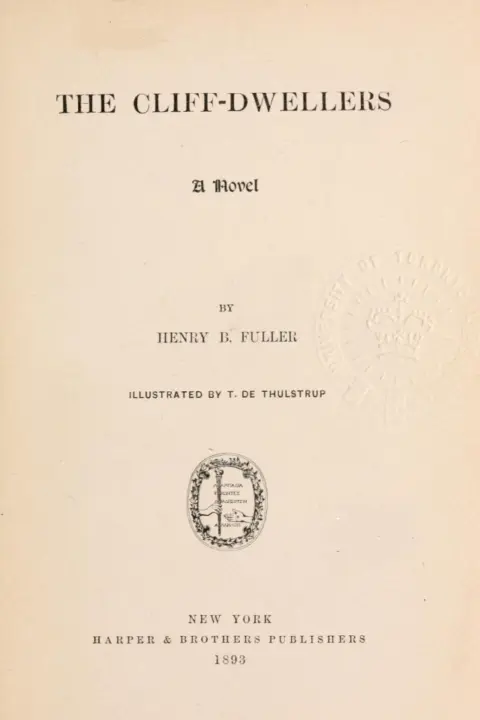
The Cliff-Dwellers: A Novel
Henry Blake Fuller
THE CLASSIC COLLECTION · 1901
"Under the Skylights" by Henry Blake Fuller is a novel written in the late 19th century. The book revolves around Abner Joyce, a passionate young writer whose earnestness and socially conscious perspectives on rural life and community reform shape his literary works. At its core, the narrative explores Abner's interactions with various city denizens—ranging from affluent society members to fellow artists and reformers—as he grapples with issues of social justice and personal identity. The opening of the story establishes Abner Joyce's character as a driven, idealistic individual who has recently gained attention with his first book, "This Weary World." His intense earnestness is juxtaposed with the superficiality he perceives in the urban social scene, which he navigates with a mixture of intrigue and disdain. As the chapters progress, the text introduces a colorful cast of characters, including Mrs. Palmer Pence, a wealthy society woman, and Leverett Whyland, a man of influence, setting the stage for Abner's internal and external conflicts between his humble origins and the seductive allure of urban intellectual life. The beginning effectively captures the tension between idealism and pragmatism, hinting at the shifts Abner will experience as he attempts to find his place among the contrasts of his rural upbringing and the modern city culture.
Introduction adapted from the source catalogue; source summaries may be automatically generated.
Free to read · English · 71,902 words · No account needed
MAKE TIME FOR A GOOD BOOK
On by default. Untick to stop anonymous reading totals. Each page counts after 10 seconds in view. How this works.
Anonymous counting is on unless you have switched it off.
The clear, placid weather had been waiting several days for Sunday to come and possess it, and now Sunday was here. The young people stood bareheaded on the porch and looked down toward the village.
"Do I hear the church bells?" asked Abner. He was a punctilious observer of Sabbath ordinances and always reached a state of subdued inner bustle shortly after the finish of the Sunday breakfast.
"We sometimes make them out," replied Stephen Giles, "when the wind
happens to blow right."
"We are all going down this morning, I suppose?" observed Abner, confidently taking the initiative.
"I expect so," replied Giles.
"Count me out," said Clytie.
"You do not go to church?" asked Abner.
"Not often."
"You have no religion?"
"Yes, I have," replied Clytie, with much pomp: "the religion of
humanity."
"You run and get your things on," said Medora. "You'll find as much humanity at the First Church as you will anywhere else."
The party set out in two vehicles. Old Mr. Giles drove one and the "hired man" the other. Clytie, despite her best endeavours to go in company with Bond, found herself associated with Abner, and a spirit of unchristian perversity took complete possession of her.
She cast her eye about, viewing the prosperous country-side, the
well-kept farms, the modest comfort symbolized in her host's equipage
itself.
"You're a great sufferer, Mr. Giles," she said suddenly; "aren't you?"
The old gentleman let the lines fall slackly on the fat backs of his sleek horses. "How? What's that?"
"I say you're a great sufferer. You're a downtrodden slave."
"Why, am I? How do you make that out?"
"Well, if you don't know without having it explained to you! The world is against you--it's making a doormat of you."
Medora looked askant. What was the child up to now?
"Poor father," she said. "If he hasn't found it out yet, don't tell him."
"No wonder he hasn't found it out," returned Clytie, making a sudden veer. "Is he suffering for lack of fresh air and pure water? And does he have to pay an extra price for sunlight? And must he herd in a filthy slum full of awful plumbing and crowded by more awful neighbours? Does he have to put up with municipal neglect and corruption, and worry along on make-believe milk and doctored bread and adulterated medicines, and endure long hours in unsanitary places under a tyrannical foreman and in constant dread of fines----?"
Abner was beginning to shift uneasily upon his seat. "Clytie, please!" said Medora, laying her hand upon the other's.
"Well, they're realities!" declared Clytie stoutly.
"They're not my realities," growled Abner, without turning round.
Your reading position is saved on this browser. Take it to another device with a library code. Reading pages adapt to text, rather than matching a printed edition.
Henry Blake Fuller
Henry Blake Fuller
Henry Blake Fuller
Henry Blake Fuller
BEHIND THE BOOK
This eBook is for the use of anyone anywhere in the United States and most other parts of the world at no cost and with almost no restrictions whatsoever. You may copy it, give it away or re-use it under the terms of the Project Gutenberg License included with this eBook or online at www.gutenberg.org. If you are not located in the United States, you will have to check the laws of the country where you are located before using this eBook. Read the source licence.
The original source file, including credits and licence, is retained by this library. Request an original-format copy at no charge. Please include the book title and Project Gutenberg identifier #8196.
KEEP YOUR CURIOSITY GOING
Coulson Kernahan

Maurice Baring
Frances Wright
Cécile Tormay

Frederic Jesup Stimson

W. H. P. (William Henry Pope) Jarvis