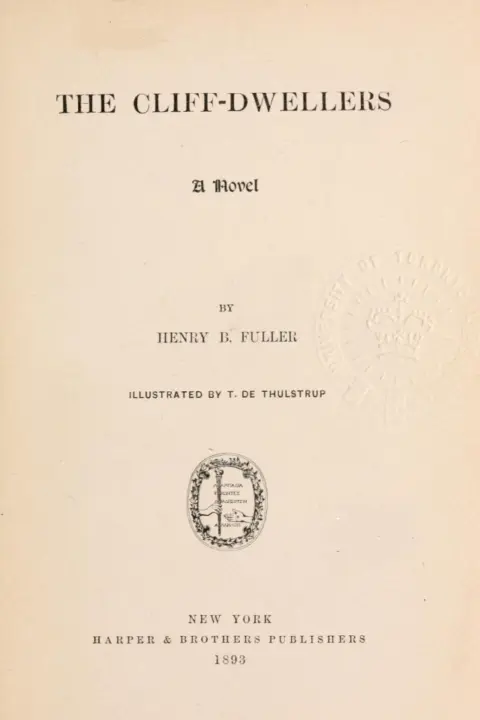
The Cliff-Dwellers: A Novel
Henry Blake Fuller
THE CLASSIC COLLECTION · 1901
"Under the Skylights" by Henry Blake Fuller is a novel written in the late 19th century. The book revolves around Abner Joyce, a passionate young writer whose earnestness and socially conscious perspectives on rural life and community reform shape his literary works. At its core, the narrative explores Abner's interactions with various city denizens—ranging from affluent society members to fellow artists and reformers—as he grapples with issues of social justice and personal identity. The opening of the story establishes Abner Joyce's character as a driven, idealistic individual who has recently gained attention with his first book, "This Weary World." His intense earnestness is juxtaposed with the superficiality he perceives in the urban social scene, which he navigates with a mixture of intrigue and disdain. As the chapters progress, the text introduces a colorful cast of characters, including Mrs. Palmer Pence, a wealthy society woman, and Leverett Whyland, a man of influence, setting the stage for Abner's internal and external conflicts between his humble origins and the seductive allure of urban intellectual life. The beginning effectively captures the tension between idealism and pragmatism, hinting at the shifts Abner will experience as he attempts to find his place among the contrasts of his rural upbringing and the modern city culture.
Introduction adapted from the source catalogue; source summaries may be automatically generated.
Free to read · English · 71,902 words · No account needed
MAKE TIME FOR A GOOD BOOK
On by default. Untick to stop anonymous reading totals. Each page counts after 10 seconds in view. How this works.
Anonymous counting is on unless you have switched it off.
"Don't work so hard at it," said Medora, laying her violin on top of the pianola. "You shake the house. A minute more and you'll have that lamp toppling over. And you'll tire yourself out."
Abner wiped his damp brow and felt of his wilted collar. He never put less than his whole self into anything he attempted. "Tire myself? I'm strong enough, I guess."
"Well, use your strength to better advantage. Let me show you."
Medora slipped into his place, reset the roll, pulled a stop or two, and trod out a dozen ringing measures with no particular effort. "Like that."
"Very well," said Abner, resuming his seat docilely. The rest wondered; he seldom welcomed suggestions or accepted correction.
"Now let's try it once more," said Medora.
An evening devoted to literature was ending with a bit of music. Abner and Bond had both read unpublished manuscripts with the fierce joy that authors feel on such occasions, and the others had listened with patience if not with pleasure. Abner gave two or three of the newest chapters of Regeneration, and Bond read a few pages to show what progress an alien romanticist was making in homely fields nearer at hand. He had hoped for Abner's encouragement and approval in this new venture of his, but he got neither.
"The way to write about cows in a pasture," commented Abner, "is just to write about them--in a simple, straightforward style without any slant toward history or mythology, and without any cross-references to remote scenes of foreign travel. For instance, you speak of a Ranz----"
"Ranz des Vaches," said Medora: "a sort of thing the Alpine
what's-his-name sings."
"It's for atmosphere," said Bond, on the defensive.
"Let the pasture furnish its own atmosphere. And you had something about a certain breed of cattle near Rome--Rome, was it?"
"Roman Campagna. Travel reminiscences."
"Travel is a mistake," declared Abner.
"So it is," broke in Clytie. "Squat on your own door-step, as Emerson
says."
"Does he?--I think not," interposed Giles the elder. "What he does say
is----"
"We all know," interrupted Stephen, "and ignore the counsel."
Abner did not know, but he would not stoop to ask. "And there was a quotation from one of those old authors,--Theocritus?"
"Theocritus, yes. Historical perspective."
"Leave the past alone. Live in the present. The past,--bury it, forget
it."
"So hard. Heir of the ages, you know. Good deal harder to forget than never to have learned at all. That's easy," jibed Bond, with a touch of temper.
"Oh, now!" cried Medora, fearful that another temper might respond.
Your reading position is saved on this browser. Take it to another device with a library code. Reading pages adapt to text, rather than matching a printed edition.
Henry Blake Fuller
Henry Blake Fuller
Henry Blake Fuller
Henry Blake Fuller
BEHIND THE BOOK
This eBook is for the use of anyone anywhere in the United States and most other parts of the world at no cost and with almost no restrictions whatsoever. You may copy it, give it away or re-use it under the terms of the Project Gutenberg License included with this eBook or online at www.gutenberg.org. If you are not located in the United States, you will have to check the laws of the country where you are located before using this eBook. Read the source licence.
The original source file, including credits and licence, is retained by this library. Request an original-format copy at no charge. Please include the book title and Project Gutenberg identifier #8196.
KEEP YOUR CURIOSITY GOING
Coulson Kernahan

Maurice Baring
Frances Wright
Cécile Tormay

Frederic Jesup Stimson

W. H. P. (William Henry Pope) Jarvis