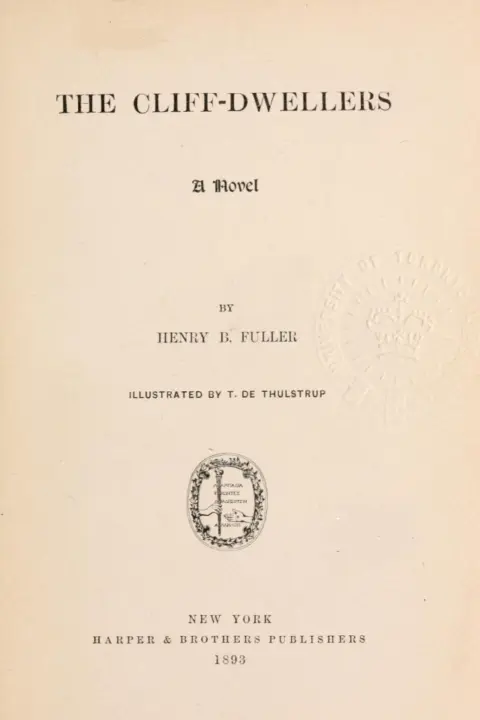
The Cliff-Dwellers: A Novel
Henry Blake Fuller
THE CLASSIC COLLECTION · 1901
"Under the Skylights" by Henry Blake Fuller is a novel written in the late 19th century. The book revolves around Abner Joyce, a passionate young writer whose earnestness and socially conscious perspectives on rural life and community reform shape his literary works. At its core, the narrative explores Abner's interactions with various city denizens—ranging from affluent society members to fellow artists and reformers—as he grapples with issues of social justice and personal identity. The opening of the story establishes Abner Joyce's character as a driven, idealistic individual who has recently gained attention with his first book, "This Weary World." His intense earnestness is juxtaposed with the superficiality he perceives in the urban social scene, which he navigates with a mixture of intrigue and disdain. As the chapters progress, the text introduces a colorful cast of characters, including Mrs. Palmer Pence, a wealthy society woman, and Leverett Whyland, a man of influence, setting the stage for Abner's internal and external conflicts between his humble origins and the seductive allure of urban intellectual life. The beginning effectively captures the tension between idealism and pragmatism, hinting at the shifts Abner will experience as he attempts to find his place among the contrasts of his rural upbringing and the modern city culture.
Introduction adapted from the source catalogue; source summaries may be automatically generated.
Free to read · English · 71,902 words · No account needed
MAKE TIME FOR A GOOD BOOK
On by default. Untick to stop anonymous reading totals. Each page counts after 10 seconds in view. How this works.
Anonymous counting is on unless you have switched it off.
"And what is the artist," asked Abner, "but the reporter sublimated? Why must the artist go afield to dabble in far-fetched artificialities that have nothing to do with his own proper time and place? Our people go abroad for study, instead of staying at home and guarding their native quality. They return affected, lackadaisical, self-conscious--they bring the hothouse with them. Why, I have seen such a simple matter as the pouring of a cup of tea turned into----"
"You can't mean Medora Giles," said the miniaturist quickly, pausing amidst the laces of her bodice. "Don't make any mistake about Medora. When she goes in for all that sort of thing, she's merely 'creating atmosphere,' as we say,--she's simply after the 'envelopment,' in fact."
"She is just getting into tone," Bond re-enforced, "with the
candle-shades and the peppermints."
"Medora," declared the painter, "is as sensible and capable a girl as I know. Why, the very dress she wore that afternoon----You noticed it?"
"I--I----" began Abner.
"No, you didn't--of course you didn't. Well, she made every stitch of it
with her own hands."
"And those tea-cakes, that afternoon," supplemented Bond. "She made every stitch of them with her own hands. She told me so herself, when I stayed afterward, to help wash things up."
"I may have done her an injustice," Abner acknowledged. "Perhaps I might like to know her, after all."
"You might be proud to," said Bond.
"And the favour would be the other way round," declared the painter
stoutly.
Abner passed over any such possibility as this. "How long was she
abroad?" he asked Bond.
"Let's see. She studied music in Leipsic two years; she plays the violin like an angel--up to a certain point. Then she was in Paris for another year. She paints a little--not enough to hurt."
"Leipsic? Two years?" pondered Abner. It seemed more staid, less vicious, after all, than if the whole time had been spent in Paris. The violin; painting. Both required technique; each art demanded long, close application. "Well, I dare say she is excusable." But here, he thought, was just where the other arts were at a disadvantage compared with literature: you might stay at home wherever you were, if a writer, and get your own technique.
"And you have done it," said Bond. "I admire some of your things so much. Your instinct for realities, your sturdy central grasp--"
"What man has done, man may do," rejoined Abner. "Yet what is technique, after all? There remains, as ever, the problem, the great Social Problem, to be solved."
"You think so?" queried Bond.
"Think that there is a social problem?"
Your reading position is saved on this browser. Take it to another device with a library code. Reading pages adapt to text, rather than matching a printed edition.
Henry Blake Fuller
Henry Blake Fuller
Henry Blake Fuller
Henry Blake Fuller
BEHIND THE BOOK
This eBook is for the use of anyone anywhere in the United States and most other parts of the world at no cost and with almost no restrictions whatsoever. You may copy it, give it away or re-use it under the terms of the Project Gutenberg License included with this eBook or online at www.gutenberg.org. If you are not located in the United States, you will have to check the laws of the country where you are located before using this eBook. Read the source licence.
The original source file, including credits and licence, is retained by this library. Request an original-format copy at no charge. Please include the book title and Project Gutenberg identifier #8196.
KEEP YOUR CURIOSITY GOING
Coulson Kernahan

Maurice Baring
Frances Wright
Cécile Tormay

Frederic Jesup Stimson

W. H. P. (William Henry Pope) Jarvis