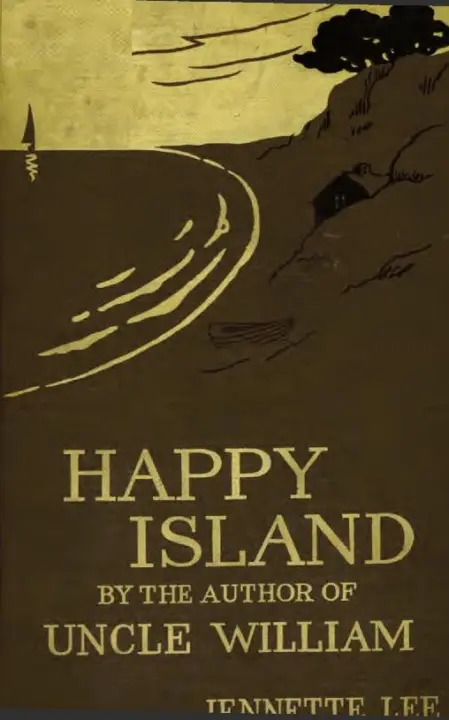
Happy Island: A New “Uncle William” Story
Jennette Lee
THE CLASSIC COLLECTION · 1906
"Uncle William: The Man Who Was Shif'less" by Jennette Lee is a fictional narrative likely written in the early 20th century. The story revolves around Uncle William Benslow, who is characterized by a carefree and generous spirit despite being labeled as 'shif'less' by those around him. Focused on themes of simplicity, contentment, and the importance of human connection, the book showcases William’s engaging interactions with a young artist, delving into the essence of life by the sea. The opening of the book introduces Uncle William as he comfortably embraces his "shif'less" identity while conversing with an artist who is painting the harbor view. Their dialogue reflects the contrasting worlds of work and creativity, as William expresses a preference for the free nature of sailing over the steadiness of painting. Throughout this initial interaction, the portrayal of Uncle William's deep connection to the sea and his simple, fulfilling lifestyle unfolds. As he prepares a chowder in his quaint home, the dynamics of warmth, generosity, and the passage of time begin to take shape in the narrative, solidifying William's likable, down-to-earth character and setting the tone for a story that values both relationships and the beauty found in everyday life.
Introduction adapted from the source catalogue; source summaries may be automatically generated.
Free to read · English · 38,601 words · No account needed
MAKE TIME FOR A GOOD BOOK
On by default. Untick to stop anonymous reading totals. Each page counts after 10 seconds in view. How this works.
Anonymous counting is on unless you have switched it off.
Uncle William crept into the rooms like a thief, but the artist was sleeping soundly. He did not stir as the latch gave a little click in the lock. “That’s good,” said Uncle William. He had slipped off his shoes and was in his stocking feet. He stole over to the bed and stood looking down at the thin face. It was a little drawn, with hollow eyes. “He’ll perk considabul when he hears about them picters,” said Uncle William.
But in the morning when, after breakfast, Uncle William announced his great news, the artist ignored it. “Is she coming--Sergia?”
Uncle William scowled his forehead in recollection. “Now, I can’t seem to remember ’t she said so.”
“What did she say?” The tone was imperative.
“Well, she asked how you was gettin’ along. I told her that--as well as
I could.”
“Didn’t you tell her I wanted to see her?”
“Yes, I told her that.” Uncle William’s voice was impartial.
“Well?”
“She didn’t seem to think much of it. I guess if I was you I’d hurry up and get well so ’s to go see her.”
The artist’s face had grown hard. “I shall not go until I can carry her the money in my hand--all that I owe her.”
“Is ’t a good deal?” asked Uncle William.
But the artist had turned his face to the wall.
Uncle William looked down at him with a kind of compassionate justice.
“If I was you--”
A whistle sounded and an arm, holding a letter, was thrust in at the
door.
“What is it?” The artist had turned. He half raised himself, reaching out a hand. “What is it? Give it to me.”
Uncle William examined the lines slowly. “Why, it seems to be for me,” he said kindly. “I dunno anybody that’d be writin’ to me.”
He found his glasses and opened it, studying the address once or twice
and shaking his head.
The artist had sunk back, indifferent.
“Why!” The paper rustled in Uncle William’s hand. He looked up. “She’s gone!” he said.
The artist started up, glaring at him.
Uncle William shook his head, looking at him pityingly. “Like as not we sha’n’t see her again, ever.”
The artist’s hand groped. “What is it?” he whispered.
“She’s gone--left in the night.”
“She will come back.” The gaunt eyes were fixed on his face
Uncle William shook his head again, returning the gaze with a kind of sternness. “I dunno,” he says. “When a man treats her like Andy has, she must kind o’ hate him--like pizen.”
Your reading position is saved on this browser. Take it to another device with a library code. Reading pages adapt to text, rather than matching a printed edition.
BEHIND THE BOOK
This eBook is for the use of anyone anywhere in the United States and most other parts of the world at no cost and with almost no restrictions whatsoever. You may copy it, give it away or re-use it under the terms of the Project Gutenberg License included with this eBook or online at www.gutenberg.org. If you are not located in the United States, you will have to check the laws of the country where you are located before using this eBook. Read the source licence.
The original source file, including credits and licence, is retained by this library. Request an original-format copy at no charge. Please include the book title and Project Gutenberg identifier #4634.
KEEP YOUR CURIOSITY GOING
Coulson Kernahan

Maurice Baring
Frances Wright
Cécile Tormay

Frederic Jesup Stimson

W. H. P. (William Henry Pope) Jarvis