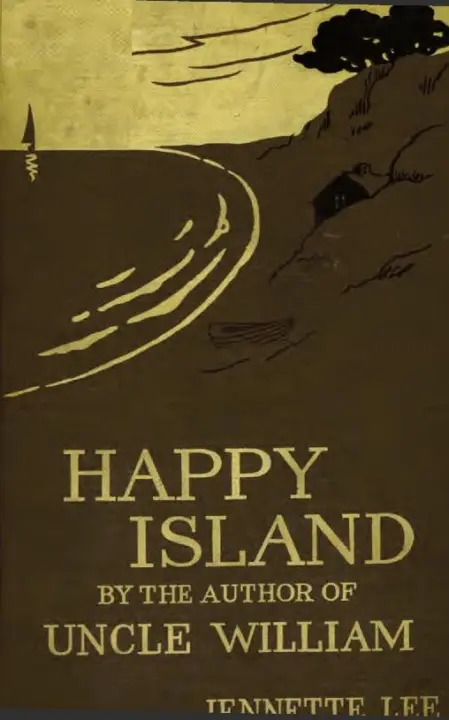
Happy Island: A New “Uncle William” Story
Jennette Lee
THE CLASSIC COLLECTION · 1906
"Uncle William: The Man Who Was Shif'less" by Jennette Lee is a fictional narrative likely written in the early 20th century. The story revolves around Uncle William Benslow, who is characterized by a carefree and generous spirit despite being labeled as 'shif'less' by those around him. Focused on themes of simplicity, contentment, and the importance of human connection, the book showcases William’s engaging interactions with a young artist, delving into the essence of life by the sea. The opening of the book introduces Uncle William as he comfortably embraces his "shif'less" identity while conversing with an artist who is painting the harbor view. Their dialogue reflects the contrasting worlds of work and creativity, as William expresses a preference for the free nature of sailing over the steadiness of painting. Throughout this initial interaction, the portrayal of Uncle William's deep connection to the sea and his simple, fulfilling lifestyle unfolds. As he prepares a chowder in his quaint home, the dynamics of warmth, generosity, and the passage of time begin to take shape in the narrative, solidifying William's likable, down-to-earth character and setting the tone for a story that values both relationships and the beauty found in everyday life.
Introduction adapted from the source catalogue; source summaries may be automatically generated.
Free to read · English · 38,601 words · No account needed
MAKE TIME FOR A GOOD BOOK
On by default. Untick to stop anonymous reading totals. Each page counts after 10 seconds in view. How this works.
Anonymous counting is on unless you have switched it off.
“Can I see her to-day?” It was the first question in the morning.
“You better?”
“Yes.”
“You feelin’ well enough to sit up?”
“Yes.”
“Well, then, you can stay where you be another day.” Uncle William
smiled cheerfully.
“Can I see her?”
“We’ll see about that. I’ve got a good many things to tend to.” Uncle William bustled away.
After a time his head was thrust in the door. “I’ll go see her, myself, byme-by,” he said kindly. “Mebbe she’ll come back with me.”
“It’s too late now.” The artist spoke a little bitterly.
“Too late!” Uncle William came out, reproachful and surprised. “What
d’you mean?”
“It’s quarter to nine. She goes to work at nine. She has pupils--she
teaches all day.”
Uncle William’s face dropped a little. “That’s too bad now, ain’t it! But don’t you mind. I wa’n’t just certain I’d let you see her to-day, anyhow.”
“When can I?”
Uncle William pondered. “You’re in a good deal of a hurry, ain’t you?”
“I want to tell her--”
“Yes, yes, I know. Well, ’bout to-morrow. How’d that do?”
“You could send her a note,” said the artist.
“I’m goin’ to see her,” said Uncle William. “She’ll be to home this evenin’, won’t she?”
“Yes.”
“I’ll go see her.”
The artist looked doubtful.
“Can’t I got see her?” said Uncle William.
“I was wondering whether you could find the way.”
“H’m-m. Where’d you say it was?”
“Eighteenth Street, near Broadway.”
“Eighteenth? That’s somewheres between Seventeenth and Nineteenth, ain’t it?” said Uncle William, dryly.
“Yes.” The artist smiled faintly.
Uncle William nodded. “I thought so. And I don’t s’pose they’ve changed the lay of Broadway a gre’ deal?”
“No--not much.”
“Well, I reckon I can find it. I gen’ally do; and I can’t get far out o’ the way with this.” He touched the compass that hung from the fob of the great watch. “I’ve been putty much all over the world with that. I reckon it’ll p’int about the same in New York as it does in Arichat. Now, I’ve got your breakfast ’most ready, but I can’t seem to remember about your coffee.--You take sugar and milk in it, don’t you?”
“Yes.” The tone was almost sulky.
Uncle William looked at him shrewdly over his spectacles. “I don’t believe you feel well enough to see anybody for a good while, do you?”
The artist’s face changed subtly--like a child’s. It was almost
cheerful.
Your reading position is saved on this browser. Take it to another device with a library code. Reading pages adapt to text, rather than matching a printed edition.
BEHIND THE BOOK
This eBook is for the use of anyone anywhere in the United States and most other parts of the world at no cost and with almost no restrictions whatsoever. You may copy it, give it away or re-use it under the terms of the Project Gutenberg License included with this eBook or online at www.gutenberg.org. If you are not located in the United States, you will have to check the laws of the country where you are located before using this eBook. Read the source licence.
The original source file, including credits and licence, is retained by this library. Request an original-format copy at no charge. Please include the book title and Project Gutenberg identifier #4634.
KEEP YOUR CURIOSITY GOING
Coulson Kernahan

Maurice Baring
Frances Wright
Cécile Tormay

Frederic Jesup Stimson

W. H. P. (William Henry Pope) Jarvis